

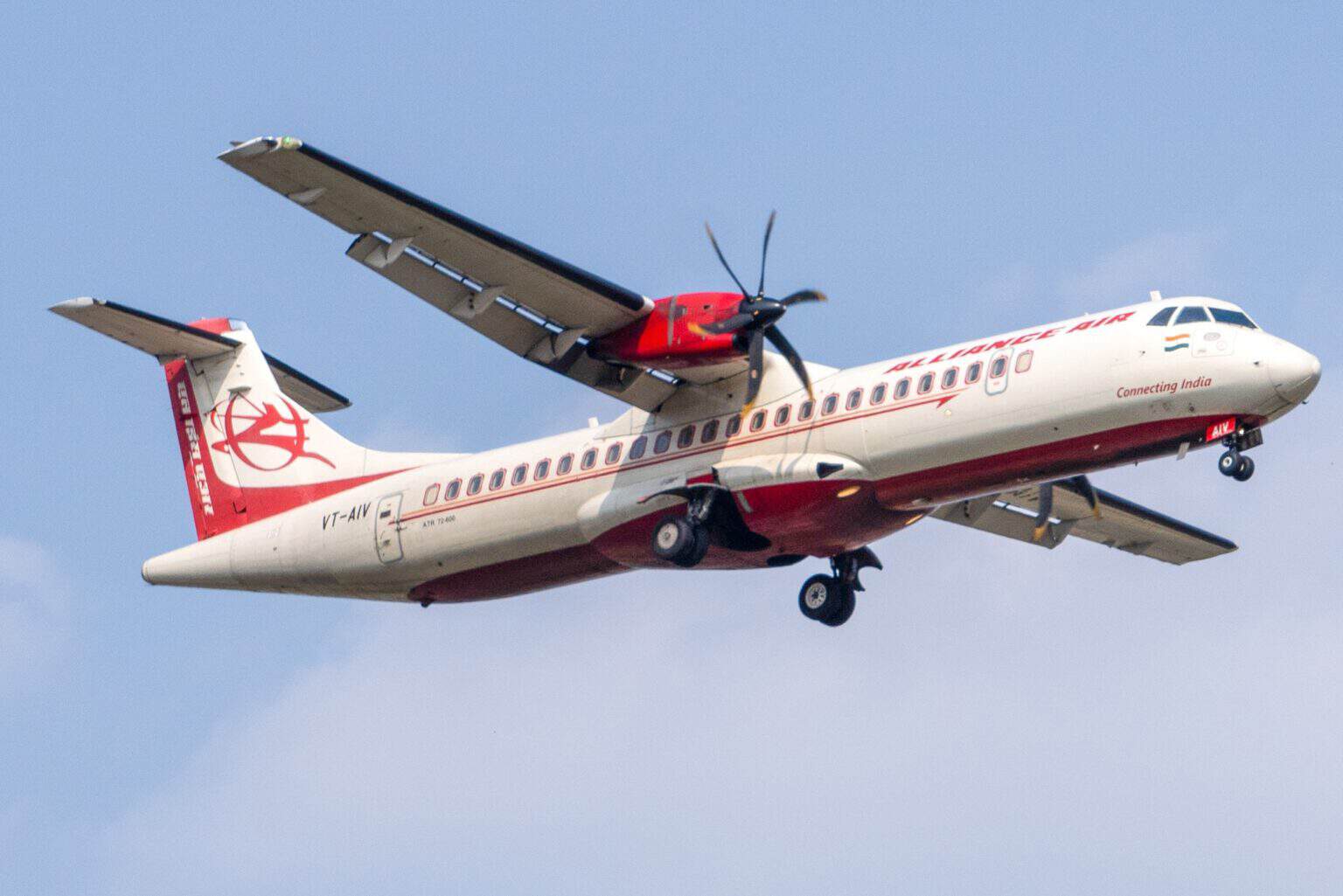
India’s Aircraft Accident Investigation Bureau (AAIB) has released its final report on Alliance Air ATR 72 VT-RKF, which struck approach lights and touched down short of the runway at Bhubaneswar on October 8, 2024. The bureau says flight 9I746 from Rourkela continued an unstable approach in a thunderstorm instead of going around.
None of the 43 passengers and four crew were hurt, but the turboprop was left with a punctured belly, cracked fuselage stringers and a torn left landing gear bay. The final report appeared on the AAIB’s website on October 21, 2026, two years after the event.
What happened on final approach
Air traffic control first held the ATR for weather and traffic, then cleared it for the ILS approach to Runway 14, with heavy rain and visibility of 800 meters (about half a mile) reported.
The approach was stable down to about 1,000 feet, where there was no rain. Near the minimums the aircraft flew into heavy rain, and the pilots asked the tower to turn the approach lights up to full intensity.
With the autopilot flying, airspeed swung between 110 and 130 knots in the turbulence, but the ATR still tracked the glideslope to within about a quarter of a dot.
At about 200 feet above the ground, the recorder picked up a nose-down push on the captain’s control column, building to roughly 25 pounds (11 daN), which most probably disconnected the autopilot. The report says the autopilot and yaw damper dropped out with no callout from either pilot.
In the next six seconds the nose dropped from about 2 to nearly 5 degrees down, and the descent rate rose from roughly 600 to nearly 1,000 feet per minute. At the same time, the wind below 250 feet swung from a 10-knot headwind to a 15-knot tailwind near the ground, which the AAIB calls low-level wind shear and possible microburst activity.
By 100 feet, the glideslope needle had reached two dots low, the bottom of the scale on the primary flight display. The report says no significant corrective input on the control column followed, and a strong nose-up input came only at about 20 feet, a late flare that could not fully arrest the descent.
The airline's own go-around rule
Alliance Air’s manual makes a missed approach mandatory if the ILS glideslope or localizer shows more than one dot of deviation near the decision height, or if the approach is not stabilized. VT-RKF was at two dots low at 100 feet. The AAIB states that the crew did not follow that mandatory missed approach.
The ATR hit one Category I and four Category II approach light fixtures before touching down at 111 knots indicated airspeed, 126 knots over the ground and 1.7 g. The report’s distances disagree: its narrative puts touchdown 30.5 meters (100 feet) short of the runway, while its GPS-based flight data analysis puts it about 100 meters (330 feet) before the threshold.
The preliminary report had given a third figure, 43.5 meters (143 feet).
The captain called the tower by landline about 16 minutes after landing to report a possible tail strike. No “glideslope” aural warning sounded, which the AAIB puts down to filtering designed to suppress nuisance alerts, acceptable under the rules.
Probable cause, and a crew with a history of exceedances
The AAIB’s probable cause is “the continuation of an unstabilized approach below the prescribed stabilization criteria during adverse weather conditions.” It names the nose-down control inputs and the headwind-to-tailwind wind shear as what pushed the ATR below the glide path, and “failure to initiate a Go-Around” among the factors that led to the undershoot.
The report also faults crew resource management between the two pilots and cites “plan continuation bias”, the pull to press on with a landing as conditions decay.
Alliance Air’s own flight data monitoring tells a longer story. Its records for January to October 10, 2024 show about 12 exceedances for the captain and about 18 for the first officer, including high descent rates on approach, GPWS cautions and long flares.
The AAIB found the airline gave no counseling or corrective training after those events beyond emails to the crew.
The report makes one safety recommendation, addressed to the operator: tougher simulator training in heavy rain, low visibility and fast-changing weather. Pilots with recent flight data exceedances should get mandatory remedial simulator sessions.
Why the go-around is so hard to call
Airlines set stabilized-approach “gates” because an aircraft that is off speed, off path or descending too fast near the ground leaves little room to fix it. When a gate is missed, the standard answer is a go-around procedure, which Alliance Air’s manual describes as safe and non-punitive.
Pilots rarely take it. Research presented in the Flight Safety Foundation’s AeroSafety World found go-arounds were flown on only about 3 percent of unstable approaches, and estimated that 83 percent of approach and landing accidents could be prevented by one.
Wind shear makes the call harder still, because losing a headwind close to the ground cuts airspeed and lift just as the aircraft needs both. The cockpit recording shows the captain had briefed for it before the approach: in case of wind shear, call it out and go around.
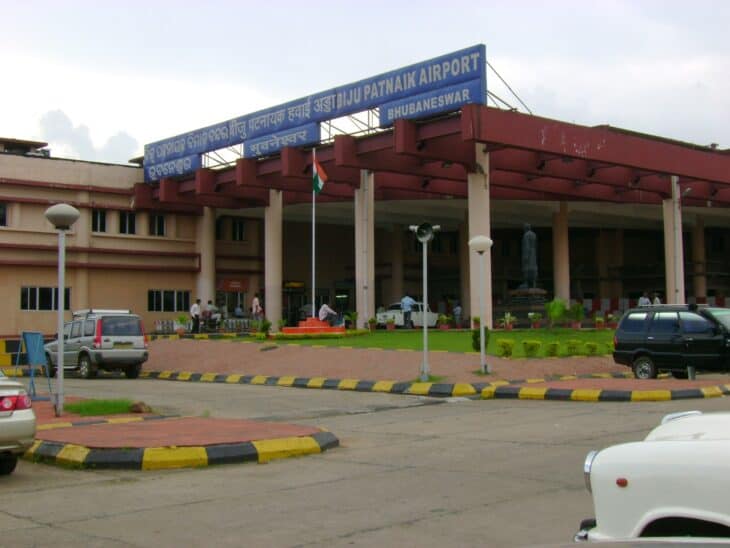
The ATR 72-600 involved was built in 2017 and has no autothrottle, so the pilots set power by hand. Alliance Air, a wholly owned subsidiary of Air India Asset Holding Limited, flies ATR 72-600s, ATR 42-600s and Dornier 228s, and serves Bhubaneswar’s Biju Patnaik Airport from smaller Odisha cities such as Rourkela.

Sources and references used for research and fact-checking.
- AAIB India, Final Investigation Report on Serious Incident of Runway Undershoot involving M/s Alliance Air Aircraft VT-RKF on 08.10.2024 at Bhubaneswar Airport
- AAIB India, Preliminary Report, VT-RKF, Bhubaneswar, 08.10.2024
- BEA, Serious incident to the ATR 72 registered VT-RKF operated by Alliance Air on 08/10/2024 at Bhubaneswar (India)
Get the Newsletter
The latest aviation news and stories sent to your inbox.
About the Author

AeroCorner News is the aviation news desk of AeroCorner.com. It covers accidents and incidents, safety rulings, airline and airport disruption, and new aircraft. It works from primary sources such as the NTSB, FAA, EASA and the manufacturers' own announcements.