

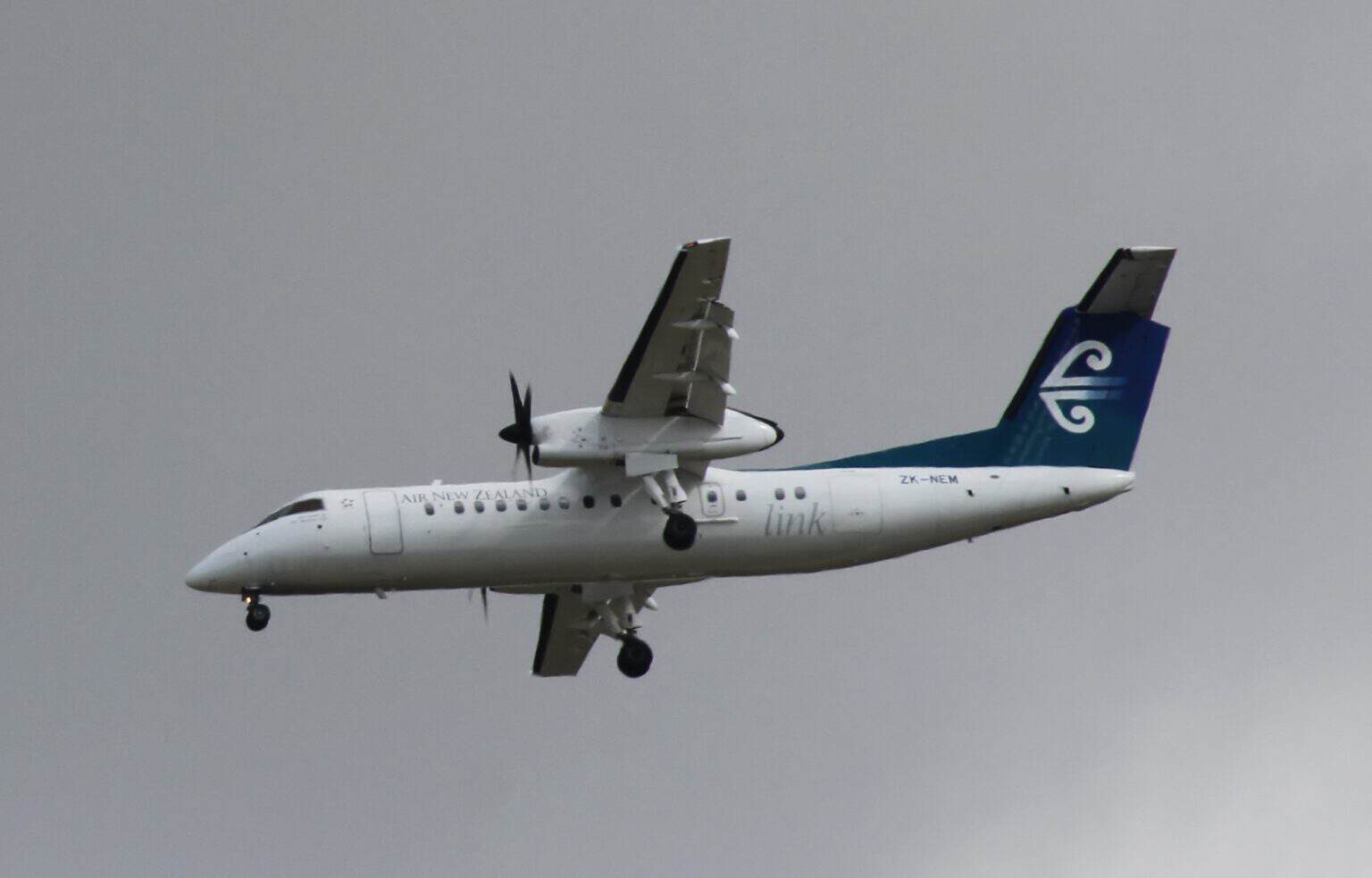
New Zealand’s Transport Accident Investigation Commission (TAIC) released its final report on October 1, 2026, into a June 13, 2023 incident in which an Air New Zealand Q300 descended to 1,156 feet near Timaru, below the area’s 2,000-foot minimum safe altitude. TAIC found the captain had left the autopilot in the wrong descent mode and neither pilot noticed until the aircraft was well off its planned path.
What happened on approach
Flight NZ8199, a De Havilland Q300 turboprop registered ZK-NEM, was flying from Wellington to Timaru at night with 33 passengers and three crew, according to 1News. TAIC said the captain switched the autopilot from vertical navigation mode to vertical speed mode during a routine altimeter check around 15,000 feet, then did not switch it back for the approach.
In vertical speed mode, the autopilot holds a fixed rate of descent instead of following the programmed approach path. TAIC said the aircraft descended at roughly 1,400 feet per minute for about 10 minutes without either pilot noticing, ending up roughly 2,500 feet below its planned flight path.
Both pilots were looking out the windscreen for the runway lights rather than monitoring their instruments, TAIC found. The aircraft reached 1,156 feet before the captain corrected course and landed the aircraft safely at Timaru.
Not a one-off
TAIC’s chief investigator, Louise Cook, said investigators found six similar autopilot mode-selection errors on Air New Zealand’s Q300 fleet before the Timaru inquiry opened, and two more after it began.
A gap the regulator had already seen
Cook told RNZ it wasn’t a case of the crew simply having a bad night. She said the error was known to both Air New Zealand and the Civil Aviation Authority, and the systems in place should have caught it before it became a serious incident.
TAIC also found that oversight of Air New Zealand had not kept pace with changes at the airline: the 2019 merger of its regional carriers and the disruption of the COVID-19 pandemic, both of which the commission said should have triggered closer regulatory scrutiny, as RNZ reported.
The mistake is a textbook case of what investigators call mode confusion, where a pilot’s mental model of what the autopilot is doing no longer matches what it is actually doing. TAIC said the Q300’s systems require a crew to manually reselect vertical navigation mode partway through a descent, a workaround the commission said raises the odds of exactly this kind of error.
What changes next
TAIC said Air New Zealand and the CAA had already addressed seven of the nine safety issues it identified, through new training, procedures and oversight changes. The commission made one formal recommendation: that Air New Zealand work with manufacturer De Havilland Canada on a flight-management-system fix that removes the need for the manual mode-reselection step.
Air New Zealand’s chief safety and risk officer, Nathan McGraw, said that work was already under way. “TAIC has recognised that work, and the final report makes one recommendation to Air New Zealand, which we’ve accepted and progressed,” he said, according to RNZ.
TAIC’s second recommendation asked the CAA to push, through the International Civil Aviation Organization, for cockpit voice recorders on this class of aircraft to meet modern recording requirements. The CAA said it accepted the recommendation and would raise it at ICAO.
The Timaru report is the latest of several recent Dash 8 safety findings, including an Australian investigation into why a Qantas jet stopped just 394 feet from a landing Dash 8 at Sydney Airport. AeroCorner’s explainer on how autopilot modes work covers the vertical navigation and vertical speed handoff at the center of the Timaru finding.
Sources and references used for research and fact-checking.
Get the Newsletter
The latest aviation news and stories sent to your inbox.
About the Author

Tim is the owner and lead editor of AeroCorner since 2019, overseeing aviation content covering aircraft, airlines, airports, and the broader aviation industry. Through years of researching, writing, editing, and publishing aviation-focused content, he has developed extensive practical knowledge of commercial aviation and air travel. Based in Asia and a frequent traveler himself, Tim also brings firsthand passenger experience to AeroCorner’s coverage. Outside of publishing, he has also explored aviation firsthand through hands-on flight training in New Zealand.