

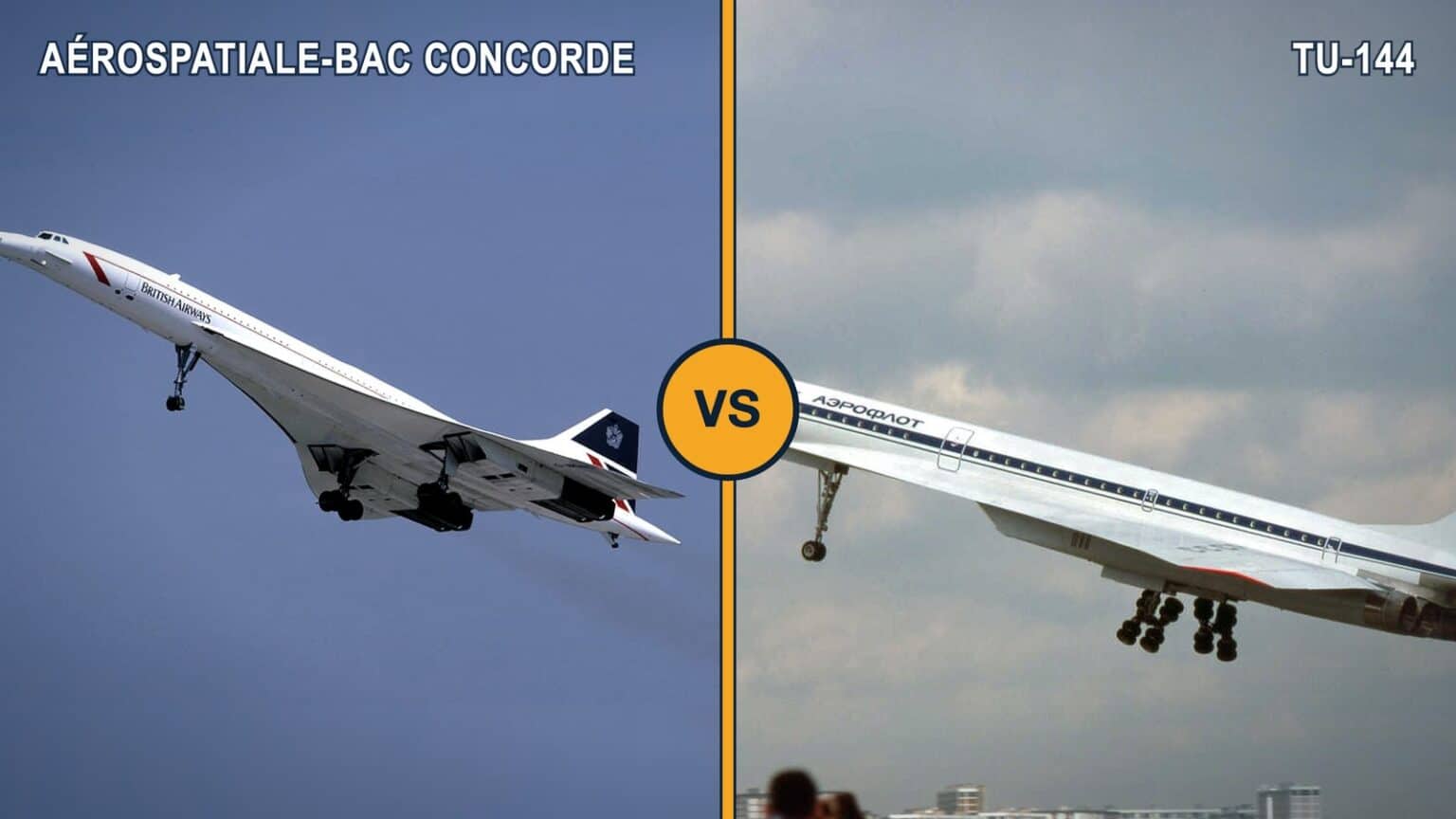

Concorde won. It entered passenger service almost two years before the Tu-144 and flew paying passengers until October 2003.
The Tu-144 flew first, on December 31, 1968, but carried passengers on only 55 flights before the Soviet Union grounded it for passenger service in 1978.

General
Aérospatiale-BAC Concorde
Manufacturer
Aérospatiale
ICAO code
CONC
Produced
1965–1979
Price
$46 million (1977)
Engine
4 × Rolls-Royce / SNECMA Olympus 593 Mk 610
Engine type
Jet
Thrust
4 × 38,050 lbf · 169 kN
-14% (total)
Avionics
Fly by wire flight controls, Digital Air Intake Control Units
Wing tips
No winglets
Seats
128 economy · 120 business · 92 first
Crew
3
Tupolev Tu-144
Manufacturer
Tupolev
ICAO code
TU144
Produced
1968–1983
Price
—
Engine
4 × Kolesov RD-36-51
Engine type
Jet
Thrust
4 × 44,000 lbf · 196 kN
+16% (total)
Avionics
—
Wing tips
No winglets
Seats
150
Crew
—
Dimensions
Aérospatiale-BAC Concorde
Cabin width
8 ft 7 in
2.62 m
8 ft 7 in
2.62 m
Cabin height
6 ft 5 in
1.96 m
6 ft 5 in
1.96 m
Cabin length
129 ft 0 in
39.32 m
129 ft 0 in
39.32 m
Exterior length
202 ft 4 in
61.66 m
202 ft 4 in
61.66 m
-6%
Tail height
40 ft 0 in
12.20 m
40 ft 0 in
12.20 m
-3%
Fuselage diameter
9 ft 5 in
2.87 m
9 ft 5 in
2.87 m
-13%
Wing span
84 ft 0 in
25.60 m
84 ft 0 in
25.60 m
-11%
Baggage volume
22 ft 0 in
6.71 m
22 ft 0 in
6.71 m
Tupolev Tu-144
Cabin width
—
—
—
Cabin height
—
—
—
Cabin length
—
—
—
Exterior length
215 ft 7 in
65.70 m
215 ft 7 in
65.70 m
+7%
Tail height
41 ft 2 in
12.55 m
41 ft 2 in
12.55 m
+3%
Fuselage diameter
10 ft 10 in
3.30 m
10 ft 10 in
3.30 m
+15%
Wing span
94 ft 6 in
28.80 m
94 ft 6 in
28.80 m
+12%
Baggage volume
—
—
—
Weights
Aérospatiale-BAC Concorde
Empty weight
173,500 lb
78,698 kg
173,500 lb
78,698 kg
-21%
Max payload
24,300 lb
11,000 kg
24,300 lb
11,000 kg
-8%
Fuel capacity
31,596 gal
119,604 L
31,596 gal
119,604 L
+3%
Max takeoff weight
408,000 lb
185,000 kg
408,000 lb
185,000 kg
-11%
Max landing weight
—
—
—
Tupolev Tu-144
Empty weight
218,699 lb
99,200 kg
218,699 lb
99,200 kg
+26%
Max payload
26,500 lb
12,000 kg
26,500 lb
12,000 kg
+9%
Fuel capacity
30,711 gal
116,254 L
30,711 gal
116,254 L
-3%
Max takeoff weight
456,500 lb
207,000 kg
456,500 lb
207,000 kg
+12%
Max landing weight
397,000 lb
180,000 kg
397,000 lb
180,000 kg
Performance
Aérospatiale-BAC Concorde
Max cruise speed
1,176 kt · 1,353 mph
2,178 km/h
1,176 kt
1,353 mph
2,178 km/h
-10%
Max speed
1,176 kt · 1,353 mph
2,178 km/h
1,176 kt
1,353 mph
2,178 km/h
-10%
Cruise speed
1,165 kt · 1,341 mph
2,158 km/h
1,165 kt
1,341 mph
2,158 km/h
+2%
Approach speed
165 kt · 190 mph
306 km/h
165 kt
190 mph
306 km/h
-3%
Rate of climb
5,000 ft/min
25 m/s
5,000 ft/min
25 m/s
-49%
Range
3,900 nm · 4,490 mi
7,220 km
3,900 nm
4,490 mi
7,220 km
+11%
Service ceiling
60,000 ft
18,300 m
60,000 ft
18,300 m
-9%
Takeoff distance
11,800 ft
3,600 m
11,800 ft
3,600 m
+20%
Landing distance
7,200 ft
2,200 m
7,200 ft
2,200 m
-15%
Tupolev Tu-144
Max cruise speed
1,300 kt · 1,496 mph
2,408 km/h
1,300 kt
1,496 mph
2,408 km/h
+11%
Max speed
1,300 kt · 1,496 mph
2,408 km/h
1,300 kt
1,496 mph
2,408 km/h
+11%
Cruise speed
1,147 kt · 1,320 mph
2,124 km/h
1,147 kt
1,320 mph
2,124 km/h
-2%
Approach speed
170 kt · 196 mph
315 km/h
170 kt
196 mph
315 km/h
+3%
Rate of climb
9,800 ft/min
50 m/s
9,800 ft/min
50 m/s
+96%
Range
3,500 nm · 4,030 mi
6,480 km
3,500 nm
4,030 mi
6,480 km
-10%
Service ceiling
66,000 ft
20,100 m
66,000 ft
20,100 m
+10%
Takeoff distance
9,850 ft
3,000 m
9,850 ft
3,000 m
-17%
Landing distance
8,550 ft
2,600 m
8,550 ft
2,600 m
+18%
Table of Contents
| Concorde | Tu-144 | |
|---|---|---|
| First flight | March 2, 1969 | December 31, 1968 |
| Mail and cargo flights | Not applicable | December 26, 1975 |
| Passenger service began | January 21, 1976 | November 1, 1977 |
| Operators | Air France, British Airways | Aeroflot |
| Aircraft built | 20, including prototypes | 16 airworthy, plus 1 unfinished |
| Fatal accidents in service | 1 (July 25, 2000) | 2 crashes (June 3, 1973 and May 23, 1978) |
| Last passenger flight | October 24, 2003 | June 1, 1978 |
Which is better, Concorde or the Tu-144?
Concorde was the better airliner. It carried passengers for 27 years while the Tu-144 managed about seven months.
The Tu-144 did get into the air first. It flew on December 31, 1968, about two months before Concorde’s prototype.
The panel above lists each aircraft’s specs side by side. This page covers what the numbers cannot: who flew when, who served and why.
Where Concorde wins
The Concorde won on service life. British Airways and Air France began scheduled flights on January 21, 1976, and the last commercial flight landed on October 24, 2003.
The network was real. Concorde flew London and Paris to New York and Washington, plus routes such as London to Barbados and Paris to Rio de Janeiro.
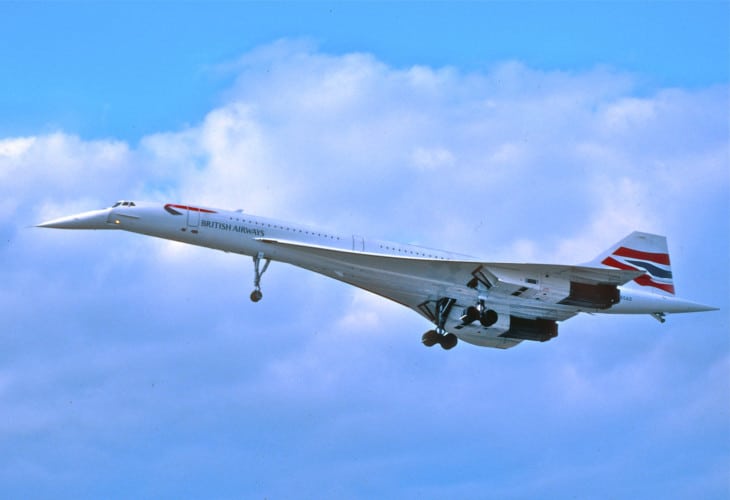
Concorde’s afterburners were needed only for take-off and for passing through the transonic range. The rest of the Atlantic crossing was flown on dry thrust at about Mach 2.
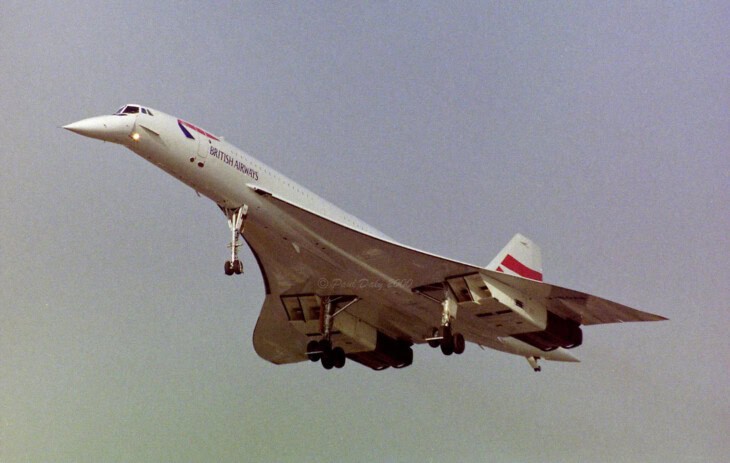
A typical supersonic crossing took just under 3.5 hours, against about 8 hours for a subsonic Paris to New York flight.
Where the Tu-144 wins
The Tu-144 won the race to the air. It flew on December 31, 1968, and began mail and freight flights between Moscow and Alma-Ata (now Almaty) on December 26, 1975, a route of about 1,930 miles (3,100 km).
It also pushed speed harder in testing. The Tu-144D reached Mach 2.15, and an afterburning NK-144 version hit about 1,518 mph (2,443 km/h).


Late in its life the Tu-144 became a research tool. NASA used a modified Tu-144D, the Tu-144LL, in the 1990s and flew it for high-speed research until the programme ended in 1999.
Its design changed in service. Production aircraft gained small retractable canards that cut landing speed to roughly 196 to 207 mph (315 to 333 km/h).


How the two designs differ
Both were tailless delta-wing airliners built for roughly twice the speed of sound. Beyond that they took different engineering paths.
Concorde used four Rolls-Royce/Snecma Olympus 593 turbojets with variable intake ramps. Reheat was used only for take-off and for passing through the transonic range, between about Mach 0.95 and 1.7.
The Tu-144S used afterburning Kuznetsov NK-144A turbofans, which burned fuel at about 1.81 kg per kilogram of thrust per hour at Mach 2. The later Tu-144D switched to non-afterburning Kolesov RD-36-51 engines that cut that to 1.22.
Concorde’s average cruise was Mach 2.02 at up to 60,000 ft (18,300 m), though a typical flight cruised nearer 56,000 ft (17,000 m). The Tu-144 cruised at about Mach 2.
Fuel and cabin: the cost of going supersonic
Neither jet was cheap to fly. Wikipedia puts Concorde at about 15.8 passenger miles per gallon at full load, against 46.4 for a Boeing 747.
That gap explains why supersonic airliners stayed a niche. Concorde carried 92 to 128 passengers in a four-abreast cabin, a fraction of a jumbo jet’s load.
Rising fuel prices were also among the reasons Soviet and foreign interest in the Tu-144 faded. The aircraft’s fuel appetite limited range, so it was used on a single domestic route.
Why the Tu-144 never matched Concorde
The Tu-144 crashed at the Paris Air Show on June 3, 1973. All six people on board and eight on the ground died.
Passenger service began on November 1, 1977, with a Moscow to Alma-Ata flight limited to about one flight a week. A second crash on May 23, 1978 killed two flight engineers and injured six crew.
The last scheduled passenger flight flew on June 1, 1978. Wikipedia counts 102 commercial flights, 55 of them with passengers.
Fuel use hurt too. The original NK-144 engine burned more fuel in cruise than the design target, and the Tu-144D with Kolesov engines gave a full-payload range of about 3,310 miles (5,330 km) against about 4,020 miles (6,470 km) for Concorde. Read the full story in our Tu-144 passenger service article.
Why Concorde ended anyway
Concorde’s own end came later and was not a design failure. Air France Flight 4590 crashed on July 25, 2000, killing all 109 on board and four people on the ground.
Service resumed in November 2001, then ended in 2003. Our piece on why Concorde stopped flying covers the economics.
What happened to the fleets
Of the 20 Concordes built, 18 are preserved, one was scrapped and one was destroyed in the 2000 crash. The final Concorde flight took place on November 26, 2003, to Bristol Filton.
The Tu-144 programme ended in 1983, after cargo flights continued past the passenger withdrawal. Its last flying role was NASA’s Tu-144LL, whose final flight was on April 14, 1999 according to Wikipedia.
NASA’s Tu-144LL project was expensive, at about $350 million by Wikipedia’s count, and it was cancelled in 1999 for lack of funding.
Concorde vs Tu-144: the verdict
Choose Concorde for the proven airliner. It flew the Atlantic on schedule for decades, and 18 of the 20 built still exist in museums and collections.
Choose the Tu-144 for the surprise. It beat Concorde into the air and into cargo service, then paid for the rush with two crashes and a short passenger career.
FAQ
Yes. The Tu-144 first flew on 31 December 1968 from Zhukovsky Airport. Concorde prototype 001 followed on 2 March 1969 from Toulouse.
Concorde. British Airways and Air France began scheduled service on 21 January 1976. The Tu-144 flew mail and freight from December 1975 but did not carry passengers until 1 November 1977.
The Tu-144 crashed at the 1973 Paris Air Show and again in a 23 May 1978 test flight near Yegoryevsk. Passenger flights stopped on 1 June 1978, after 55 flights with passengers. Cargo flights continued until the programme ended in 1983.
Twenty Concordes were built, including prototypes and pre-production aircraft. The Tu-144 programme produced 16 airworthy aircraft plus one unfinished airframe.
No. NASA flew a modified Tu-144D as a research aircraft, the Tu-144LL, from 1996. The programme was cancelled in 1999 for lack of funding. Concorde made its last commercial flight on 24 October 2003.
Sources and references used for research and fact-checking.
About the Author

Tim is the owner and lead editor of AeroCorner since 2019, overseeing aviation content covering aircraft, airlines, airports, and the broader aviation industry. Through years of researching, writing, editing, and publishing aviation-focused content, he has developed extensive practical knowledge of commercial aviation and air travel. Based in Asia and a frequent traveler himself, Tim also brings firsthand passenger experience to AeroCorner’s coverage. Outside of publishing, he has also explored aviation firsthand through hands-on flight training in New Zealand.