


Table of Contents
| AC-130J Ghostrider | C-130J Super Hercules | |
|---|---|---|
| Role | Armed close air support and ground attack | Tactical airlift of troops, vehicles and cargo |
| Armament | 30 mm cannon, 105 mm howitzer, missiles and small diameter bombs | None on the standard transport |
| Built from | The MC-130J Commando II | New-build Hercules, first flown April 5, 1996 |
| Enters service | 2017 | Deliveries began in 1999 |
| Fuselage versions | One | Standard and stretched C-130J-30 |
| Predecessors | AC-130A, H, U and W gunships, all retired | C-130E and C-130H transports |
Which versions this page compares
The specification panel above lists the AC-130J Ghostrider, the only gunship still flying, and the standard C-130J with the shorter fuselage. The older gunships (AC-130H, U and W) and the stretched C-130J-30 are named where they change the answer.
AC-130 vs C-130: the short answer
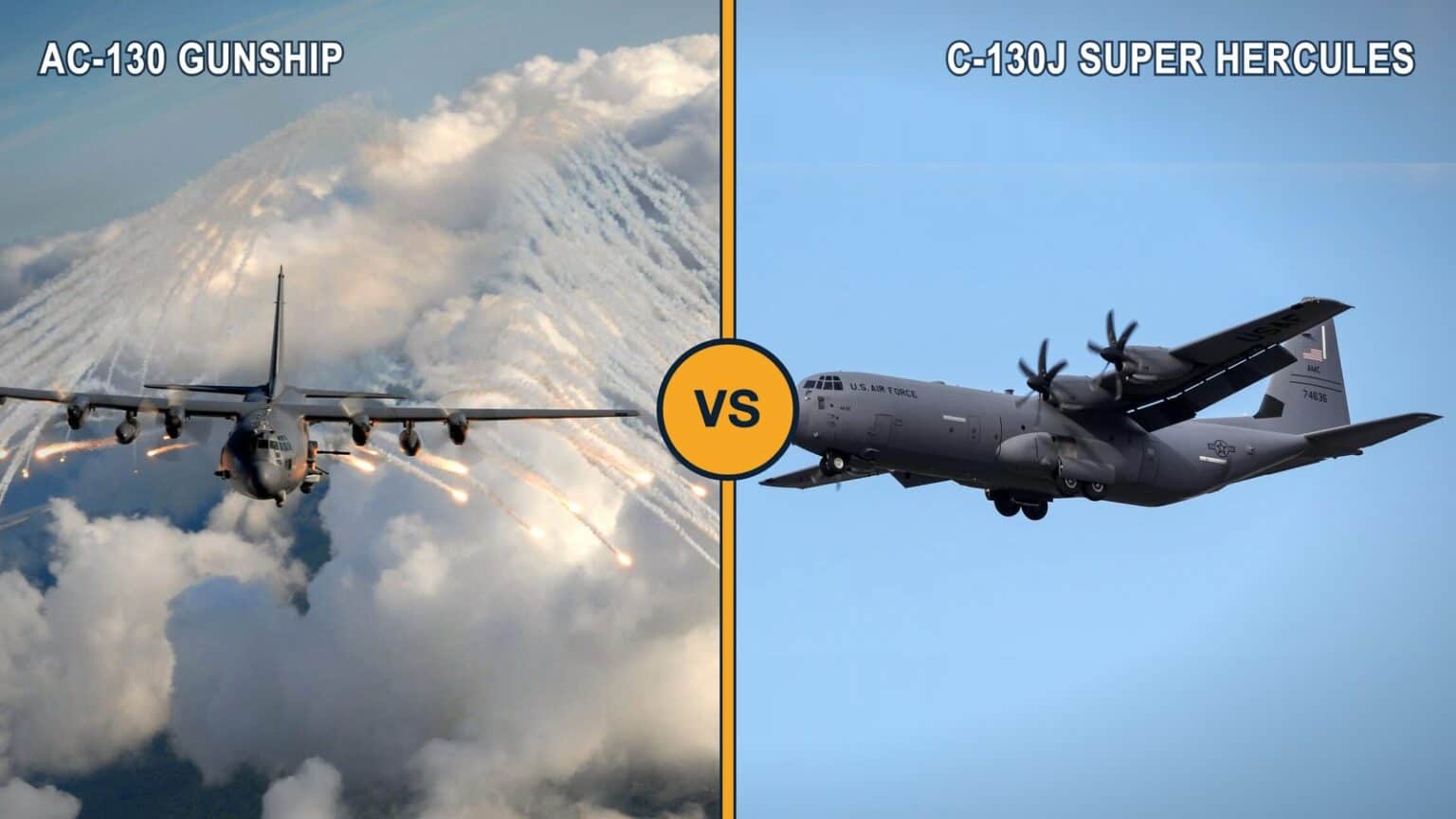
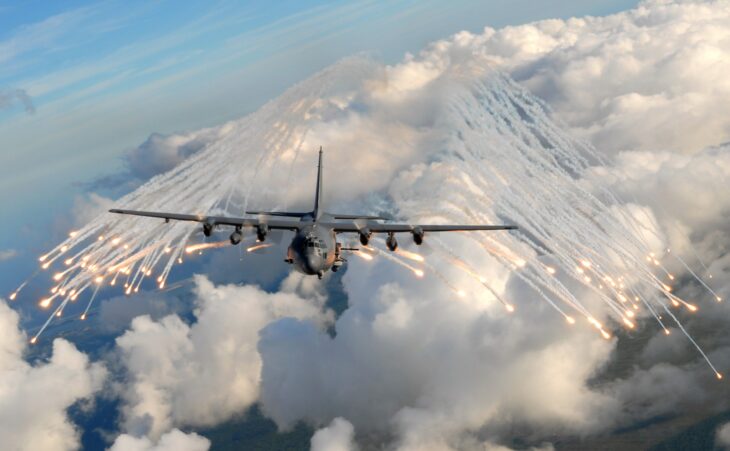
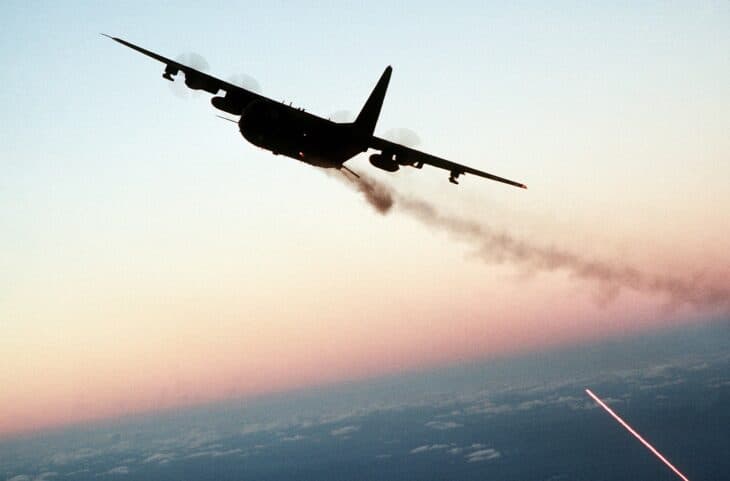
The AC-130 is a C-130 that was turned into a weapon. Its guns fire from the left side of the fuselage, and the crew flies a banked circle around the target so the guns keep pointing at one spot.
The C-130J is the unarmed transport. It moves people and freight, and it needs three crew where the gunship carries seven.
They are not rivals. One is a ground-attack aircraft and the other is a truck with wings, and the Air Force flies both.
Role: a gun platform against a cargo hauler
According to Wikipedia, the AC-130 is a heavily armed, long-endurance ground-attack version of the C-130, with its weapons tied into sensors, navigation and fire control. It usually flies close air support at night and typically works at around 7,000 feet.
The C-130J does the original Hercules job. It airlifts troops, vehicles and pallets into short or rough strips, and Wikipedia lists it at 92 passengers for the standard aircraft and 128 for the C-130J-30.

Weapons: what the AC-130 carries and the C-130J does not
The gunship has been rearmed with each generation. Wikipedia lists the AC-130H with a 40 mm Bofors cannon and a 105 mm howitzer, and the AC-130U with a 25 mm GAU-12 added to those two.
The AC-130J carries a 30 mm GAU-23/A cannon and a 105 mm M102 howitzer. It can also launch Griffin and Viper Strike munitions from a launch tube, carry small diameter bombs on the wing, and Wikipedia lists wing-mounted Hellfire missiles for the J.
A standard C-130J carries none of this. The armed Hercules versions are conversions, which is why the gunship is a separate aircraft and not an option on the transport.
Crew: seven against three
The AC-130J crew is seven, according to Wikipedia: two pilots, two combat systems officers and three enlisted special mission aviators. The extra people operate the sensors and the guns.
The C-130J needs a minimum of three, two pilots and a loadmaster. Its digital cockpit removed the navigator and flight engineer that older Hercules carried.

What they share: engines, wings and the airframe
The two aircraft look alike on the ramp for a reason. The specification panel above shows the same four Rolls-Royce AE 2100D3 turboprops at 4,700 shp each, the same 164,000 lb (74,500 kg) takeoff weight and the same 362 kt (417 mph) top speed.
The AC-130J is built on the MC-130J Commando II, a special operations C-130J. That is why the gunship has the modern engines and six-blade propellers of the C-130J and not the older Allison engines of earlier gunships.
Wikipedia puts the C-130J ahead of older C-130E and H transports by 40 percent in range, 21 percent in top speed and 41 percent in takeoff distance. The newest gunship inherits that.
Range: why the gunship does not fly the longest legs
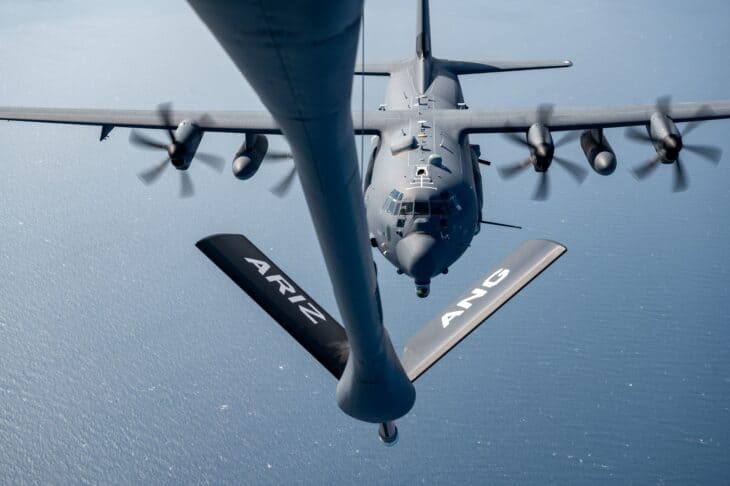
The panel gives the C-130J a range of 1,800 nm (2,070 mi) at maximum normal payload. The AC-130J is listed at 3,000 mi (4,830 km), with air refueling.
The two figures are measured differently, so they should not be read as a win for the gunship. The gunship is built to arrive and stay on station for hours, and its tanker is part of the plan.

Variants: one gunship, many transports
The gunship line has changed hands several times. The first AC-130A flew in 1967 after a JC-130A prototype was converted, and entered service in 1968.
The AC-130H retired on May 26, 2015, the AC-130U in June 2020 and the AC-130W in July 2022, according to Wikipedia. That leaves the AC-130J as the only gunship in service.
The C-130J has a wider family. Besides the standard aircraft there is the C-130J-30, which adds 15 feet (4.6 m) to the fuselage and raises the pallet count from 6 to 8.

Combat record: Khafji and Vietnam
Gunships have a combat history the transport does not. Six AC-130s and 52 aircrew were lost in Vietnam, according to Wikipedia.
On January 31, 1991, AC-130H Spirit 03 was shot down during the Battle of Khafji by an Iraqi soldier with a Strela-2 shoulder-fired missile. All 14 crew died.
The C-130J is a transport and has a different record. It is built for delivery, not for flying circles over a firefight.
Fleet size: a few dozen gunships against hundreds of transports
Wikipedia counts the AC-130J fleet differently in different sections: 32 procured as of 2014 and 37 active-duty as of 2024. Treat any single number as approximate.
The C-130J is far more common. Wikipedia says 500 aircraft had been delivered to 26 operators in 22 countries as of March 2022, although its own delivery table adds up to more.
Only the U.S. Air Force flies the gunship, so exports and civil use are not on offer. For the unarmed Hercules, see the full C-130J Super Hercules page.
AC-130 vs C-130: which is better?
It depends on the job. If the job is hitting a target on the ground for hours, only the gunship does it.
If the job is moving 92 passengers or 42,000 lb (19,100 kg) of payload into a short strip, the C-130J is the aircraft. The gunship cannot do that, because its cargo bay holds weapons and crew stations.
FAQ
Sources and references used for research and fact-checking.
- Wikipedia, Lockheed AC-130 (variants, armament, crew, service history, losses)
- Wikipedia, Lockheed Martin C-130J Super Hercules (development, specifications, C-130J-30, deliveries)
- AeroCorner, Lockheed AC-130 Gunship specification panel
- AeroCorner, Lockheed Martin C-130J Super Hercules specification panel
About the Author

Tim is the owner and lead editor of AeroCorner since 2019, overseeing aviation content covering aircraft, airlines, airports, and the broader aviation industry. Through years of researching, writing, editing, and publishing aviation-focused content, he has developed extensive practical knowledge of commercial aviation and air travel. Based in Asia and a frequent traveler himself, Tim also brings firsthand passenger experience to AeroCorner’s coverage. Outside of publishing, he has also explored aviation firsthand through hands-on flight training in New Zealand.