

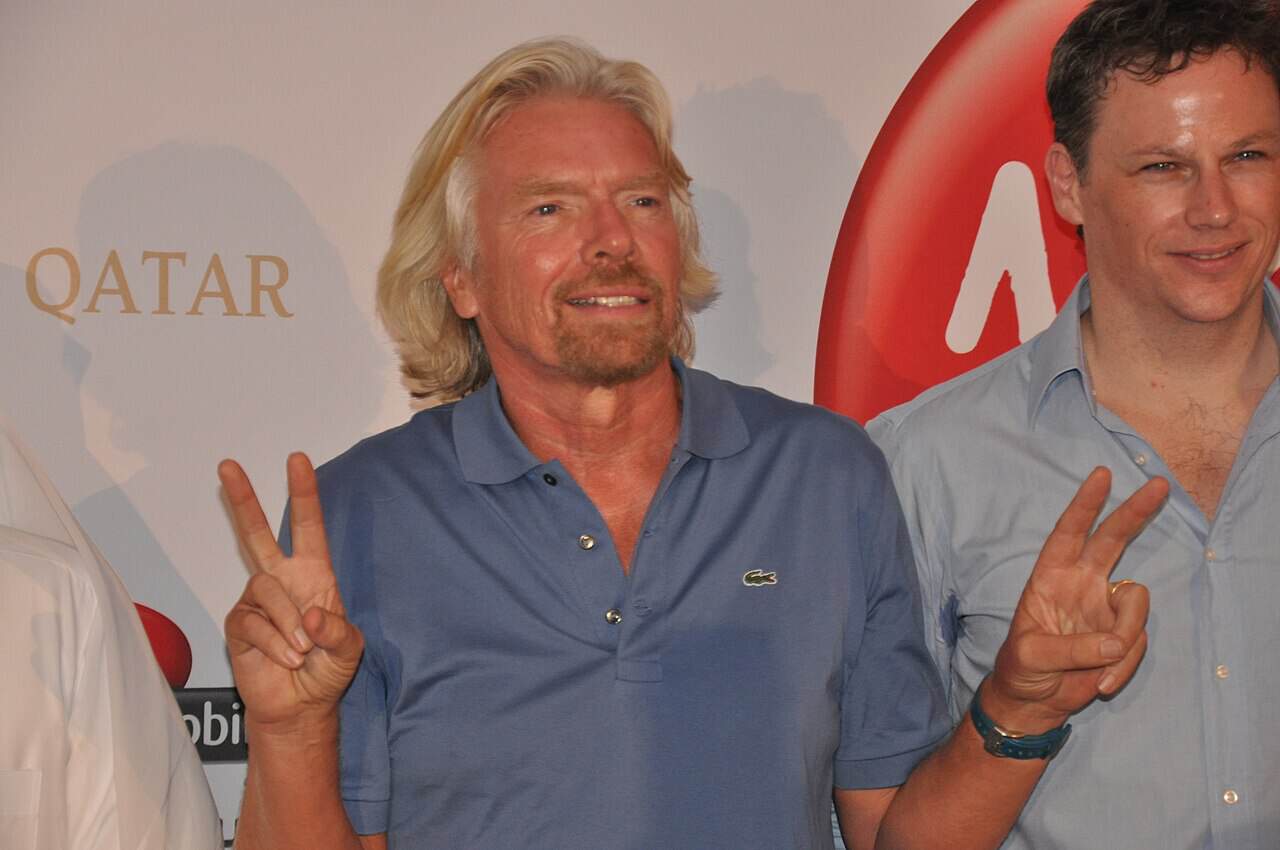
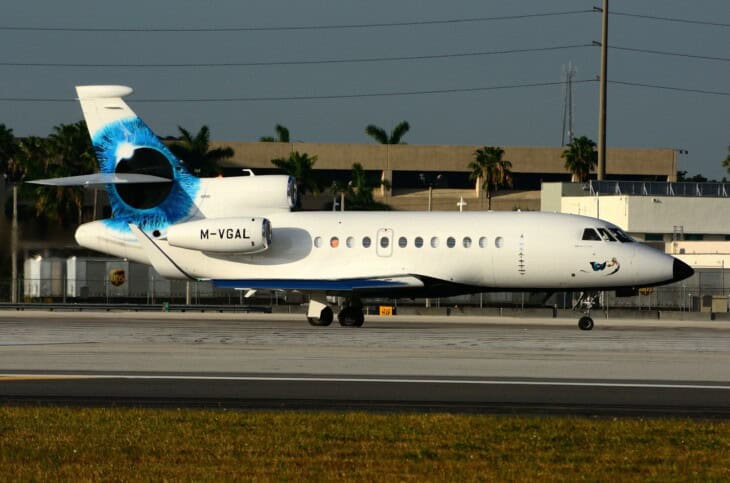
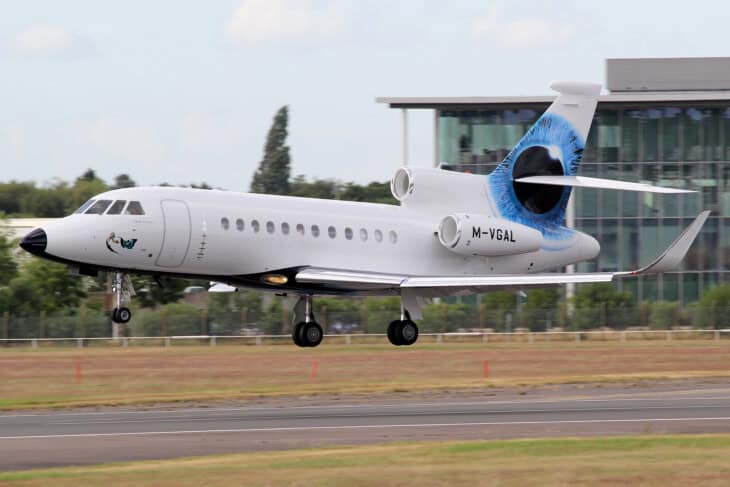
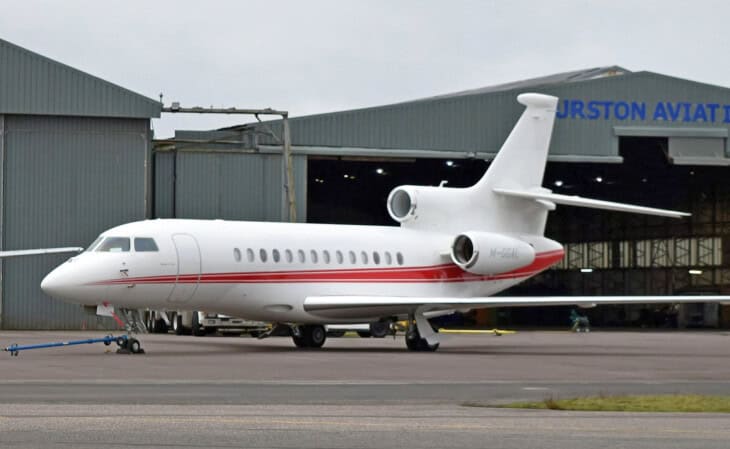
On August 24, 2026, the Isle of Man Aircraft Registry cancelled the registration of a 2008 Dassault Falcon 900EX wearing the mark M-VGAL and recorded its export to the United States. The next day, the same airframe appeared on the FAA register as N900PN.
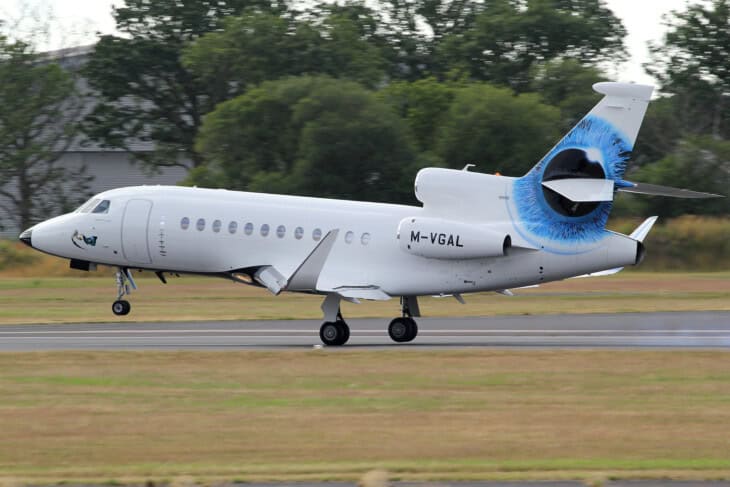
M-VGAL reads as Virgin Galactic, and it was the fifth Richard Branson private jet since 2006 to carry a Virgin or Galactic registration. Its owner of record was Charter Air Ltd of Douglas, the company behind all five. With it gone, no aircraft is left on the Isle of Man register under that name.
What follows is the full record: every Falcon, its serial number and register dates, the jet that became Max Verstappen’s first aircraft, the small trijet Branson kept for a short Caribbean runway, and what the paperwork can and cannot tell you about where his last jet went.
Quick facts about Richard Branson’s private jet
Richard Branson’s Private Jet Fleet
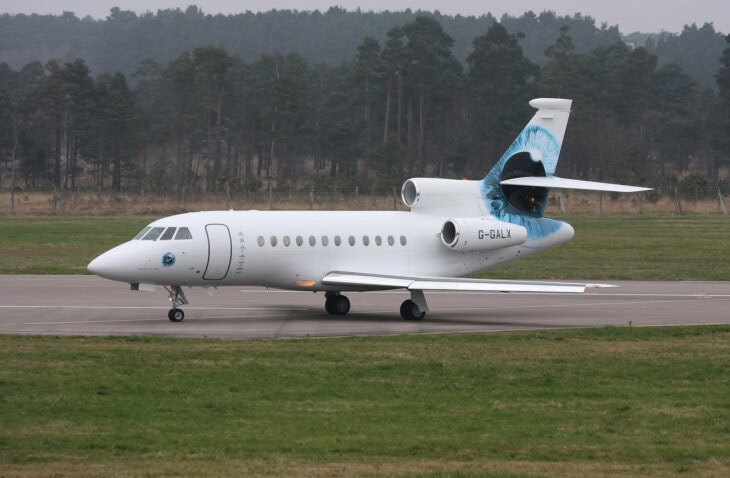
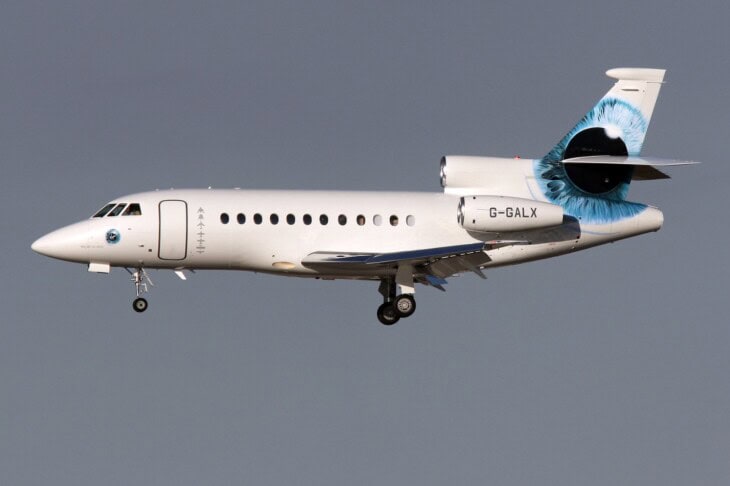
Branson’s aviation record is unusually consistent. Every business jet we could tie to him in the public registers since 2006 is a Dassault Falcon, and all five wore marks built around Virgin or Galactic: G-GALX, M-VGIN, M-GGAL, and M-VGAL twice.
They were held through Charter Air Ltd, and registered first in the UK and then on the Isle of Man. That is why his jets carried G- and M- prefixes rather than a US N-number. The cards run from the most recent aircraft back to the first.
The Origin Story: Twenty Years of Galactic Girls
The Falcons arrived with Virgin’s move into space. Branson announced Virgin Galactic in September 2004, and his first jet in its colours followed less than two years later.
1984
Virgin Atlantic is born. Branson forms the airline and Virgin Cargo, and it remains the airline he says he uses for his long flights.
September 2004
Virgin Galactic is announced. Branson signs a deal to license the technology behind SpaceShipOne and take paying passengers to suborbital space. The Galactic name will end up on almost every jet he owns.
July 2006
The first Galactic Girl. A new Falcon 900EX, serial 163, joins the UK register as G-GALX, owned by Charter Air Ltd and painted to promote Virgin Galactic.
July 2012
G-GALX is sold. The UK registration is cancelled after six years. The aircraft later flies in the United States as N575JJ.
September 2012
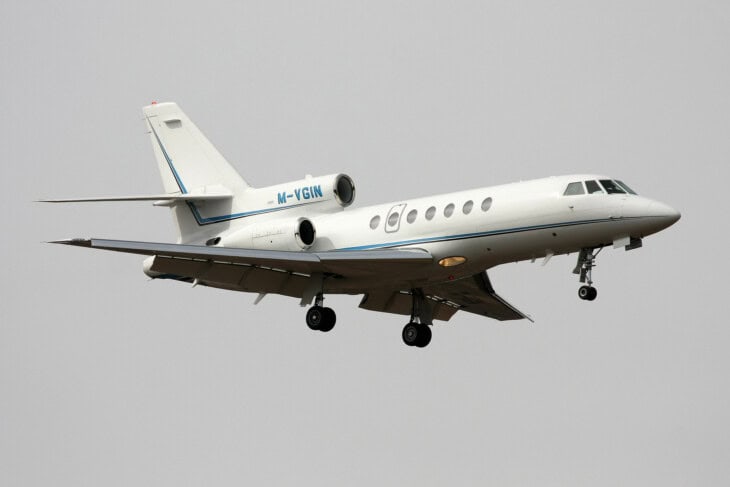
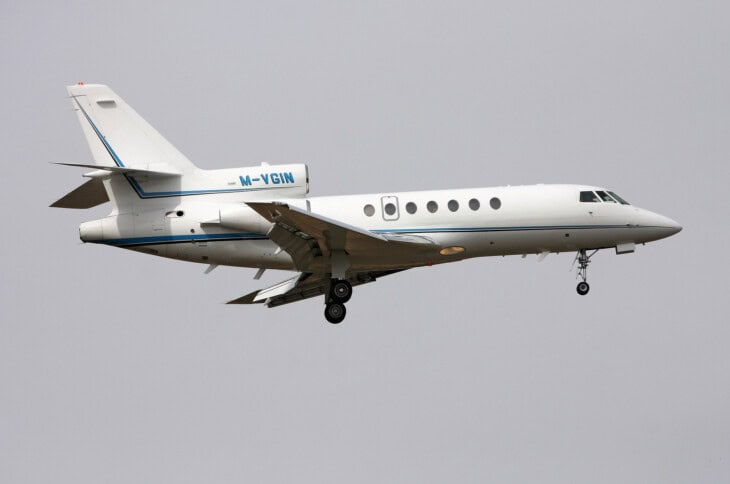
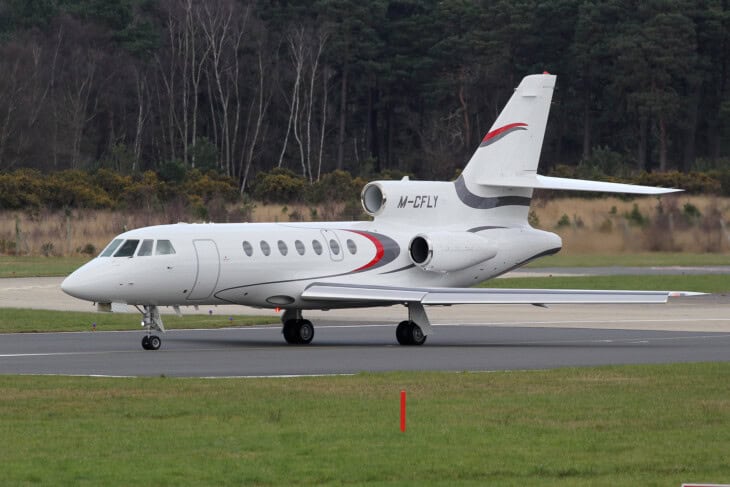
A smaller jet for a smaller runway. A 2001 Falcon 50EX, serial 320, joins the Isle of Man register as M-VGIN.
August 2014
The 50EX changes hands. The register records a new owner, a British Virgin Islands company, and the mark changes from M-VGIN to M-CFLY.
January 2015
M-VGAL, the first one. A 2008 Falcon 900EX EASy, serial 205, arrives from India, where it flew as VT-CAP. Spotter photos list it under Virgin Galactic through 2018.
November 2019
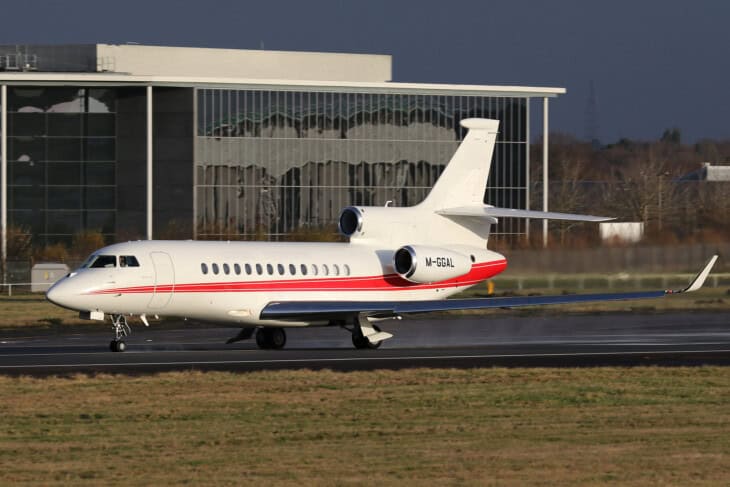
The 7X arrives. Falcon 7X serial 168, previously flown in China by Deer Jet, joins the Isle of Man register as M-GGAL. For eleven months Charter Air holds two jets at once.
October 2020
M-VGAL goes to Max Verstappen. After a change of owner in September, the jet moves to the Dutch register on October 21 and becomes PH-DTF.
July 2023
The 7X leaves. M-GGAL is deregistered on July 21 and exported to Germany, where it later joins VistaJet as D-AIFH.
December 2023
M-VGAL, the second one. Another 2008 Falcon 900EX, serial 207 and formerly N900DJ in the US, takes the same mark on December 20.
August 2026
The register empties. The second M-VGAL is deregistered on August 24 and exported to the United States, where it is registered as N900PN the next day.
Notice what the mark M-VGAL did. When the first airframe went to Verstappen, the registration stayed available, and three years later it went straight onto a second aircraft of the same type and the same build year.
Where Is Richard Branson’s Private Jet Now?
On the public record as of September 2026, not anywhere with his company’s name on it. The Isle of Man register, current to September 11, lists the second M-VGAL as deregistered on August 24, 2026, with the United States as its new state of registry.
The FAA’s aircraft database released on September 10 shows the same airframe, serial 207, registered as N900PN on August 25. The registered owner is Bank of Utah, acting as trustee.
That second detail is the one that matters. A trustee registration tells you who holds legal title on paper, not who the aircraft is actually for.
What a Bank of Utah trust registration means
Foreign citizens and many companies cannot register an aircraft with the FAA on their own, so they use an owner trust. The trustee, here Bank of Utah, holds legal title and appears on the public register, while the beneficiary stays private. The bank says it does not buy, finance or operate the aircraft it holds in trust, and shares ownership details only with regulators or under subpoena. The FAA knows who the beneficiary is. The public does not.
So the record cannot tell you whether the jet was sold or simply moved to a US trust for the same principal. We found no announcement of a sale and no reporting on the transfer at all.
What can be said plainly is narrower. As of September 2026, no aircraft is registered to Charter Air Ltd on the Isle of Man, and no aircraft in the FAA database is registered to Branson personally, to Virgin Group, or to Charter Air Ltd.
Inside the Falcon 900EX: The Jet He Kept Coming Back To
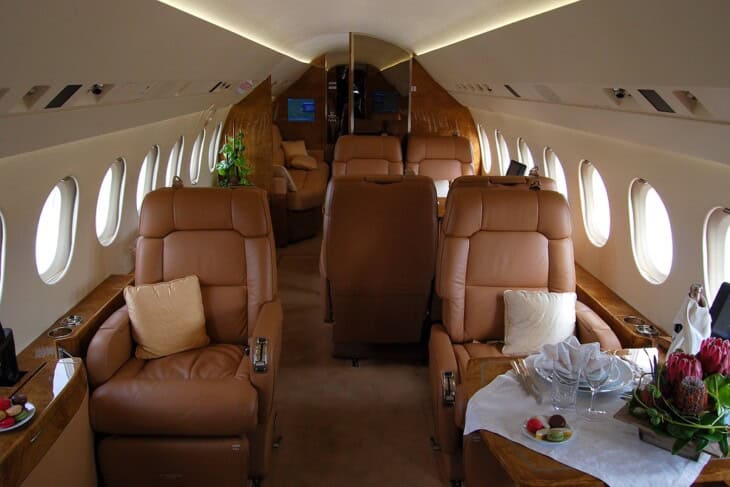
Three of Branson’s five jets were Falcon 900EXs, which says a lot about how he flew. The 900EX is a large-cabin trijet with a 4,500 nautical mile range, but it sits a class below the ultra-long-range Gulfstreams and Bombardier Globals many owners in this series chose.
Dassault built the EASy version, with its Primus Epic flight deck, from 2004 to 2009. Both M-VGAL airframes were built in 2008, late in that run.
Performance
Last airframe
Isle of Man record
The first of the three, G-GALX, carried the name Galactic Girl and an exterior promoting Virgin Galactic. Spotter photos of the first M-VGAL list it under Virgin Galactic too, from its arrival in 2015 through 2018.
For the full technical picture of the type, our Dassault Falcon 900EX aircraft page carries the complete specification.
The Falcon 50EX and the Short Runway Home
Between the first 900EX and the second, Branson flew something smaller. In a 2014 interview with Business Jet Traveler, he was asked what airplane he owned.
A Falcon 50EX. I need a small plane just to get out of the British Virgin Islands. And I use that for shorter distances.
Branson lives on Necker Island. Visitors reach it by flying into Terrance B. Lettsome International Airport on Beef Island, the closest international airport, and then taking a 30-minute speedboat.
Beef Island’s single runway is 4,642 feet (1,415 m) long, short by long-range business jet standards. A plan to add another 2,504 feet was dropped in 2017, so the runway is the same length today as when Branson gave that answer.
The Falcon 50EX fit the job. It carries 8 to 9 passengers on three Honeywell TFE731-40 engines and has a 3,075 nautical mile range in a lighter airframe than the 900EX.
It did not stay long. The Isle of Man register records a new owner, a company in Road Town, Tortola, on August 15, 2014, a few months after the interview, and the mark changed from M-VGIN to M-CFLY the same day. It left for the US in July 2017 and flies today as N221CB.
The Falcon 7X Years
The biggest jet of the run arrived in November 2019. M-GGAL was a Dassault Falcon 7X, serial 168, delivered in January 2013 and flown in China by Deer Jet before it reached the Isle of Man.
The 7X was the first fully fly-by-wire business jet, and its 5,950 nautical mile range made it the longest-legged of Branson’s five Falcons. It seats 12 to 16 and cruises at Mach 0.80, with a maximum of Mach 0.90.
It is also the aircraft several published fleet guides still list as his current jet. The Isle of Man register shows it left on July 21, 2023, for Germany, and it now flies with VistaJet as D-AIFH.
For eleven months, from November 2019 to October 2020, the 7X shared the fleet with the first M-VGAL. In these records, it is the only stretch in which Branson’s company held two jets at once.
The Jet That Became Max Verstappen’s
The first M-VGAL, serial 205, is the Branson jet with the most famous second life. It started out in India as VT-CAP before joining the Isle of Man register on January 7, 2015.
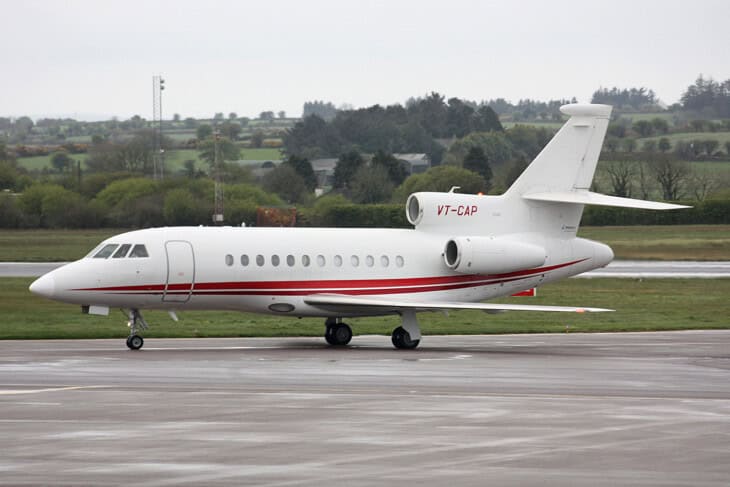
On September 18, 2020, the register recorded a new owner, Mavic Aviation S.à r.l. of Luxembourg. A month later, on October 21, the aircraft moved to the Dutch register.
There it became PH-DTF, Max Verstappen’s first private jet, operated by the Dutch company Exxaero and repainted matt black and orange. Simple Flying reported it was worth around $15 million, and Verstappen flew it to races through the 2021 season that ended with his first world title.
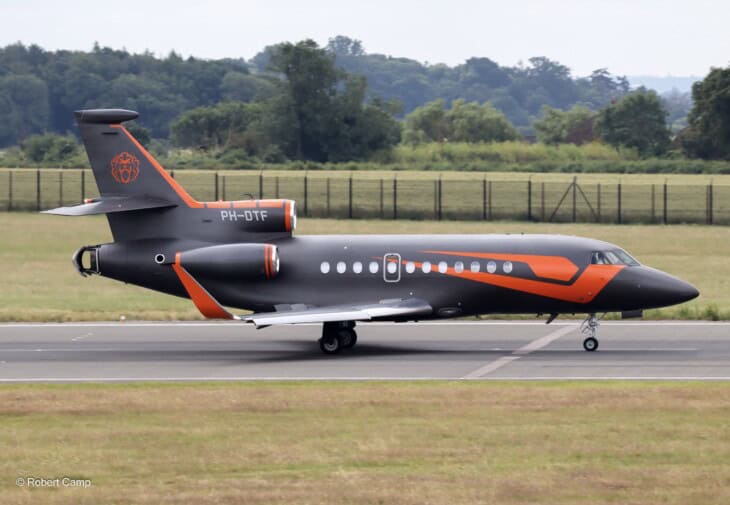
Verstappen replaced it with a Falcon 8X in 2025, a story we cover in our roundup of F1 drivers with private jets.
The sale landed in a hard year for Virgin. In 2020 Branson put Necker Island up as collateral for a commercial loan to save Virgin Atlantic, though nothing on the record connects that crisis to the jet.
An Airline Founder Who Flies Private
Branson occupies an awkward spot in the private jet debate. He built an airline, he has talked about climate action for two decades, and he has owned a business jet for nearly all of that time.
In 2006 he pledged $3 billion over ten years to tackle global warming. The author Naomi Klein later argued he had put in well under $300 million by 2014, and that Virgin’s airline emissions rose considerably after the pledge.
His own case for the jet has always been practical rather than ideological. Asked in 2014 how business aviation had helped his career, his whole answer was: it saves time and gives me flexibility.
What Branson says the jet was for
In the same 2014 interview, Branson said he flew around six months of the year and took his longer flights on Virgin Atlantic because it mattered to spend time with the staff and passengers. The Falcon, he said, was for shorter or more complicated trips, business or charity, and said he aimed to raise about $10 million a year for charity through around 25 speeches.
On the airline side, he put himself on board a landmark test. On November 28, 2023, he flew on Virgin Atlantic’s Flight100, a Boeing 787 that crossed from Heathrow to JFK on 100% sustainable aviation fuel, which Virgin billed as the first transatlantic flight of its kind.
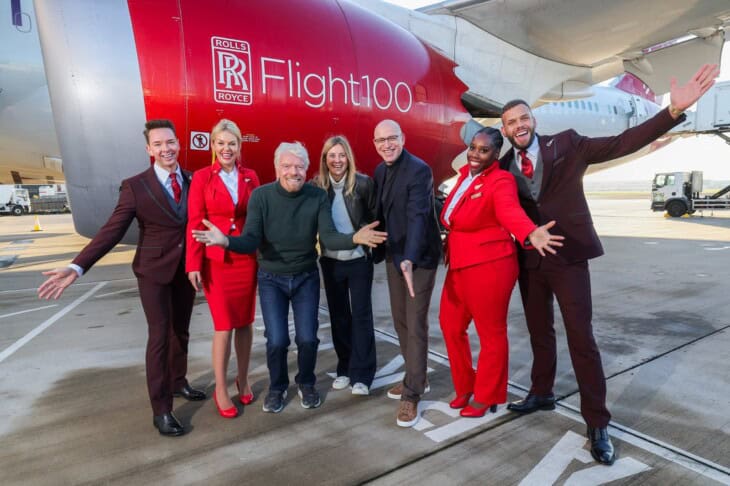
Virgin’s lifecycle analysis, published in May 2024, put the saving at 95 tonnes of CO2, or 64% of the emissions of a standard Heathrow to JFK flight. The airline’s own conclusion was that the fuel now needs to be produced at scale.
Richard Branson’s Most Famous Flights
The Falcons are the least dramatic aircraft in Branson’s flying history. His famous flights happened in balloons and a spaceship.
1987: Across the Atlantic by balloon
A year after his Virgin Atlantic Challenger II beat the Atlantic powerboat record by two hours, Branson crossed the same ocean in the hot air balloon Virgin Atlantic Flyer. Its capsule is now on display at the Imperial War Museum at Duxford.
1991: The Pacific at 145 mph
In January 1991 he crossed the Pacific from Japan to Arctic Canada, 6,700 miles (10,800 km), in a balloon of 2.6 million cubic feet. The flight set a record speed of 145 mph (233 km/h).
1998: Morocco to Hawaii, and no further
Between 1995 and 1998, Branson, Per Lindstrand, Steve Fossett and others tried to take a balloon around the world. Their late-1998 attempt set a record from Morocco to Hawaii before ending in the Pacific on December 25, 1998.
Bertrand Piccard and Brian Jones completed the first round-the-world balloon flight in Breitling Orbiter 3 in March 1999.
2021: 53 miles up
On July 11, 2021, Branson flew to the edge of space aboard VSS Unity, reaching 53 miles (86 km) above Spaceport America in New Mexico. It made him the first billionaire founder of a space company to make the trip.
Unity was carried aloft by the mothership VMS Eve, named after his mother, Eve Branson. It is still on the FAA register as N348MS, owned by Virgin Galactic rather than by Branson.
Nine days later, Jeff Bezos flew on Blue Origin’s New Shepard to 66 miles (107 km). Our guide to space tourism covers both programmes.
How Branson’s Jets Compare to Other Billionaires’
Branson never chased the ultra-long-range flagship. Where Jeff Bezos and Elon Musk settled on Gulfstream G650ERs, he stayed with Dassault’s trijets for twenty years.
| Owner | Aircraft | Note |
|---|---|---|
| Richard Branson | Dassault Falcon 900EX (M-VGAL) | Left the Isle of Man register in August 2026 |
| Max Verstappen | Dassault Falcon 8X (PH-UTL) | Replaced the ex-Branson 900EX in 2025 |
| Taylor Swift | Dassault Falcon 7X | Same type as Branson’s M-GGAL |
| Jeff Bezos | Gulfstream G650ER | Ultra-long-range flagship |
| Elon Musk | Gulfstream G650ER | Ultra-long-range flagship |
| Warren Buffett | NetJets fractional share | A share of a fleet rather than one jet |
The closest parallel is Taylor Swift, who flies the same Falcon 7X type Branson owned from 2019 to 2023. The furthest is Warren Buffett, who flies on a NetJets fractional share rather than owning a single jet.
What sets Branson apart is the paper trail. Five airframes, two registers, the same company and the same naming theme for twenty years, and in August 2026 the last of them left without a word from anyone.
FAQ
Sources and references used for research and fact-checking.
- Isle of Man Aircraft Registry, Isle of Man Aircraft Register search (data current to 11 September 2026)
- Federal Aviation Administration, Releasable Aircraft Database Download (MASTER and DEREG files, released 10 September 2026)
- FlightAware, N900DJ aircraft registration record
- Airport-Data.com, Aircraft Data G-GALX, 2006 Dassault Falcon 900EX C/N 163
- Airport-Data.com, Aircraft Data M-VGIN, 2001 Dassault Falcon 50EX C/N 320
- OneSpotter, D-AIFH, VistaJet (Germany) Dassault Falcon 7X, MSN 168
- JetPhotos, M-VGAL aviation photos
- Simple Flying, Richard Branson's Eclectic Private Aircraft Collection
- Simple Flying, How Many Private Jets Does Richard Branson Own?
- Simple Flying, A Look At F1 World Champion Max Verstappen's Private Jet
- Aviation24.be, Formula One racing driver Max Verstappen acquires former Virgin Galactic private jet
- Motorsport.com, Verstappen puts private jet up for sale after buying all-new Falcon 8X and yacht
- Business Jet Traveler, Sir Richard Branson interview
- Virgin Limited Edition, Travelling to Necker Island
- Wikipedia, Terrance B. Lettsome International Airport
- Wikipedia, Dassault Falcon 900
- Wikipedia, Dassault Falcon 50
- Wikipedia, Dassault Falcon 7X
- Bank of Utah, Information Regarding Aircraft Owner Trusts
- Wikipedia, Richard Branson
- Wikipedia, VSS Unity
- Wikipedia, Scaled Composites White Knight Two
- Wikipedia, Blue Origin NS-16
- Virgin Atlantic, Virgin Atlantic flies world's first 100% Sustainable Aviation Fuel flight from London Heathrow to New York JFK
- Virgin Atlantic, Virgin Atlantic's Flight100 saved 95 tonnes of CO2
Get the Newsletter
The latest aviation news and stories sent to your inbox.
About the Author

Tim is the owner and lead editor of AeroCorner since 2019, overseeing aviation content covering aircraft, airlines, airports, and the broader aviation industry. Through years of researching, writing, editing, and publishing aviation-focused content, he has developed extensive practical knowledge of commercial aviation and air travel. Based in Asia and a frequent traveler himself, Tim also brings firsthand passenger experience to AeroCorner’s coverage. Outside of publishing, he has also explored aviation firsthand through hands-on flight training in New Zealand.