

Table of Contents
Pick Qantas if Australia is where you are going. It flies nonstop to Australia from 5 US cities, Air New Zealand from none, and its economy fare from the US includes a checked bag of up to 70 pounds (32 kg).
Pick Air New Zealand if New Zealand is the destination, or if you want to lie flat without paying for business class. It flies nonstop to Auckland from 5 US cities against Qantas’s 1, sells the Skycouch row in economy, and gives premium economy 41 inches (104 cm) of pitch to Qantas’s 38 inches (97 cm).
Business class and safety are close to a tie, and Qantas is the higher-rated airline overall. This comparison uses the two airlines’ own route, baggage and results pages, seat specifications from launch coverage, Skytrax and AirlineRatings, as of November 2026.
| Criterion | Qantas | Air New Zealand | Edge |
|---|---|---|---|
| US cities with a nonstop to Australia | 5 (Los Angeles, Dallas/Fort Worth, San Francisco, Honolulu, Las Vegas from Dec. 29) | 0 (connect in Auckland) | Qantas |
| US cities with a nonstop to New Zealand | 1 (New York JFK, via Auckland to Sydney) | 5 (Honolulu, Houston, Los Angeles, New York, San Francisco) | Air NZ |
| Economy pitch, 787-9 | 32 in (81 cm), 3-3-3 | 31 in (79 cm), 3-3-3; 35 in (89 cm) in Economy Stretch rows | Qantas (1 in) |
| Lie-flat option in economy | None | Skycouch rows; Skynest bunks delayed past summer | Air NZ |
| Premium economy pitch, 787-9 | 38 in (97 cm), 2-3-2 | 41 in (104 cm), 2-3-2 | Air NZ |
| Business class, 787-9 | 1-2-1, every seat on the aisle, no doors | 1-2-1 herringbone, no doors; paid front-row Luxe suites with doors | Even |
| Free checked bags, economy from the US | 1 bag, up to 70 lb (32 kg) | 0 on Seat fares; 1 bag, up to 50 lb (23 kg), on Seat+Bag | Qantas |
| Skytrax World Airline Awards, 2026 | No. 12 | No. 32 | Qantas |
| AirlineRatings safest full-service airlines, 2026 | No. 3 | No. 6 (top six within 1.3 points) | Even |
| Alliance and US partner | oneworld; American Airlines | Star Alliance; United | Even |
How we compared
Routes count US cities with a nonstop flight on each airline’s 2026-27 schedule, opened November 10, 2026. Qantas’s network is from Simple Flying (March 1, 2026) and AeroRoutes (March 27, 2026); Air New Zealand’s is from its own destinations page, which lists Chicago as paused, so Chicago is not counted. Seat figures are for the Boeing 787-9, the aircraft both airlines fly most to the US: Qantas from its 2016 and 2017 launch specifications, Air New Zealand from The Milelion’s May 2025 review of its refitted 787-9. The premium economy gain is premium economy pitch minus economy pitch: Qantas 38 – 32 = 6 inches, Air New Zealand 41 – 31 = 10 inches. Bag rules are each airline’s own page for travel from the US.
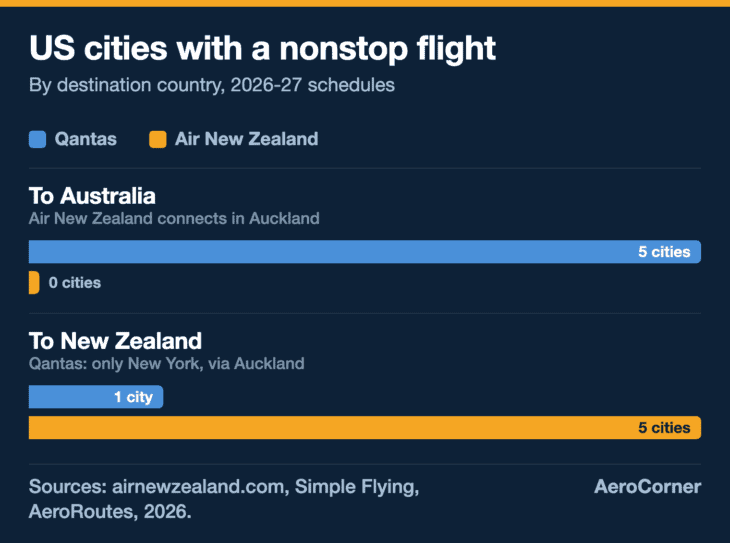
Where each airline flies nonstop from the US
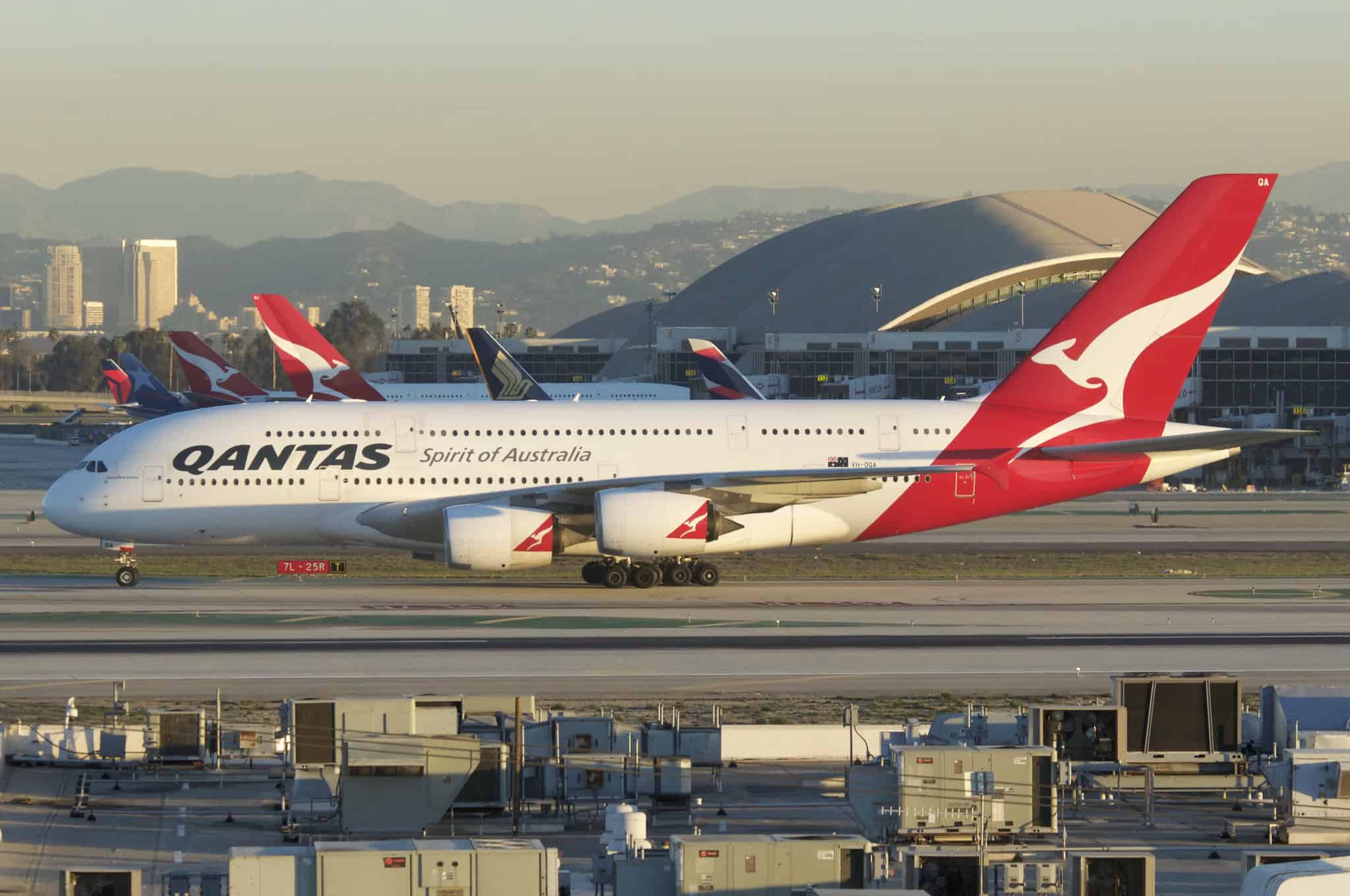
This decides most bookings. Qantas flies nonstop from Los Angeles to Sydney, Melbourne and Brisbane, from Dallas/Fort Worth to Sydney and Melbourne, and from San Francisco and Honolulu to Sydney.
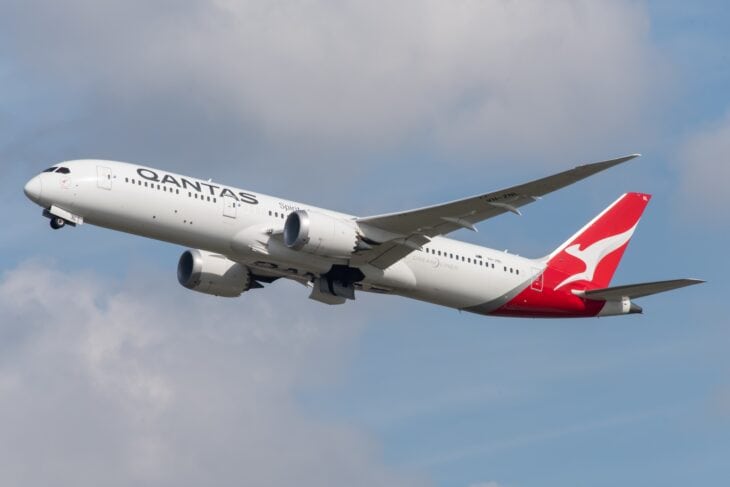
Its sixth US city is new: a seasonal Sydney to Las Vegas flight runs three times a week on the Boeing 787-9 from December 29, 2026 to March 12, 2027. Qantas reaches New Zealand from the US only on its New York flight, which stops in Auckland on the way to Sydney.
Air New Zealand runs the mirror image. It flies year-round to Auckland from Honolulu, Houston, Los Angeles, New York and San Francisco, plus Vancouver in Canada, and lists its Chicago flight as paused.
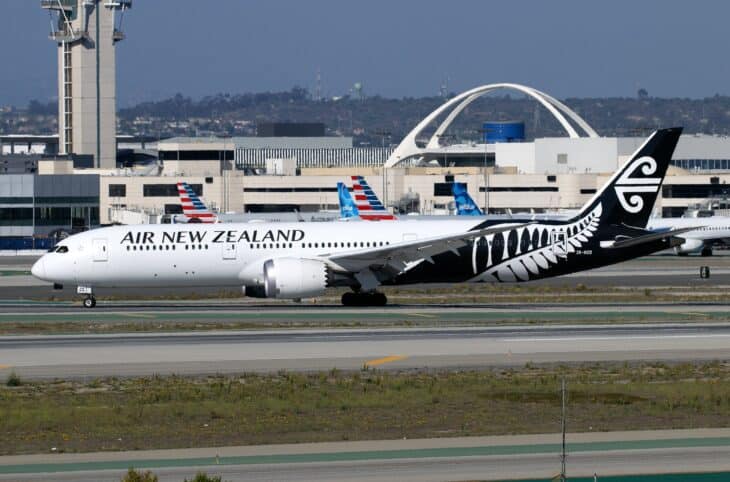
It has no nonstop from the US to Australia, so a Sydney trip on Air New Zealand means a connection in Auckland. That is a real option on price, but it adds a stop that Qantas does not.
Edge: Qantas to Australia, Air New Zealand to New Zealand. Each airline flies nonstop to its home country from 5 US cities; the other manages 1 to New Zealand and 0 to Australia.
Economy seats
Both airlines seat economy 9 across, 3-3-3, on the 787-9. Qantas gives 32 inches (81 cm) of pitch and a 17.2-inch (44 cm) seat, according to the specifications it released for the aircraft, one inch more pitch than its A380 economy.
Air New Zealand’s refitted 787-9 gives 31 inches (79 cm), with 35 inches (89 cm) in the Economy Stretch rows at the front of the cabin. The airline said 9 of its 14 Dreamliners had the new interior by August 2026, with the rest due by November.
What Qantas cannot match is the Skycouch: a row of three economy seats whose footrests fold up into a flat surface, so two people or a parent and child can lie down. Air New Zealand also sells Skynest, six bunk-style beds rented in four-hour sessions from $495 in its launch release.
Skynest was due to fly on Auckland to New York in December 2026, but the airline delayed it past the summer peak because an overseas certifying authority could not finish its approvals in time.
“We want it in the air doing what it was built to do,” Air New Zealand’s chief customer and digital officer Jeremy O’Brien told Karryon; no new date has been set.
Our guide to the Skynest bunk beds covers how a session works.
Edge: Qantas on the standard seat by an inch, Air New Zealand on the option to lie flat. If you will book Skycouch or Stretch, Air New Zealand wins economy outright.
Premium economy
Air New Zealand’s new premium economy seat has 41 inches (104 cm) of pitch and is about 19 inches (48 cm) wide, in a 2-3-2 layout with privacy wings instead of shells.
Qantas’s 787-9 premium economy, also 2-3-2, launched with 38 inches (97 cm) of pitch and a cradle recline that the airline said intrudes less on the passenger behind.
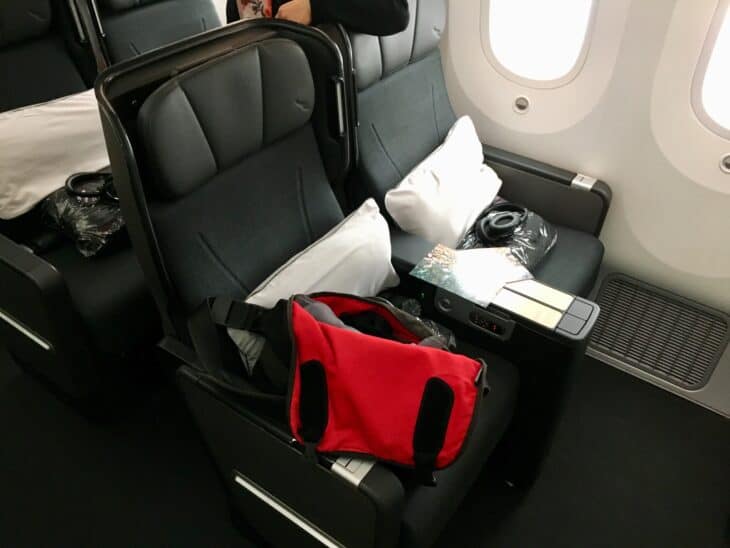

Subtract each airline’s economy pitch and the upgrade buys 10 extra inches on Air New Zealand and 6 on Qantas. That is the number to weigh against the fare difference, as our premium economy vs economy guide explains.
The upgrade buys more legroom on Air New Zealand
Moving from economy to premium economy on the 787-9 adds 10 inches (25 cm) of pitch on Air New Zealand, from 31 to 41 inches, against 6 inches (15 cm) on Qantas, from 32 to 38 inches. Both cabins are 2-3-2.
Edge: Air New Zealand. Three more inches of pitch than Qantas on the same aircraft type.
Business class
Qantas’s 787-9 business cabin has 42 seats in a 1-2-1 layout, so every seat reaches the aisle and turns into a flat bed. It has no doors.
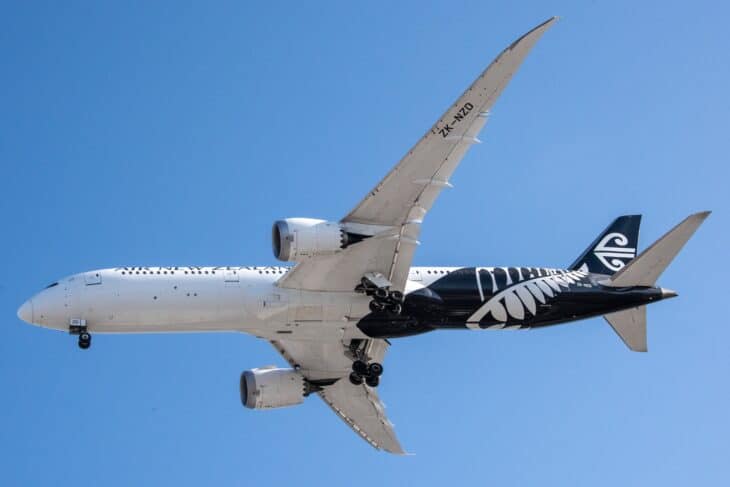
Air New Zealand’s refitted 787-9 uses a 1-2-1 inward-facing herringbone with a bed about 6.5 feet (2 m) long and a privacy screen, also without doors. The front row is Business Premier Luxe, suites with sliding doors sold as a seat upgrade for NZ$210 to NZ$820 depending on the route.
Qantas still flies the Airbus A380 on some Los Angeles and Dallas flights, and its A380 retirements begin in 2028. Not every Air New Zealand flight to the US uses a refitted 787-9, so check the aircraft before you pay for a cabin. For how both rank globally, see our best business class airlines list.
Edge: Even. Both standard seats are 1-2-1 flat beds without doors; Air New Zealand’s door costs extra.
Checked bags from the US
Qantas includes one checked bag of up to 70 pounds (32 kg) in economy on flights to and from the Americas, and two in premium economy and business. A prepaid extra bag costs US$170.
Air New Zealand’s cheapest economy fare, Seat, includes carry-on only. Seat+Bag and the higher fares include one bag of up to 50 pounds (23 kg), premium economy gets two and business three, and an extra bag from the US costs US$140.
So the lowest Qantas economy fare carries 20 pounds (9 kg) more free luggage than Air New Zealand’s Seat+Bag, and 70 pounds more than its Seat fare. Compare fares bag for bag, not headline price.
Edge: Qantas. A heavier free bag on every economy fare.
Ratings, safety and reliability
Qantas placed No. 12 in the 2026 Skytrax World Airline Awards, up from 14 in 2025. Air New Zealand placed No. 32, down from 24. Both hold a Skytrax 4-star rating.
On safety, AirlineRatings put Qantas third and Air New Zealand sixth among full-service airlines for 2026. The site’s CEO Sharon Petersen noted that just 1.3 points separated the top six and warned that small gaps should not be read as safety differences; our safest airlines ranking explains the method.
Air New Zealand has had a harder year. It reported a NZ$336 million loss before tax for the year to June 2026, and said Rolls-Royce Trent 1000 and Pratt & Whitney engine problems cost about NZ$190 million.
Its on-time rate recovered from 77.5% in 2025 to 84.0% in the second half of its 2026 financial year. Qantas posted an A$2.06 billion underlying profit before tax for the same year.
Edge: Qantas on ratings, even on safety. The safety gap is too small to choose on.
Miles, alliances and partners
Qantas belongs to oneworld, the alliance American Airlines is in. Air New Zealand belongs to Star Alliance, and it and United codeshare on each other’s flights between New Zealand and the US.
That makes the miles you already collect a fair tiebreaker. AAdvantage members point toward Qantas; MileagePlus members point toward Air New Zealand, whose Koru Gold, Platinum and Black members can use the United Club at Los Angeles and San Francisco.
The two airlines’ own partnership is ending. Qantas will stop its codeshare and frequent flyer deal with Air New Zealand on April 7, 2027, and Air New Zealand has applied to expand its codeshare with Virgin Australia instead.
Myth: Qantas and Air New Zealand are partners, so it doesn't matter which one you book
They sit in rival alliances, oneworld and Star Alliance, and their codeshare and frequent flyer partnership ends on April 7, 2027. From that date Qantas members stop earning points and status credits on Air New Zealand domestic flights in New Zealand, Qantas codeshares on Air New Zealand can no longer be booked, and lounge access for eligible Qantas members changes too.
Edge: Even. Fly the airline whose alliance holds your miles.
Who should pick which
| If you… | Pick | Because |
|---|---|---|
| Are flying to Sydney, Melbourne or Brisbane | Qantas | Nonstops from 5 US cities; Air New Zealand connects in Auckland |
| Are flying to New Zealand | Air New Zealand | Nonstops to Auckland from 5 US cities against Qantas’s 1 |
| Want to lie flat in economy | Air New Zealand | Skycouch rows now, Skynest bunks once certified |
| Are buying premium economy | Air New Zealand | 41 in (104 cm) of pitch against 38 in (97 cm) |
| Check a heavy bag on a cheap fare | Qantas | 70 lb (32 kg) free against 50 lb (23 kg) or nothing |
| Collect American AAdvantage miles | Qantas | oneworld partner |
| Collect United MileagePlus miles | Air New Zealand | Star Alliance partner |
If you are visiting both countries, fly into one on its home airline and out of the other on the other, or use the Qantas New York flight, which serves Auckland and Sydney on one ticket.
FAQ
Sources and references used for research and fact-checking.
- Air New Zealand, Destinations we fly to
- Air New Zealand, Baggage
- Qantas, USA Baggage, Seats and Service Fees
- Simple Flying, Qantas Makes History: New Nonstop Route Marks Record 6th US Gateway
- AeroRoutes, Qantas NS26 Intercontinental Network Changes
- AirlineRatings, Qantas unveils 787 interior
- AirlineRatings, Qantas launches stunning premium economy seat
- The Milelion, First look: Air New Zealand's all-new B787-9 Dreamliner cabins
- Air New Zealand, The future of long haul travel: Air New Zealand's Economy Skynest on sale from May 2026
- Karryon, Air New Zealand delays Skynest launch past 2026 summer
- Air New Zealand, Air New Zealand announces 2026 annual results
- Travel Weekly, Qantas posts $2bn underlying profit as Middle East disruption bites
- Skytrax, World's Top 100 Airlines 2026
- Skytrax, The World's 4-Star Airlines
- AirlineRatings, World's safest airline rankings for 2026
- Travel Monitor, Qantas and Air NZ codeshare ends on 7 April
- Air New Zealand, United Airlines
Get the Newsletter
The latest aviation news and stories sent to your inbox.
About the Author

Tim is the owner and lead editor of AeroCorner since 2019, overseeing aviation content covering aircraft, airlines, airports, and the broader aviation industry. Through years of researching, writing, editing, and publishing aviation-focused content, he has developed extensive practical knowledge of commercial aviation and air travel. Based in Asia and a frequent traveler himself, Tim also brings firsthand passenger experience to AeroCorner’s coverage. Outside of publishing, he has also explored aviation firsthand through hands-on flight training in New Zealand.