

Table of Contents
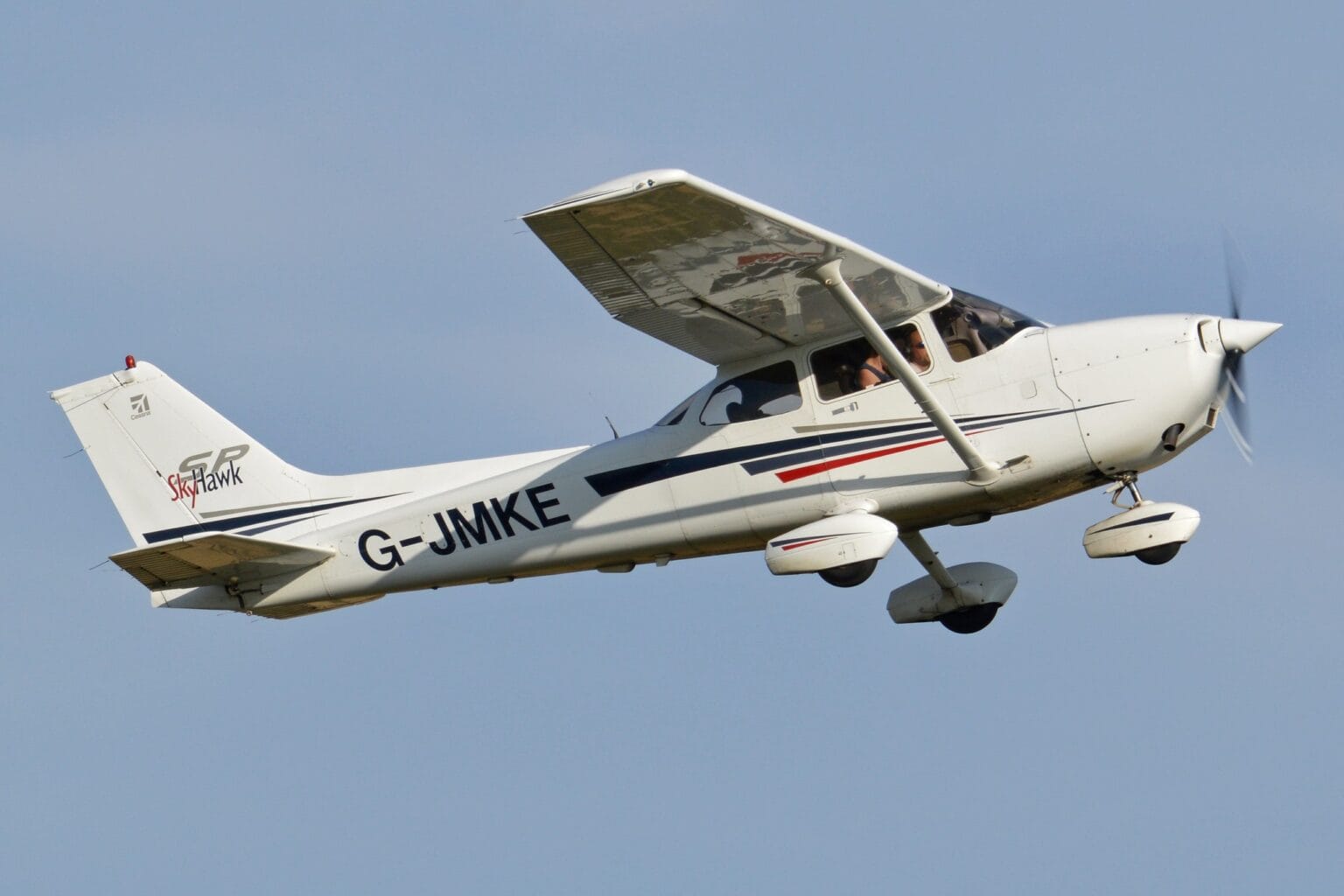
A small plane lifts off, the nose pitched up, climbing at little more than its slowest safe speed. A few hundred feet above the trees, the engine coughs, surges, or simply goes quiet.
The runway the pilot just left is right there, behind them. Every instinct says to turn around and land on it.
That instinct has killed a lot of pilots. Here is why the first minute of a flight is the worst moment to lose an engine in a single-engine airplane, why the turn back is called “the impossible turn,” and what pilots are trained to do instead.
Why Is Engine Failure After Takeoff So Dangerous?
Because it arrives when the airplane has the least of everything a pilot needs to handle it: height, speed and time. The plane is low, slow and nose-high, so it starts losing airspeed the instant the power goes, and there may be only seconds before the wing stalls.
The usual answer, landing straight ahead or slightly to one side, is unpleasant but survivable. The FAA’s Airplane Flying Handbook says it “usually represents the option with the lowest risk.” The deadly outcome tends to come from the alternative: a steep, slow turn back toward the runway, close to the ground.
The riskiest minute, at a glance
Why it is hard: the airplane is low, slow and pitched up for the climb, so airspeed bleeds away fast once the engine stops. The first job: lower the nose to the glide attitude. The safest default: land ahead or slightly to the side, under control and as slowly as possible. The trap: turning back to the runway, which takes far more than 180 degrees of turn, raises the stall speed and costs height the airplane may not have.
Low, Slow and Nose-Up: Why the First Seconds Decide It
In cruise, an engine failure in a light single usually leaves thousands of feet of height to glide, troubleshoot and pick a field. In the initial climb, the same airplane may have a few hundred feet, and it is flying in the attitude that loses speed fastest when the thrust disappears.
That is why the Airplane Flying Handbook puts one action first: “lower the nose of the airplane and establish the proper glide attitude.” Hold the climb attitude without power and the wing slows toward a stall, at a height too low to recover from one.
The pilot also has to notice the problem and believe it. A 2016 FAA training aid on engine failure after takeoff says startle responses during exactly this kind of surprise “have contributed to loss of control of aircraft.” Barry Schiff, testing turnbacks for AOPA, allowed four seconds simply to recognize the failure before doing anything.
Partial power brings its own trap. An engine that is still running but weak tempts the pilot to keep climbing or to nurse the airplane back to the runway, while the climb rate quietly falls away.
The numbers show where the risk sits. AOPA’s Air Safety Institute counted 929 accidents in non-commercial fixed-wing flying in 2023, 156 of them fatal, and found that takeoff and climb accidents “showed a higher concentration of fatal outcomes.”
The Impossible Turn: Why the Runway Is Farther Away Than It Looks
Turning back sounds like a 180-degree problem: reverse course and land on the runway you just used. It is not, because an airplane turns along a curve with a real radius, and that curve ends to one side of the runway, not on it.
The FAA’s own textbook example makes the point brutally. An airplane climbs to 300 feet (91 m) above the ground, the engine fails, and after a 4-second reaction the pilot starts a gentle standard-rate turn, the kind used every day in normal flying.
At a 65-knot glide, that turn has a radius of 2,100 feet (640 m), so after 180 degrees the airplane is 4,200 feet (1,280 m) to the side of the runway. The pilot needs another 45 degrees to point back at it, for 225 degrees of turning in all.
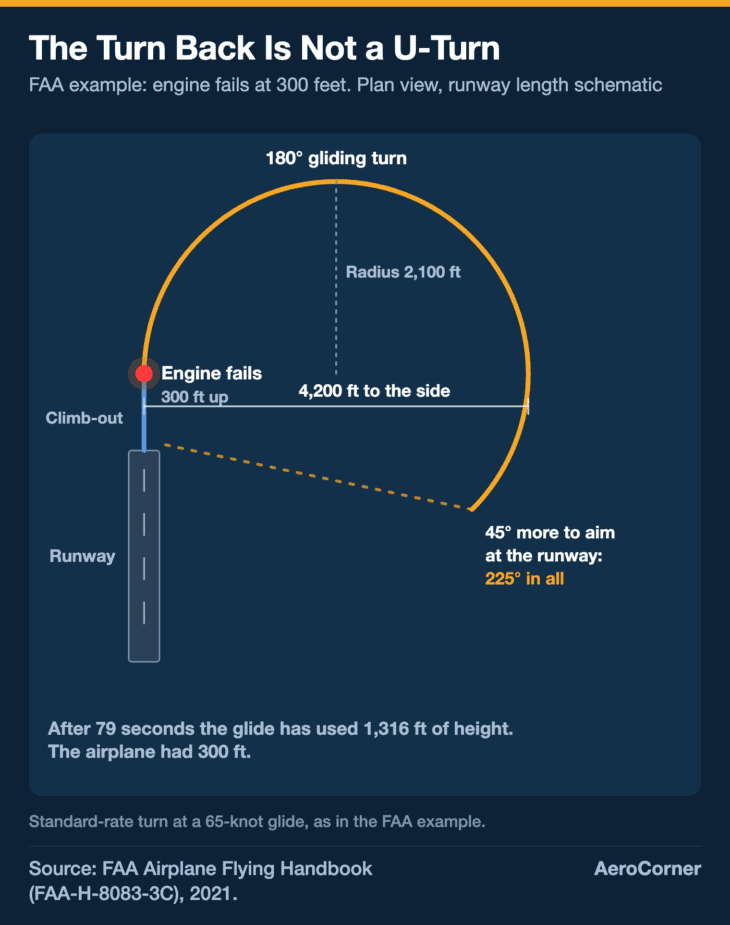
That takes 75 seconds, plus the 4 seconds of reaction. Gliding down at about 1,000 feet per minute, the airplane descends 1,316 feet, which in the handbook’s words places it “1,016 feet below the runway.” It had only 300 feet to begin with.
Schiff found the same thing in flight testing. A Cessna 172L lost about 300 feet in a 45-degree-banked 180-degree turn, including the 4-second delay, but needed about 450 feet to actually get back to the runway, because lining up takes at least 30 degrees more turn and then 30 degrees back.
Why Banking Harder Is Its Own Trap
The handbook’s conclusion from its example is that a turn back, if attempted, needs a steeper bank: a gentle turn simply takes too long.
Schiff’s numbers agree. At a 30-degree bank the turn rate is about 9 degrees per second, so 180 degrees takes 20 seconds, and the 172 lost 380 feet with a shallow bank but only 210 feet at 75 degrees.
The catch is that bank raises the speed at which the wing stalls. In a level turn, the wing has to carry more than the airplane’s weight, and the stall speed rises with it, gently at first and then very steeply.
| Bank angle | Stall speed rise vs wings level | Source |
|---|---|---|
| 30° | About 6% (50 to 53 knots, Cessna 172L) | Barry Schiff, AOPA |
| 45° | 19% | Barry Schiff, AOPA |
| 60° | 41% (a 2G level turn) | NTSB |
| 75° | 97% | Barry Schiff, AOPA |
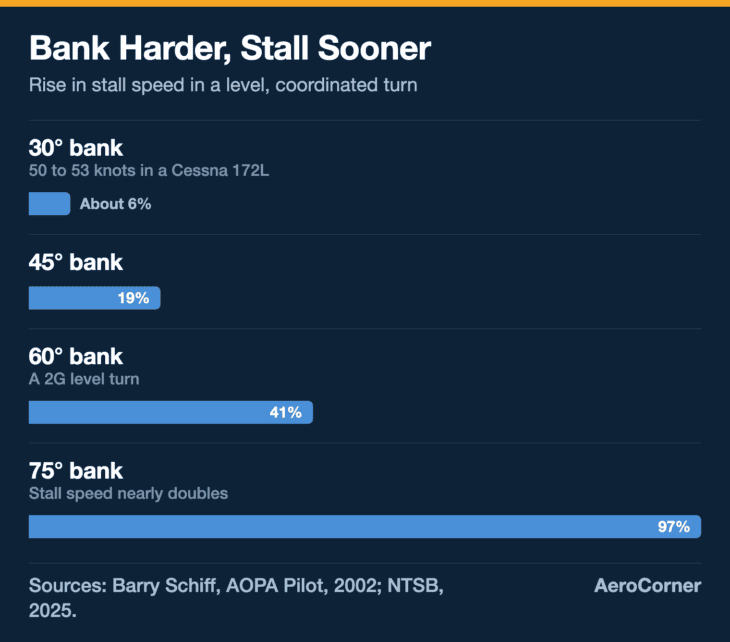
So the pilot is squeezed from both sides. A shallow turn loses too much height, while a steep one pushes the stall speed up toward the speed the airplane is already flying, with the ground close enough that every instinct says to pull the nose up.
The handbook spells out the result: if the pilot does not lower the nose enough during the turn, “an accelerated stall and fatal crash may occur.” At a few hundred feet there is no room to recover.
The handbook lists other ways a turn back goes wrong. A wing that strikes the ground during the turn can cartwheel the airplane. A successful turn often leaves a downwind landing, at a higher groundspeed that raises the chance of serious injury if the airplane does not make the field.
Our guide to how a wing stalls at high speed explains why speed alone does not protect against it.
What Pilots Are Taught to Do Instead
The default is to land ahead, or slightly to the side of the takeoff path. The handbook’s reasoning is that it gives the pilot time to set up a safe landing attitude, and the airplane touches down “under control and as slowly as possible,” usually into the wind it took off into.
The decision is meant to be made on the ground. The FAA’s 2016 training aid tells pilots to brief, before every takeoff, the speeds, the obstacles, and their plan for an engine failure during and after the takeoff.
It also suggests an abort point: if the airplane has not reached 70% of its takeoff speed by the runway’s midpoint, stop.
Fly the airplane into the crash
Touching down in a field, or even in trees, under control, wings level and as slowly as possible minimizes the risk of injury, in the FAA handbook’s words. A stall at low height takes that control away. That is why the handbook calls the straight-ahead option usually the safest one, even when the ground ahead looks uninviting.
Owners of the Cirrus SR22 and its siblings have a third option: an airframe parachute. Cirrus’s training syllabus splits a takeoff engine failure into bands: at or below 500 feet (600 feet on the G5 model), land straight ahead; from there to 2,000 feet, pull the parachute immediately; above 2,000 feet, troubleshoot.
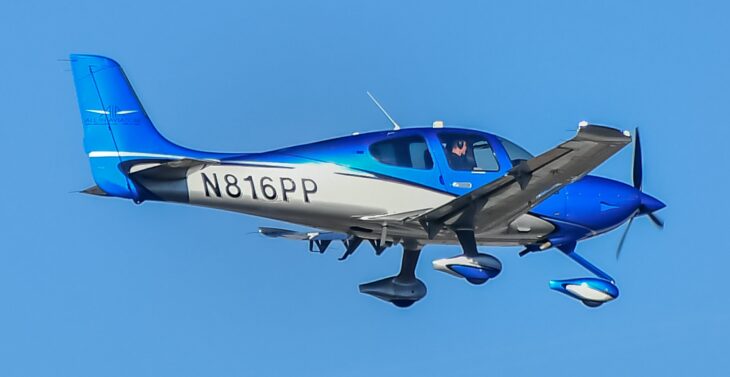
The same syllabus has pilots call out “CAPS available” as they climb through that lower boundary, so the choice at each height is already made before it is needed. It says a pilot who rehearses the options before takeoff “has a higher likelihood of a successful outcome.”
The Myth vs the Reality
Myth: the runway is right behind you
It feels like a half turn away. In the FAA’s own example, a turn back from 300 feet needs 225 degrees of turning and ends with the airplane 1,016 feet below the runway. Getting back means a steep, slow, low-altitude turn, the exact recipe for a stall.
The opposite myth is also wrong: that turning back is never possible. The handbook says some airplanes “can usually return” and some can under certain conditions. AOPA’s Air Safety Institute flew turnback profiles in 2021 in a Piper Super Cub, a Van’s RV-4, a Cessna 172N and a Beechcraft Bonanza A36, and its team called the results “surprising.”
Official guidance has moved with it. The FAA’s flight instructor advisory circular, AC 61-83J, now tells instructors to teach “when and how to make a safe 180-degree turnback,” including the typical altitude loss for the make and model. Pilots are to brief that loss, “plus a sufficient safety factor,” before takeoff.
Schiff’s rule of thumb for that factor is to measure the height a given airplane loses in the turn at a safe altitude, then add at least half again.
The handbook is blunter still: a pilot “should not attempt a turn back unless a successful turn back will result,” and for student, low-time and out-of-practice pilots it is an “unacceptable risk.”
Experience is no guarantee. On October 1, 2023, a Cessna 177RG lost partial power on takeoff from Lake Placid, New York, then turned hard back toward the airport at a few hundred feet and stalled. Both pilots aboard died, among them Richard McSpadden, who had led AOPA’s Air Safety Institute.
The NTSB found a partial loss of power for reasons it could not determine, with inadequate weight and balance planning and “aggressive low altitude maneuvering” as contributing factors. At the stall, its data showed the airplane at 52 knots in a 39-degree bank, still heading away from the runway.
Why It Is in the News
The question comes up every time a small plane goes down near an airport. On November 3, 2026, a Cirrus SR22 crashed shortly after takeoff from Lee C. Fine Memorial Airport at Lake of the Ozarks, Missouri, killing the two people aboard, after a reported mayday call.
What prompted that call has not been reported, and nothing public says the engine failed. That is for the NTSB to establish, and its preliminary report is the place to look for it.
What is known is why this minute of flight is so unforgiving, and why the answer to it is decided on the ground. A pilot who has already said out loud “if it quits below this height, I land there” does not have to argue with instinct at 300 feet.
In a single-engine plane, that briefing is the difference between a forced landing and a stall.
Sources and references used for research and fact-checking.
- Federal Aviation Administration, Airplane Flying Handbook (FAA-H-8083-3C), Chapter 18: Emergency Procedures, Engine Failure After Takeoff (Single-Engine)
- FAA / General Aviation Joint Steering Committee, Aircraft Control After Engine Failure on Takeoff (training aid)
- AOPA, Engine out (Barry Schiff, AOPA Pilot, July 2002)
- National Transportation Safety Board, Aviation Investigation Final Report ERA24FA001, Cessna 177RG N545PZ, Lake Placid, New York
- AOPA, AOPA's Air Safety Institute releases video on crash that killed Richard McSpadden and Russ Francis
- AOPA Air Safety Institute, Reality Check: The Runway Behind You
- AOPA Air Safety Institute, Almost impossible
- Holding Pattern, Single-Engine Failure after Takeoff: The Anatomy of a Turnback Maneuver (Les Glatt, 2020)
- Cirrus Aircraft, CAPS Syllabus, Pilot Edition
- AVweb, Report: GA Accident Rates Fall, Flights Increase
Get the Newsletter
The latest aviation news and stories sent to your inbox.
About the Author

Tim is the owner and lead editor of AeroCorner since 2019, overseeing aviation content covering aircraft, airlines, airports, and the broader aviation industry. Through years of researching, writing, editing, and publishing aviation-focused content, he has developed extensive practical knowledge of commercial aviation and air travel. Based in Asia and a frequent traveler himself, Tim also brings firsthand passenger experience to AeroCorner’s coverage. Outside of publishing, he has also explored aviation firsthand through hands-on flight training in New Zealand.