

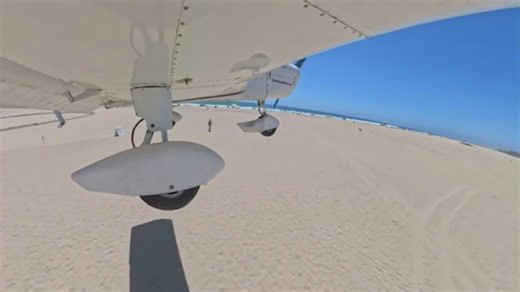
On July 28, 2026, a single-engine Piper PA-28 Cherokee made an emergency landing on the sand at Huntington State Beach in Southern California after its engine failed shortly after takeoff. The pilot and his teenage nephew walked away unhurt, and no beachgoers were injured, according to accounts the pilot and witnesses gave to local news stations.
A dead engine and a few seconds to decide
The airplane had departed John Wayne Airport in Santa Ana, bound for Van Nuys, when the engine quit about 1,000 feet above the ground, pilot Mike Bremner told local reporters. He said he immediately transmitted a distress call: “I just called, Mayday, Mayday, Mayday, that we lost our engine and that we were making a forced landing on Huntington Beach.”
With no runway within reach, Bremner set the airplane down on the sand near Magnolia Street and the Pacific Coast Highway, roughly 2 miles (3 km) south of the Huntington Beach Pier. Witnesses described a controlled, deliberate touchdown rather than a crash. “He made a perfect landing and I just couldn’t believe what I was seeing,” one bystander told CBS affiliate Live 5 News.
Bremner, a corporate pilot, was flying with his 16-year-old nephew, who was visiting from Canada. “I think we’re extremely fortunate,” he told ABC affiliate KABC, adding that pilots train for a forced landing but “you never really know what you’re going to do until it happens.” The FAA is investigating what caused the engine to fail.
Why engine failure right after takeoff is the moment pilots drill most
An engine failure just after takeoff is the most time-critical emergency in a single-engine airplane. The aircraft is low, slow, and has only a handful of places to go, so pilots rehearse it from their earliest lessons. A light trainer like the Cherokee, built by Piper, has one piston engine and no backup if it stops.

The core rule is counterintuitive. At low altitude, a pilot is trained to land more or less straight ahead rather than turn back toward the runway. That turn-back, known among pilots as the “impossible turn,” bleeds off altitude and airspeed and can end in a stall and spin. Picking a survivable surface ahead is usually the safer choice.
A powerless light airplane is not falling out of the sky, it is gliding. Held at the right speed, it trades altitude for distance in a predictable descent, giving the pilot a few seconds to choose the best available surface: a field, a road, or in this case an open stretch of beach.
A dead engine still glides
Without power, a small airplane like a PA-28 keeps flying forward, covering more than a mile of distance for every 1,000 feet of altitude at its best glide speed. That is what buys a pilot the time to pick a landing spot instead of simply coming down.
The contrast with airline flying is stark. A crew in a twin-engine jet that loses one engine still has a second one and can usually make a precautionary return to a nearby airport. A single-engine pilot at 1,000 feet has no such margin, which is exactly why the straight-ahead forced landing is taught as a reflex.
Reality check
The calm outcome reflects training as much as luck. Practicing forced landings is a required part of earning a private pilot certificate, and the straight-ahead touchdown Bremner described is precisely the result that training is built to produce.
Get the Newsletter
The latest aviation news and stories sent to your inbox.
About the Author
Tim is the owner and lead editor of AeroCorner since 2019, overseeing aviation content covering aircraft, airlines, airports, and the broader aviation industry. Through years of researching, writing, editing, and publishing aviation-focused content, he has developed extensive practical knowledge of commercial aviation and air travel. Based in Asia and a frequent traveler himself, Tim also brings firsthand passenger experience to AeroCorner’s coverage. Outside of publishing, he has also explored aviation firsthand through hands-on flight training in New Zealand.