

Table of Contents
On May 28, 1971, a twin-engine Aero Commander carrying Audie Murphy, America’s most decorated soldier of World War II, flew into a cloud-covered ridge about 14 nautical miles (26 km) northwest of Roanoke, Virginia. Murphy, 45, died with the pilot, Herman Butler, and four other passengers: Claude Crosby, Raymond Prater, Jack Littleton and Kim Dodey.
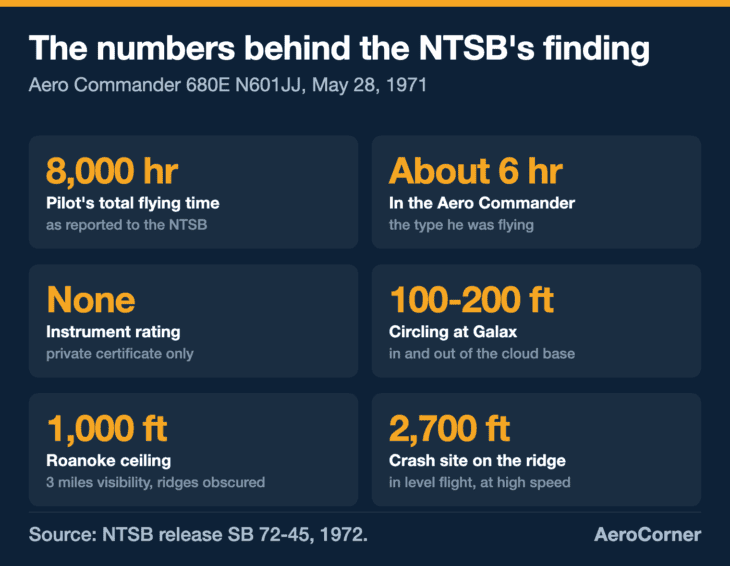
The crash is usually told as an experienced pilot caught by a storm with zero visibility. The record is narrower. Butler had some 8,000 hours, but no instrument rating and only about 6 hours in the Aero Commander, and the weather at Roanoke was exactly the legal minimum for visual flight.
This article is built from the National Transportation Safety Board’s release SB 72-45 of June 15, 1972, which announced the Board’s report on the crash (file IAD71AI055), and from the FAA registration record for the airplane, N601JJ.
May 27, 1971
Positioning. The Aero Commander flies from Denver to Atlanta to pick up Murphy’s party.
May 28, 9:10 a.m.
Departure. After a telephone weather briefing, the pilot leaves DeKalb Peachtree Airport, Atlanta, under visual flight rules for Martinsville, Virginia. No flight plan is filed.
About 11:30 a.m.
Galax. Witnesses about 45 miles west of Martinsville see the airplane circling in and out of the cloud base at 100 to 200 feet for about 20 minutes. It makes an unsuccessful attempt to land on a four-lane highway bypass.
11:49 a.m.
Roanoke radio. The pilot calls the FAA’s Roanoke Flight Service Station without giving his position. He is told the ceiling is 1,000 feet broken, visibility 3 miles, “mountain ridges obscured”, and says he will land at Roanoke. It is the last contact.
12:08 p.m.
The ridge. Heading 100 degrees toward the Roanoke VORTAC in level flight, the airplane strikes trees at the 2,700-foot level on the western side of Brushy Mountain. All six aboard die.
May 28, afternoon
Missing. Friends waiting at Martinsville learn the flight had changed destination. When it does not reach Roanoke, a search begins.
May 31, 1971
Found. After three days of poor weather, a Civil Air Patrol crew spots the wreckage near the top of the ridge.
June 15, 1972
The finding. The NTSB issues its report and probable cause.
What happened
By 1971, Murphy’s film career had faded and he had gone through bankruptcy. He had become a director of Telestar Leisure Investments, a holding company, and his job on this trip was to look at a business it might back.


That business was Modular Properties, whose plant in Martinsville, Virginia, built prefabricated homes and motels. Claude Crosby, president of its Modular Management arm, flew with him, along with Raymond Prater, a Chattanooga attorney for that company, and Jack Littleton, who represented a group of investors. Kim Dodey, a friend of Littleton’s, joined the flight at the last moment.
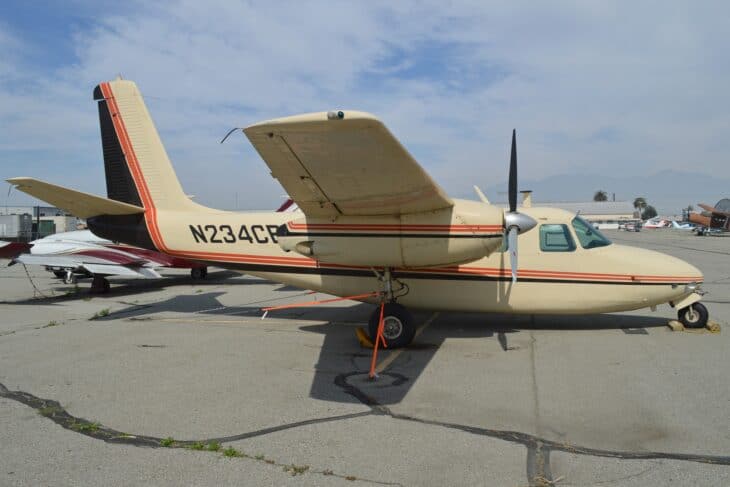
The airplane was an Aero Commander 680E, a high-wing piston twin that the NTSB release says belonged to Colorado Aviation, Inc. The FAA record for N601JJ, serial 680-491-161, lists the same company. Its pilot, Herman Butler, was the company’s secretary.

Butler phoned for a briefing before takeoff and, according to the NTSB, received “all of the pertinent weather and winds aloft required for the flight”. He left Atlanta at 9:10 a.m. under visual flight rules. He filed no flight plan and, as far as the record shows, made no contact with any FAA en route facility for the next 2 hours 39 minutes.
A low-pressure system lay over the route. At Galax, Virginia, witnesses watched the Aero Commander circle in and out of the cloud base at 100 to 200 feet in fog and rain for about 20 minutes. Butler then tried, and failed, to land on a four-lane highway bypass northwest of the town.
At 11:49 a.m. he called the Roanoke Flight Service Station. He was given a measured ceiling of 1,000 feet broken, 2,500 feet overcast, 3 miles visibility in light rain and fog, and the remark “mountain ridges obscured”. He said he would land at Roanoke, took the altimeter setting of 30.11 inches, and was not heard from again.
Nineteen minutes later, the airplane struck two large trees on a steep, wooded slope and hit the ground at the 2,700-foot level. Because there was no flight plan and the weather stayed low, searchers did not find it until May 31.
What the NTSB found
The Board’s probable cause reads: “the pilot’s attempt to continue visual flight into adverse weather conditions at an altitude too low to clear the mountainous terrain. The Board also finds that the pilot attempted to continue flight into instrument weather conditions which were beyond his operational capabilities.”
The airplane was not the problem. The Board found no evidence of failure or malfunction in the structure, systems or engines before impact. Every navigation aid at Roanoke was working: the VORTAC, the instrument landing system, a non-directional beacon and the airport surveillance radar.
The position of the wreck tells its own story. The Aero Commander was flying level at high speed on a heading of 100 degrees toward the Roanoke VORTAC, in an area the Board said would have been covered by low overcast.
Joseph Zacko, who led the NTSB team at the site, told reporters four days after the crash that the pilot was definitely not making an approach to Roanoke, as had first been thought.
Then comes the pilot. Butler held a private pilot certificate with single- and multi-engine land ratings, and no instrument rating. He was reported to have some 8,000 hours of flying, but only about 6 hours in Aero Commander aircraft.
The Board summed it up in one sentence. He tried to fly in weather “for which he was not properly certificated and for which he did not possess the requisite experience and ability”, and he also lacked experience in the Aero Commander and in flying around Roanoke and Martinsville.
What most accounts get wrong
The common version is a seasoned 8,000-hour pilot caught by a sudden storm with zero visibility, flying Murphy’s own plane. The NTSB record says otherwise on each point. The hours were not the qualification that mattered: Butler had no instrument rating and about 6 hours in the Aero Commander. The weather was not a surprise. He had a full briefing before takeoff, circled under the cloud at Galax for about 20 minutes, and was told at 11:49 that Roanoke had a 1,000-foot ceiling and 3 miles, the legal minimum for visual flight, with the ridges in cloud. The airplane was not Murphy’s either. The NTSB and the FAA register both list it under Colorado Aviation, Inc.
Why “legal VFR” in the valley meant cloud on the ridge
A pilot without an instrument rating has to stay out of cloud and see where he is going. The basic rule today, 14 CFR 91.155, bars visual flight beneath a ceiling of less than 1,000 feet near a controlled airport, and requires at least 3 miles of ground visibility to take off or land there.
Roanoke’s weather met that floor exactly. But a ceiling is measured above the airport, which sits in a valley, and the ridge northwest of the city was reported at 3,065 feet. The Flight Service Station’s remark, “mountain ridges obscured”, meant the tops were inside the cloud.
Pilots call what happens next scud running: staying low to keep the ground in sight as the cloud base comes down. The Galax sighting, an airplane at 100 to 200 feet weaving in and out of the cloud, is a textbook picture of it. In mountains, it fails, because the terrain rises into the same cloud the pilot is ducking.
An instrument flight rules (IFR) flight handles that problem with altitude. Under 14 CFR 91.177, where no published minimum applies, an IFR aircraft over designated mountainous terrain must stay 2,000 feet above the highest obstacle within 4 nautical miles of its course.
Such a flight goes through the cloud, well above the ridge, guided by navaids like the Roanoke VORTAC Butler was heading for.
Butler could not legally do that, and the Board found he had neither the training nor the experience to try. The record shows no sign of a loss of control. The airplane was flying level and fast on a steady heading, at an altitude that would have been safe in the valley and was not safe over Brushy Mountain.
The same pattern ended the Rocky Marciano plane crash two years earlier: a private pilot with no instrument rating, flying on under a low overcast.
What changed
We found no rule or NTSB recommendation that traces back to this crash. The release names no defect in the airplane, the navaids or air traffic control, and announces no recommendation. The cause was a pilot’s decision, and the rules that applied to it already existed.
Training is the part that is different now. Under 14 CFR 61.109, a private pilot applicant must log at least 3 hours of training in controlling an airplane solely by reference to instruments, including recovery from unusual attitudes.
That training is meant to get a pilot out of cloud he has blundered into. It does not qualify him to fly in it.
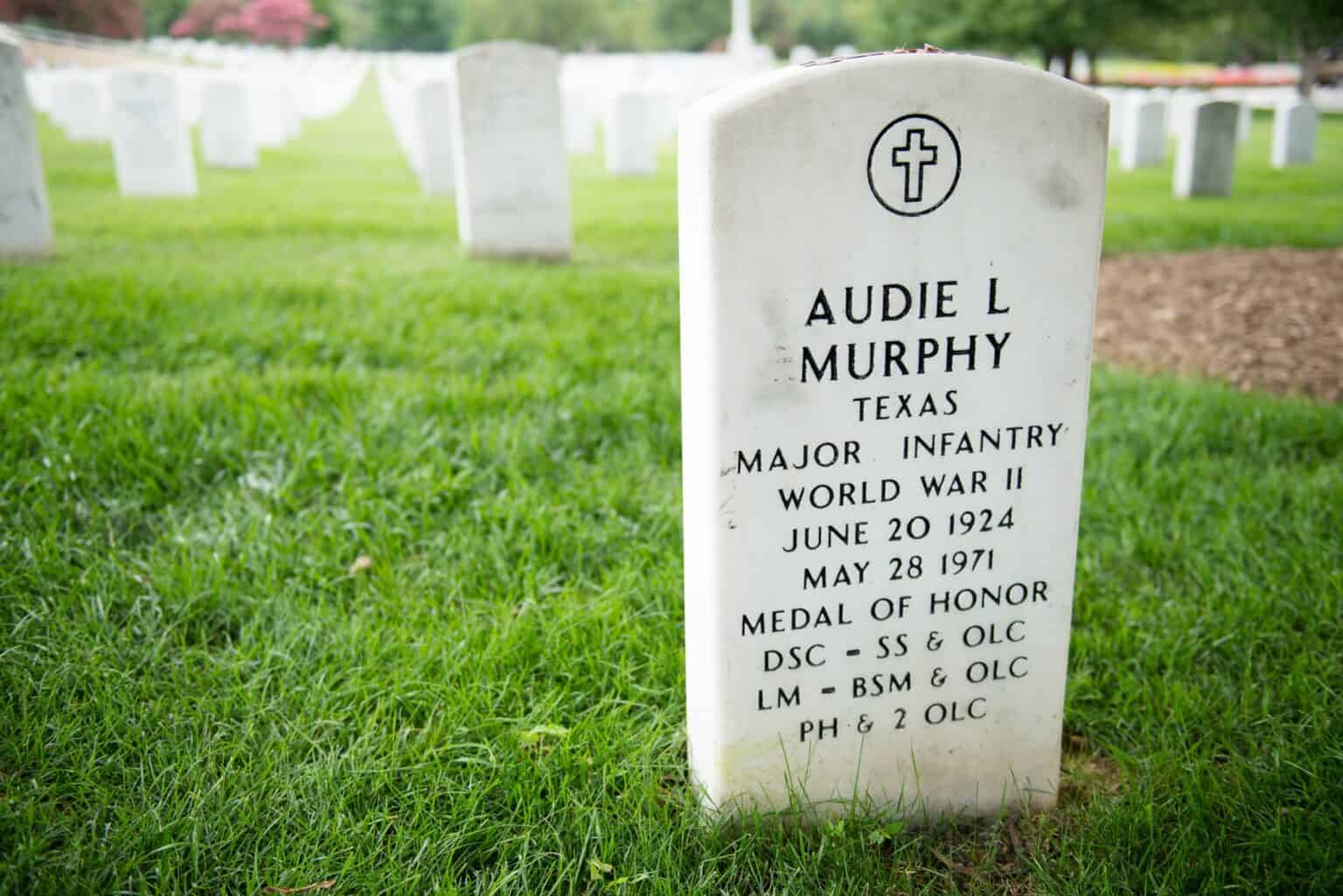
Murphy’s family sued, and in December 1975 a jury awarded them $2.5 million against Colorado Aviation, according to accounts of the case. Murphy himself was buried with military honors at Arlington National Cemetery on June 7, 1971. His grave is the cemetery’s second most visited, after that of President John F. Kennedy.
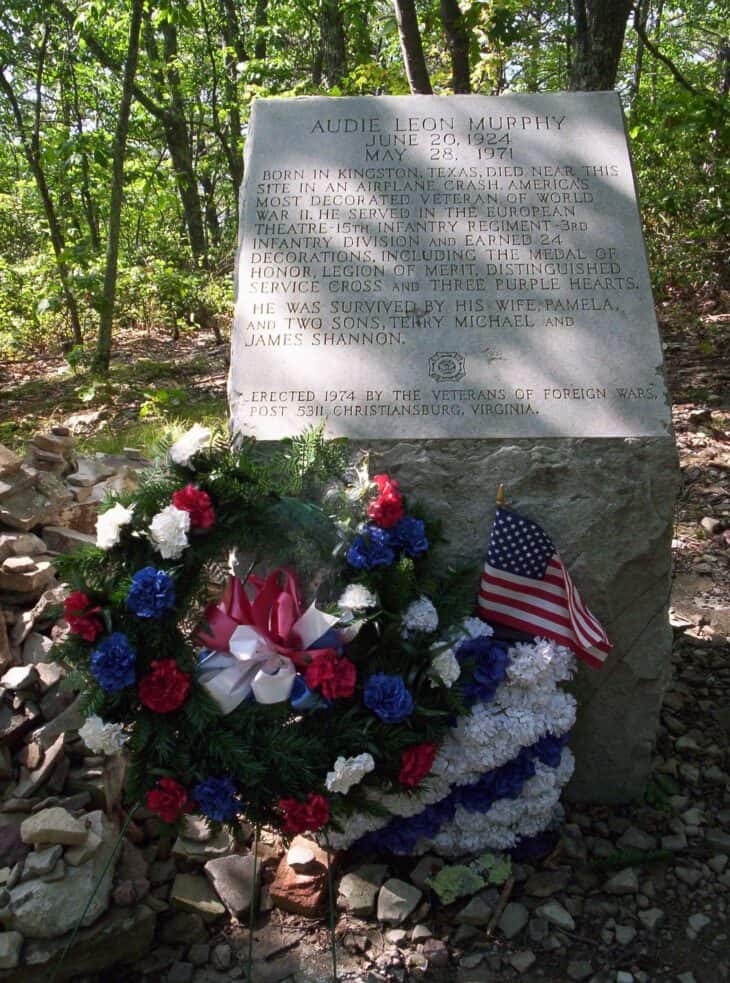
The mountain kept his name. A Veterans of Foreign Wars post placed a memorial stone near the crash site in 1974, and the Appalachian Trail was later rerouted along the ridge past it. The NTSB called the ridge Brushy Mountain; the memorial and most maps say Brush Mountain.

The registration had a longer life than the airplane. The FAA cancelled N601JJ under Colorado Aviation on August 24, 1971, and the number has since been issued to other aircraft. A registry search today returns those later records, not the Aero Commander.
FAQ
Sources and references used for research and fact-checking.
- National Transportation Safety Board (copy held by the Audie Murphy National Fan Club), NTSB release SB 72-45: report on the crash of Aero Commander 680E, Roanoke, Virginia, May 28, 1971 (file IAD71AI055)
- Federal Aviation Administration, Releasable Aircraft Database (DEREG and RESERVED files), N601JJ
- Audie Murphy National Fan Club archive, Murphy Death Crash Probe Continues (AP), Houston Chronicle, June 2, 1971
- Check-Six.com, The End of a Soldier's Long March: The Crash of Audie Murphy's Aero Commander
- Wikipedia, 1971 Colorado Aviation Aero Commander 680 crash
- Wikipedia, Audie Murphy
- Appalachian Trail Histories, Walking by History: Who is Audie Murphy
- Cornell Legal Information Institute, 14 CFR 91.155, Basic VFR weather minimums
- Cornell Legal Information Institute, 14 CFR 91.177, Minimum altitudes for IFR operations
- Cornell Legal Information Institute, 14 CFR 61.109, Aeronautical experience
Get the Newsletter
The latest aviation news and stories sent to your inbox.
About the Author

Tim is the owner and lead editor of AeroCorner since 2019, overseeing aviation content covering aircraft, airlines, airports, and the broader aviation industry. Through years of researching, writing, editing, and publishing aviation-focused content, he has developed extensive practical knowledge of commercial aviation and air travel. Based in Asia and a frequent traveler himself, Tim also brings firsthand passenger experience to AeroCorner’s coverage. Outside of publishing, he has also explored aviation firsthand through hands-on flight training in New Zealand.