Military Helicopters
Sikorsky HH-3F Pelican
ICAO: HH3F
The Sikorsky MH-53E Sea Dragon is the U.S. Navy's three-engine airborne mine countermeasures helicopter, the heavy tow platform that swept mines for more than three decades and is now in its final years of service.
Updated: by Tim de Vries

The latest aviation news and stories sent to your inbox.
The Sikorsky MH-53E Sea Dragon is the Navy’s heavy mine countermeasures helicopter, a CH-53E Super Stallion airframe with enlarged fuel sponsons, a digital flight-control system tuned for towing, and a refueling probe. It first flew in 1981, entered Navy service in 1986 and was exported to Japan. By late 2026 only one Navy squadron, HM-15, still flies it, with the last aircraft scheduled to retire in 2027.
Live Fleet Activity (H53E)
Fetching live data…


The Sikorsky MH-53E Sea Dragon is the U.S. Navy’s long-range airborne mine countermeasures helicopter. It is a variant of the CH-53E Super Stallion, built by Sikorsky as the S-80M.
It hunts mines with sonar, sweeps them with towed gear and also moves heavy cargo for the fleet. The full specification table for the aircraft is on this page.
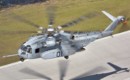
The MH-53E keeps the three-engine, seven-blade layout of the Marine Corps Super Stallion. Sikorsky added enlarged sponsons for much more fuel and endurance, and the helicopter kept its in-flight refueling probe.
Its digital flight-control system has features designed to help it tow minesweeping gear. Up to seven 300-US-gallon ferry tanks can also be fitted inside the cabin.
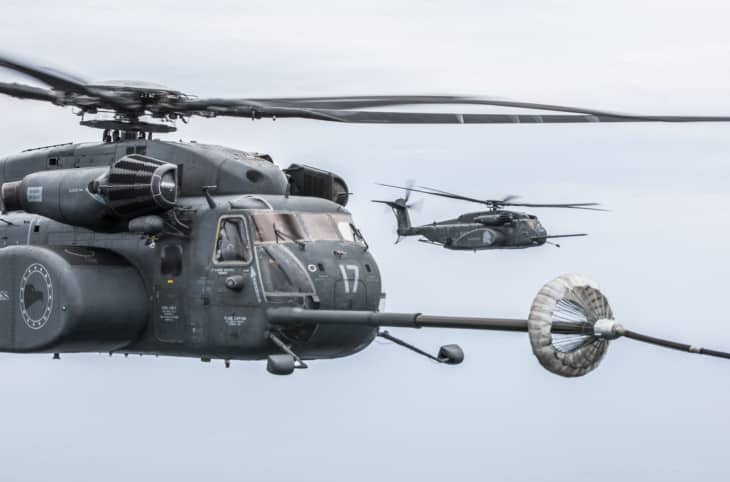
The prototype MH-53E first flew on 23 December 1981, and the Navy began using the type in 1986. The Navy took 50 MH-53Es, and Japan received 11 as the S-80M, with deliveries starting in 1989.
Japan’s Maritime Self-Defense Force retired its last Sea Dragons in 2017. During Operation Desert Storm, shipboard Sea Dragons cleared mines in the Persian Gulf off Kuwait.
A former Sea Dragon pilot describes the AN/AQS-14 side-looking sonar as the hunting tool. Sweeping uses towed devices such as the Mk 104, the Mk 105 sled and the magnetic orange pipe.
Towing is precise, low work. According to a former Sea Dragon pilot writing for The War Zone, the helicopter flies 25 to 75 feet above the water at 18 to 25 knots while holding a tow tension of about 15,000 to 20,000 pounds.
Three engines supply the torque for that. The same pilot says the sponsons hold about 22,000 pounds of fuel, enough for roughly three and a half to four hours of mission time.

The speed row on the specification panel looks modest for a heavy helicopter. That is deliberate: The War Zone’s source says the Sea Dragon is held to 150 knots to preserve the airframe.
The engines are the same General Electric T64 family used across the H-53 line. Their power is listed per engine, so the helicopter has three times the figure shown.
The wing span row is the main rotor diameter, since a helicopter has no wing. It is the best single number for how much deck or ramp space the rotors need.
The Sea Dragon is not only a minehunter. It is also used for ship-to-shore transport and vertical onboard delivery, and the same pilot recalls carrying an F-14 engine, afterburner attached, inside the cabin.

The MH-53E has the highest accident rate of any Navy helicopter. A 2008 Associated Press report counted 27 deaths between 1984 and 2008, and a class A mishap rate of 5.96 per 100,000 flight hours against a Navy helicopter average of 2.26.
After a 2000 crash near Corpus Christi, the fleet returned to service with improved swashplate duplex bearings and new warning systems. The same pilot describes about 24 maintenance hours for every flight hour, and more than 600 people to support a full squadron of 10 aircraft.
The Navy folded HM-14 into HM-15, with deactivation set for 31 July 2023. HM-12 held its sundown ceremony at Naval Station Norfolk on 21 March 2025, leaving HM-15 as the last Navy squadron flying the Sea Dragon.
In an article updated in June 2026, The War Zone reports that the last 11 aircraft are scheduled to sunset sometime next year, meaning 2027. The MH-60S Seahawk and uncrewed systems are taking over, though the MH-60S cannot tow the largest sleds.
No HM-15 sundown date had been confirmed in the sources we checked, so treat 2027 as a schedule rather than a fixed date.
No, but they share a core airframe. The Sea Dragon adds enlarged fuel sponsons, a flight-control system designed for towing and a mine countermeasures role.
Wikipedia lists 50 built for the U.S. Navy. A further 11 were built for Japan as the S-80M.
Yes, but only just. HM-15 is the last Navy squadron flying it, and the last 11 aircraft are scheduled to retire in 2027.
Its main job is airborne mine countermeasures, hunting mines with sonar and sweeping them with towed sleds. It also does heavy-lift transport and vertical onboard delivery for the fleet.
Not realistically. The CH-53 family is built for military customers, and the Sea Dragon is a Navy mine countermeasures aircraft that is being retired rather than sold.
The MH-60S Seahawk, paired with new mine countermeasures systems and uncrewed underwater and surface vessels. Per a former pilot, it can do the mission but cannot tow the large sleds the Sea Dragon can.
Sources and references used for research and fact-checking.