Heavy Business Jets
Airbus A340 Private Jet
ICAO: A343
A Palace in the Sky — Luxury on the World’s Largest Airliner
The latest aviation news and stories sent to your inbox.
When the double-deck Airbus A380 is transformed into a private jet, it becomes something unlike anything else in aviation — a flying mansion with space for bedrooms, lounges, dining halls, offices, and even spa suites. The Airbus A380 Private Jet is the ultimate expression of airborne luxury, built for people who redefine what “first class” means.
Live Fleet Activity (A388)
Fetching live data…
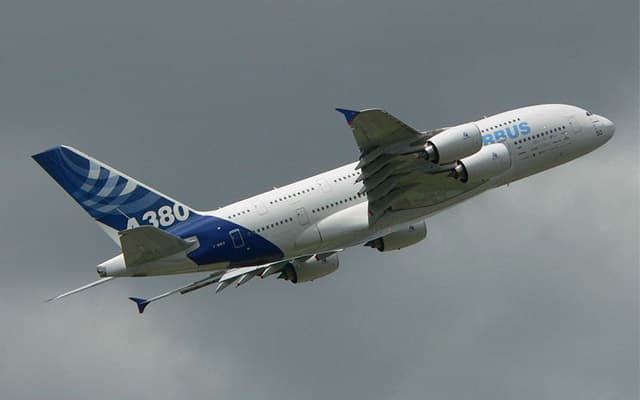
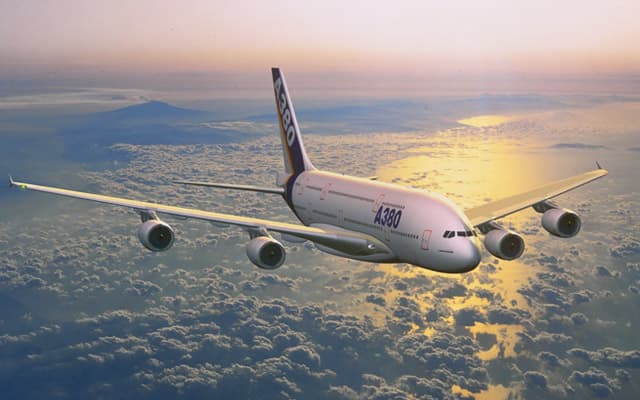
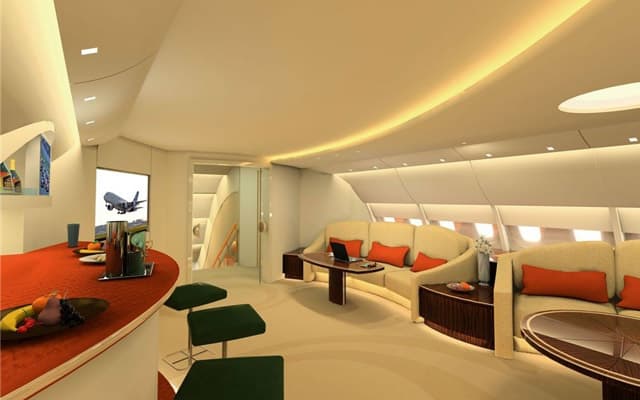
The Airbus A380 Private Jet, often marketed as the A380 Prestige or ACJ380, is the VIP and head-of-state version of the world’s largest passenger aircraft. Based on the A380-800 platform, it offers more interior space than any other private jet — with nearly 6,000 square feet (≈550 m²) of cabin area across two full-length decks.
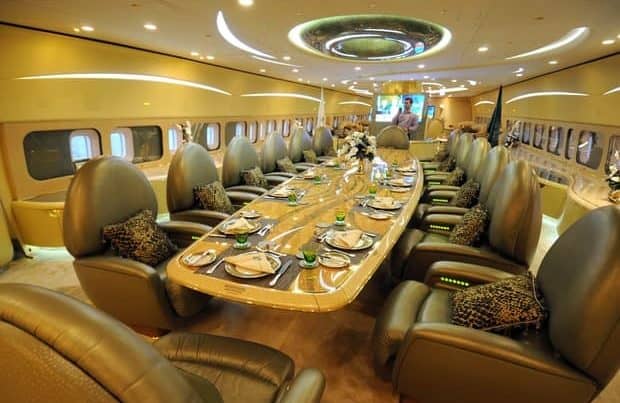
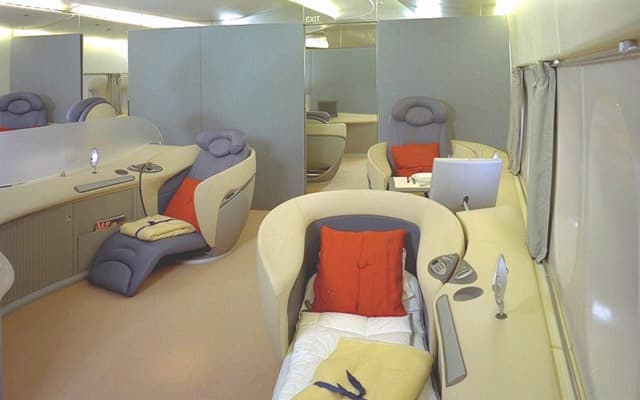
This extraordinary space allows owners to design layouts that go far beyond traditional VIP configurations. A typical A380 private jet concept includes multiple bedrooms, private suites, a grand lounge, conference rooms, a dining area, spa or wellness zones, and dedicated crew quarters. Some concepts even include elevators between decks and walk-in wardrobes, creating a level of comfort comparable to a luxury penthouse or superyacht.
The A380’s long-range capability enables nonstop travel between almost any major global city pair. Quad-engine redundancy and advanced flight systems provide reliability favored by governments and royal families, who are the primary clients for such large VIP conversions.
While no A380 has yet flown as a fully completed private jet, several airframes were ordered for VIP conversion, and at least one was partially outfitted before the project was canceled. The aircraft’s sheer size, cost, and customization complexity have limited demand, but the concept remains the pinnacle of airborne luxury.
The Airbus A380 Private Jet stands as a symbol of what is possible when engineering scale meets personal luxury — a flying residence that redefines the upper limits of private aviation.
Interest in a VIP variant of the double-deck widebody arose from Airbus sales efforts to extend its corporate jet family into the ultra-large cabin segment. The intent was to offer an alternative to purpose-built airliners and converted widebodies by providing a turnkey platform capable of accommodating full residential-scale interiors. Program planning emphasized factory cooperation with completion centers rather than offering only raw airframes.
Preliminary design work evaluated structural interfaces for large-scale interior installations, operator-specific systems integration, and the logistics of long-duration habitability at high altitudes. Engineers considered modifications to environmental control systems, plumbing, and galley support to sustain multiple residential zones. Attention also fell on regulatory compliance for novel internal arrangements such as large private suites and internal elevators.
Prototyping concepts included mockups and cabin demonstrators intended for customer review rather than flight test validation. These mockups were used to refine stowage, service flows, and emergency egress provisions unique to a multi-room, multi-deck private interior. Certification planning addressed the need to maintain airworthiness while permitting nonstandard furnishings and fixed interior partitions.
Production planning assumed limited serial conversions rather than high-rate manufacturing. Airbus and third-party completions providers discussed partnering models whereby conversion work could be carried out at specialized facilities with experience in VIP completions, allowing operators to obtain factory support for systems integration and certification oversight.
The conversion approach treats the base airframe as a secure, pressurized shell while replacing airline-standard fittings with residential-scale components. Structural attachment points for heavy furniture, large partitions, and elevators are reinforced to distribute concentrated loads into the primary structure. Cabin layout emphasizes circulation continuity between decks with bridges and passageways arranged for both crew operations and guest privacy.
Systems engineering centers on redundancy and habitability. Environmental control units receive upgraded filtration and distribution to serve segmented living areas. Water treatment and waste management systems are scaled to domestic-level demands, and galley design accommodates full-size appliances and refrigeration units suited to long-range international travel. A dedicated service corridor is often retained to isolate crew movements from guest spaces.
Avionics philosophy follows the base model while accommodating bespoke communications and security suites. Satellite communications, secure data links, and extensive cabin control networks are integrated into cockpit avionics interfaces where permissible. Interior systems are zoned for independent control of lighting, climate, and audiovisual elements so that private suites operate independently of public areas.
Distinguishing features in concept designs include full-height partitions creating separate rooms, built-in closets and wardrobes, and areas designed for prolonged occupancy such as offices and medical suites. Noise attenuation and vibration isolation are enhanced through additional acoustic insulation and specialized mounting for heavy fixtures to preserve onboard comfort during extended flights.
Converting a large airliner to a private configuration alters operational weight and center of gravity, which affects range and payload tradeoffs. The removal of high-density seating reduces occupant count but not necessarily weight, since residential furnishings and additional systems add significant mass. Operators and completion centers evaluate tradeoffs between interior fitment weight and fuel capacity to achieve desired nonstop routing.
Cruise characteristics remain consistent with the base aircraft in terms of typical airspeed and service ceiling, while takeoff and landing performance depend on final operating weight and airport runway capabilities. High gross weights resulting from heavy interiors and full fuel loads may impose runway length or weight restriction considerations at some airports.
Endurance for long ferry legs or nonstop intercontinental flights is a planning parameter driven by fuel reserves and cabin service provisioning. Extended-range options such as auxiliary fuel tanks were considered in some concepts to increase nonstop capability, but any modification that affects fuel system certification requires detailed analysis and approval.
Operational limitations for a very large private configuration include increased ground handling complexity, specialized crew complement and training, and more extensive maintenance demands. Airports must provide suitable ramp access, hangar space, and passenger processing capabilities to accommodate an aircraft of this scale as a private transport.
The private-configuration concept is a direct interior conversion of the base twin-deck widebody rather than a separate production variant. Relationship to the production model centers on keeping the primary aerostructure, flight controls, and propulsion intact while modifying cabin systems and furnishings to owner specifications. Conversion pathways examined both factory-supported completions and third-party completion center processes.
Some completion proposals envisioned modular interior kits that could be adapted to operator needs with varying degrees of permanence. These ranged from semi-permanent fixtures that could be removed to restore higher-density seating to fully fixed installations optimizing long-term private use. Certification implications differ depending on whether components are considered transport category fittings or removable equipment.
No standardized subvariant family was established because each finished interior is highly individualized. As a consequence, completion documentation focused on demonstrating compliance for each bespoke configuration rather than producing a catalog of factory-approved interior packages.
Operators and potential customers for ultra-large private cabin conversions include state delegations, heads of state, and ultra-high-net-worth individuals seeking secure, long-range transport with extensive onboard accommodation. Operational planning for such users emphasizes discrete routing, enhanced onboard security systems, and the ability to support official functions inflight.
Deployment considerations prioritize airports with infrastructure to accept very large aircraft as private transports, including apron availability, secure handling, and VIP terminal access. Ground service requirements extend to larger-vehicle logistics for convoy-style support, provisioning of supplies for extended missions, and maintenance facilities capable of accommodating widebody airframes.
Fleet experience for large private transports highlights the importance of lifecycle costs and availability of specialized maintenance expertise. Heavy maintenance checks, component shops, and spares provisioning for a unique interior fit are factors that influence operational readiness and scheduling, prompting operators to plan for longer lead times and bespoke supply chains.
Commercial adoption of extremely large private conversions encountered market resistance due to high acquisition and operating costs, airport compatibility constraints, and the limited pool of potential operators with requisite infrastructure. Completion centers and operators studied niche business models such as charter operations for high-end corporate events, but general market uptake remained constrained by economics.
Marketing of ultra-large private conversions targeted the highest tier of corporate and state customers with emphasis on turnkey completions. Sales efforts highlighted the ability to create multi-room environments that support diplomatic functions and sustained long-haul travel without intermediate stops. Commercial offerings focused on bespoke contracting and long-term support agreements.
Service planning for potential commercial use addressed crew composition, provisioning, and turnover. Larger cabins require expanded service teams and accommodation for relief crews during international sectors. Operators and completion providers emphasized the need for robust maintenance and operational support packages as part of any commercial sale.
Charter operators and completion centers considered fractional or event-based charters as potential revenue models to offset ownership costs. Implementation of such models requires careful regulatory navigation to permit commercial passenger carriage under private-type certificates and to satisfy host nation rules for public transport operations.
The concept underscored practical limits of ultra-large private conversions, providing a case study in the cost, infrastructure, and regulatory demands associated with scaling VIP comforts to the size of a commercial airliner. Lessons learned informed completion center practices regarding systems integration, load path reinforcement, and certification approaches for large bespoke interiors.
Technically, the program reinforced integration standards for residential-scale systems in transport category aircraft, advancing techniques for acoustic treatment, distributed services, and cabin zoning. Completion experience contributed to procedures and documentation models used in later widebody VIP projects, particularly in managing complex system interfaces between flight-critical systems and noncertified furnishings.
The project also clarified market signaling for manufacturers and completions providers about demand thresholds for extreme luxury conversions. This informed subsequent product planning for smaller widebody and long-range narrowbody corporate offerings that balance private-cabin amenities with lower operational costs and broader airport access.
Sources and references used for research and fact-checking.