
Cargo Airplanes
A rebuilt Boeing Stratocruiser with a hinged nose, built to haul rocket stages.
Updated: by Tim de Vries

The latest aviation news and stories sent to your inbox.
The Super Guppy is a four-engine turboprop built to carry cargo that will not fit in anything else. Its entire nose swings open on a hinge so rocket stages, spacecraft and aircraft sections can be rolled straight in. Aero Spacelines built the first one in 1965 to feed NASA’s Apollo program, and NASA still flies the last airworthy example.
Live Fleet Activity (SGUP)
Fetching live data…


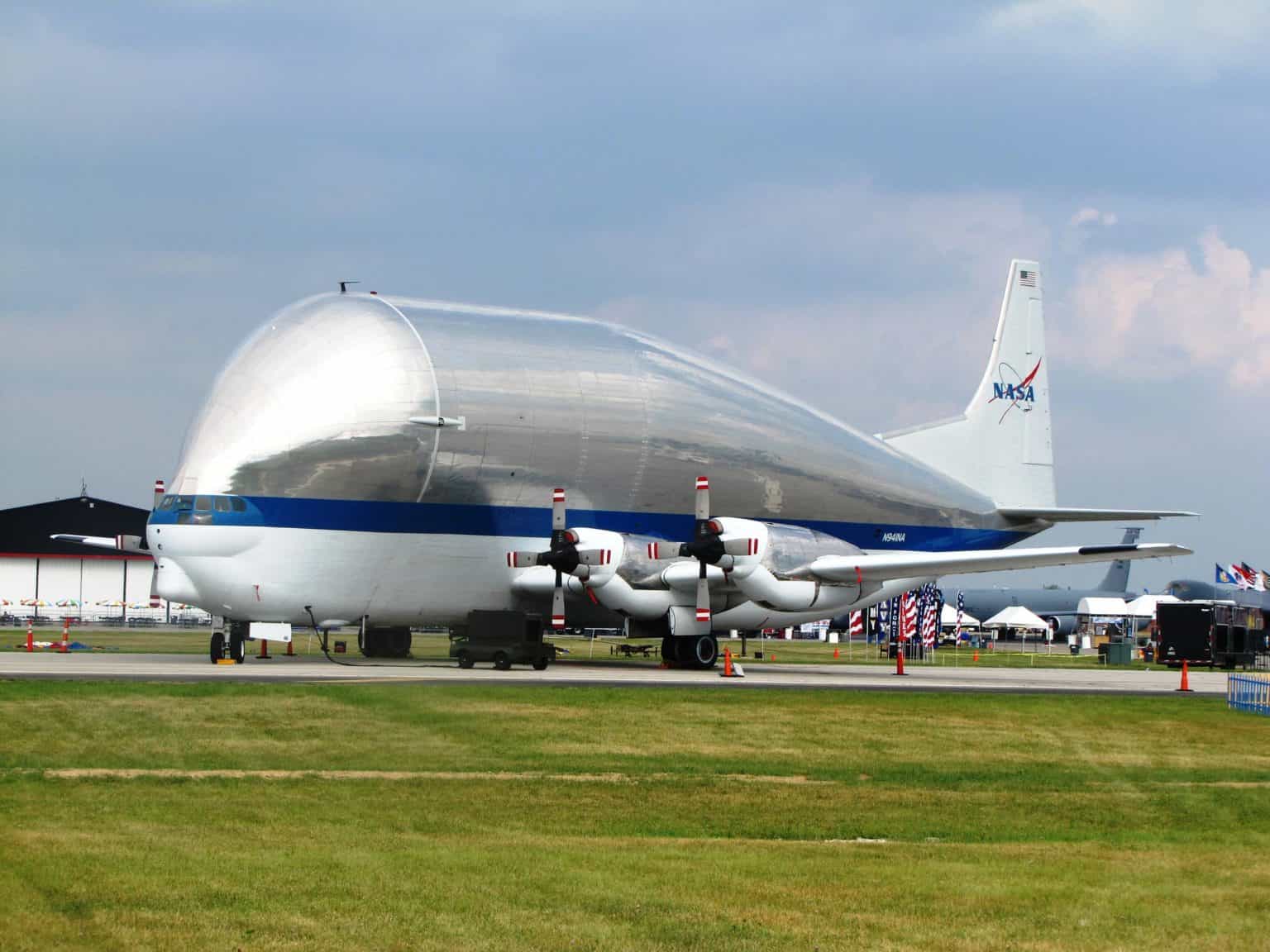


The Super Guppy is an oversize cargo aircraft built from a Boeing 377 Stratocruiser airliner, or its military twin, the C-97. Aero Spacelines gave it a huge bubble fuselage and a nose that swings open on a hinge, so cargo can be rolled straight in from the front.
It exists because rocket stages and spacecraft are too wide for any normal aircraft door and too tall for most roads, tunnels and bridges. NASA’s own description of the aircraft is a transport for components that cannot fit in conventional aircraft or travel overland.
Five Super Guppies were built in two variants: one original Super Guppy and four Super Guppy Turbines. Only one is still airworthy today, NASA’s N941NA.
The story starts with John M. Conroy, a former U.S. Air Force pilot who founded Aero Spacelines. He believed rebuilt Stratocruisers could fly rocket sections that otherwise crawled across the country by barge and rail.
His first aircraft, the Pregnant Guppy, made its first flight on September 19, 1962, with Conroy and test pilot Clay Lacy at the controls. It was built from a former Pan American Stratocruiser and was soon carrying Apollo hardware, including S-IVB rocket stages.

The larger Super Guppy followed. Its first flight was on August 31, 1965, and it was converted from a retired Air Force YC-97J.
The program nearly ended early. During certification tests on September 25, 1965, the upper fuselage collapsed in a high-speed dive, and the aircraft had to be rebuilt.
The original Super Guppy used Pratt & Whitney T34 turboprops. The Super Guppy Turbine, or SGT, is the version people mean today.
The SGT has four Allison 501-D22C turboprops, the commercial version of the T56 engine used on the C-130H and P-3. It also has a cargo section built almost entirely new, with a wider floor than the original.
Two of the four SGTs were built in France by Union de Transports Aeriens Industries, in 1982 and 1983. Airbus flew SGTs to move aircraft sections between its European factories until the Airbus Beluga took over. The Beluga can carry roughly twice as much cargo by weight.

NASA lists the cargo bay at 111 feet long and 25 feet across, in both width and height. The bay is not pressurized or climate controlled, so sensitive cargo has to be vented or conditioned.
The nose is hinged at the point where the fuselage splits and is swung aside by an electrically powered outrigger. NASA’s current user’s guide gives the swing as 100 degrees, while NASA’s web page and most other sources say 110.
The cargo floor sits about 11 feet above the ground, so a loader raises the pallet to deck height. An aircraft-mounted winch then pulls it in along floor rails, and hydraulic lock pins hold it for flight.

The full specification table for the aircraft is on this page. A few figures need context, because the headline versions of them get quoted against each other.
Start with payload. The table shows the maximum payload NASA’s user’s guide gives, but that is a best case. NASA notes the usable load shrinks with the route and the weather: roughly 48,000 pounds on a winter run along the U.S. East Coast, nearer 36,000 pounds on a summer flight across the country.
Range works the same way. The table lists the long-range figure published for the type, while NASA’s user’s guide lists a maximum range of 800 miles. Treat the long figure as a best-case flight and plan real missions around the shorter one.
Speed is the last one that surprises people. NASA’s user’s guide gives a cruise speed of 240 kt (276 mph, 444 km/h), which is turboprop pace, which is turboprop pace rather than jet pace.
The Super Guppy is credited as the only airplane to have carried a complete S-IVB, the third stage of the Saturn V rocket, and it did so several times during Apollo. and NASA says the original aircraft flew over three million miles across the Apollo, Gemini, Skylab and International Space Station programs.
Today’s NASA aircraft has carried space station components, rocket segments, test articles and aircraft. NASA’s pages name T-38 and V-22 sections among the Department of Defense cargo it has flown. The Osprey in NASA’s user’s guide is chained down and supported on a purpose-built structure.

NASA took delivery of its Super Guppy Turbine in 1997 under a barter agreement tied to International Space Station hardware. It is the fourth SGT built.
Several others survive as museum pieces. The original Super Guppy prototype is at the Pima Air & Space Museum in Arizona, one SGT is at the Aeroscopia museum in Toulouse, and another is at Hamburg Finkenwerder Airport. A fourth was broken up in December 2020, with its cockpit preserved by the South Wales Aviation Museum.
NASA’s Super Guppy Turbine, N941NA, is still in service, and it is the only airworthy example of the type. Reports on July 8, 2026 said it had been damaged in severe weather and withdrawn from EAA AirVenture, with a crew repairing it and no timeline given. Searches in early October 2026 found no announcement of a return to service.
It is an outsize cargo aircraft built from a Boeing 377 Stratocruiser, with a hinged nose for frontal loading. It was created to move rocket stages for NASA’s Apollo program. Today NASA uses it for spacecraft, space station components and aircraft sections.
Airbus replaced its Super Guppy Turbines with the Airbus Beluga, which carries about twice as much cargo by weight. NASA still flies its own Super Guppy for cargo that does not fit anywhere else.
Five: one original Super Guppy and four Super Guppy Turbines. Two of the turbine versions were built in France in 1982 and 1983.
NASA’s user’s guide says payloads are installed through the swing nose. A loader raises the cargo to floor level and a winch pulls it straight in along the floor rails, with no side door or rear ramp involved.
Sources and references used for research and fact-checking.