

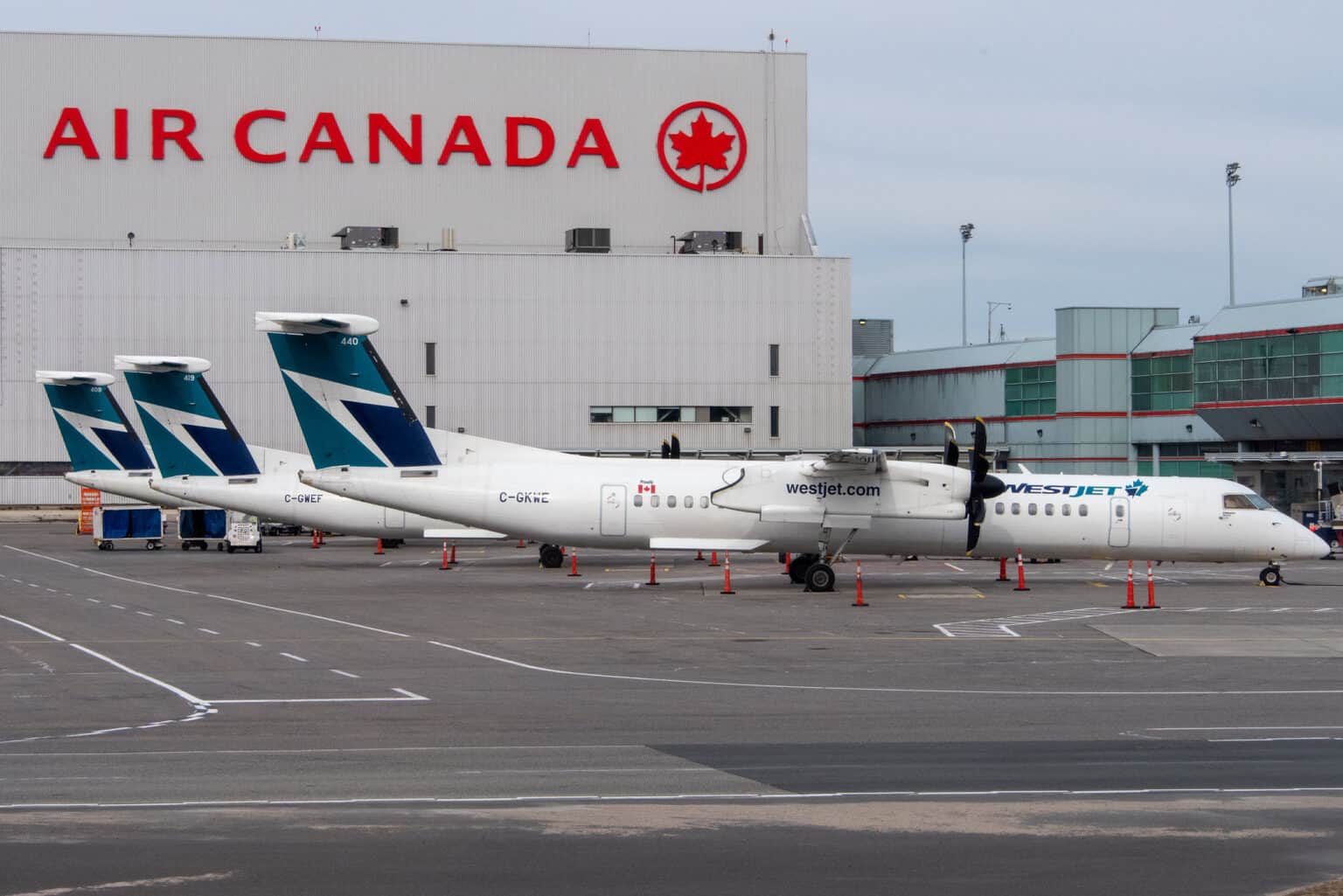
The Transportation Safety Board of Canada released its final report on September 22, 2026 into a WestJet Encore Dash 8-400 whose No. 2 engine surged and caught fire in the climb. A single rotor blade, cracked from the inside out, started it.
The aircraft, a Bombardier DHC-8-402 registered C-GVEN, was operating flight WEN3532 from Kamloops to Calgary on March 2, 2023, with four crew and 74 passengers aboard.
Twelve minutes after departure the crew heard a loud bang. The aircraft was at 25,000 feet, about 42 nautical miles north-northeast of Kelowna, and the No. 2 engine’s second-stage low-pressure compressor rotor had just failed.
The crew shut the engine down, declared an emergency and diverted to Kelowna International. The TSB records that the aircraft landed safely and there were no injuries.
How a Broken Blade Becomes a Fire
The fire was not caused by the broken blade directly. According to the TSB, the blade fracture surged the engine, and the engine control system responded to the power loss by increasing fuel flow to try to recover it.
That left a fuel-rich mixture venting into the exhaust duct, where it burned. The fire detection system triggered on the heat, and hot exhaust gas was re-ingested by the engine.

Examination found the blade had failed by high-cycle fatigue from a crack that started below the surface, roughly five thousandths of an inch under the pressure side, and no metallurgical anomaly at the initiation point. A second blade on the same rotor was cracked in a matching spot.
Reality check
This rotor was nowhere near worn out. The TSB records that it had run 909 cycles against a life limit of 20,000. Fatigue here is driven by how the engine is operated, not by how much of its life it has used.
The Problem Is a Speed, Not a Part
The interesting part of this report is what puts the crack there. Pratt & Whitney Canada’s investigation, with TSB laboratory oversight, traced the fatigue to a mechanical resonance the rotor enters at a specific shaft speed: 26,000 rpm, give or take 50.
Every rotating assembly has frequencies at which it flexes far more than the input would suggest. Hold one there and the blade accumulates fatigue cycles at a rate that has nothing to do with thrust setting or hours flown.
What pushes the engine into that band is an ordinary cockpit selection, on a turboprop airlines still fly precisely because it is cheap to operate. The report states that using the BLEED MIN setting in climb and cruise raises low-pressure compressor speed, and that this can leave the engine dwelling in the 26,000 rpm window.
Cold makes it worse. Below about minus 13°F (minus 25°C), the manufacturer found resonance stresses at the crack site multiply by 2.5, and roughly 30 minutes of cumulative exposure is enough to matter.
Why this is worth reading twice
BLEED MIN is a routine, approved, fuel-saving selection in the operating manual, and high-altitude cruise in Canada is cold by definition. The conditions that cracked this blade were not abuse or neglect. They were normal line flying.
That is also why the answer has been inspections and software rather than a new blade. AeroCorner covered a separate Dash 8-400 wing tank directive earlier this month, and the pattern is the same: find it, then change how the aircraft is flown or managed.
Thirteen Events, and What Was Done
The report’s own table lists 13 second-stage rotor events on the PW150A, seven involving Canadian operators and six foreign. They run from a Flybe failure in October 2012 to a Widerøe blade fracture in June 2025.
Not all 13 share this cause. The TSB logs the three earliest foreign events as soft foreign object damage, so the table is a record of how often this rotor has shed a blade, not a count of resonance failures.
October 2012
First on the list. A Flybe Dash 8-402 fractures a second-stage rotor blade. This one, and South African Express in June 2014 and Ethiopian Airlines in July 2015, are logged by the TSB as soft foreign object damage.
March 16, 2016
First Canadian event. A Porter Dash 8-402 releases a blade in the climb out of Halifax, investigated by the TSB as A16A0028.
March 2, 2023
WEN3532. The WestJet Encore occurrence, with an exhaust duct fire and a diversion to Kelowna.
July 22, 2023
Inspections begin. Pratt & Whitney Canada issues Special Instruction 72-2023, an endoscopic fluorescent penetrant inspection of the second-stage blades.
2023 to 2024
More found. WestJet Encore suffers two further in-flight releases and finds two more cracked blades during on-wing inspections. PAL has one in March 2024.
September 12, 2025
Mandated. Transport Canada issues AD CF-2025-44, requiring a FADEC software upgrade with a modified fuel flow limit schedule and a new engine event detection function.
The software change is the quiet fix. Rewriting the fuel flow limit schedule attacks the part of the sequence that turned a compressor failure into a fire, which is the step that made this occurrence more than an engine shutdown.
The TSB also recorded that the WEN3532 crew followed standard operating procedures and checklists, and credited their crew resource management with the outcome. De Havilland’s corrective work with Pratt & Whitney Canada was still continuing when the report was written.
Sources and references used for research and fact-checking.
Get the Newsletter
The latest aviation news and stories sent to your inbox.
About the Author

Tim is the owner and lead editor of AeroCorner since 2019, overseeing aviation content covering aircraft, airlines, airports, and the broader aviation industry. Through years of researching, writing, editing, and publishing aviation-focused content, he has developed extensive practical knowledge of commercial aviation and air travel. Based in Asia and a frequent traveler himself, Tim also brings firsthand passenger experience to AeroCorner’s coverage. Outside of publishing, he has also explored aviation firsthand through hands-on flight training in New Zealand.