

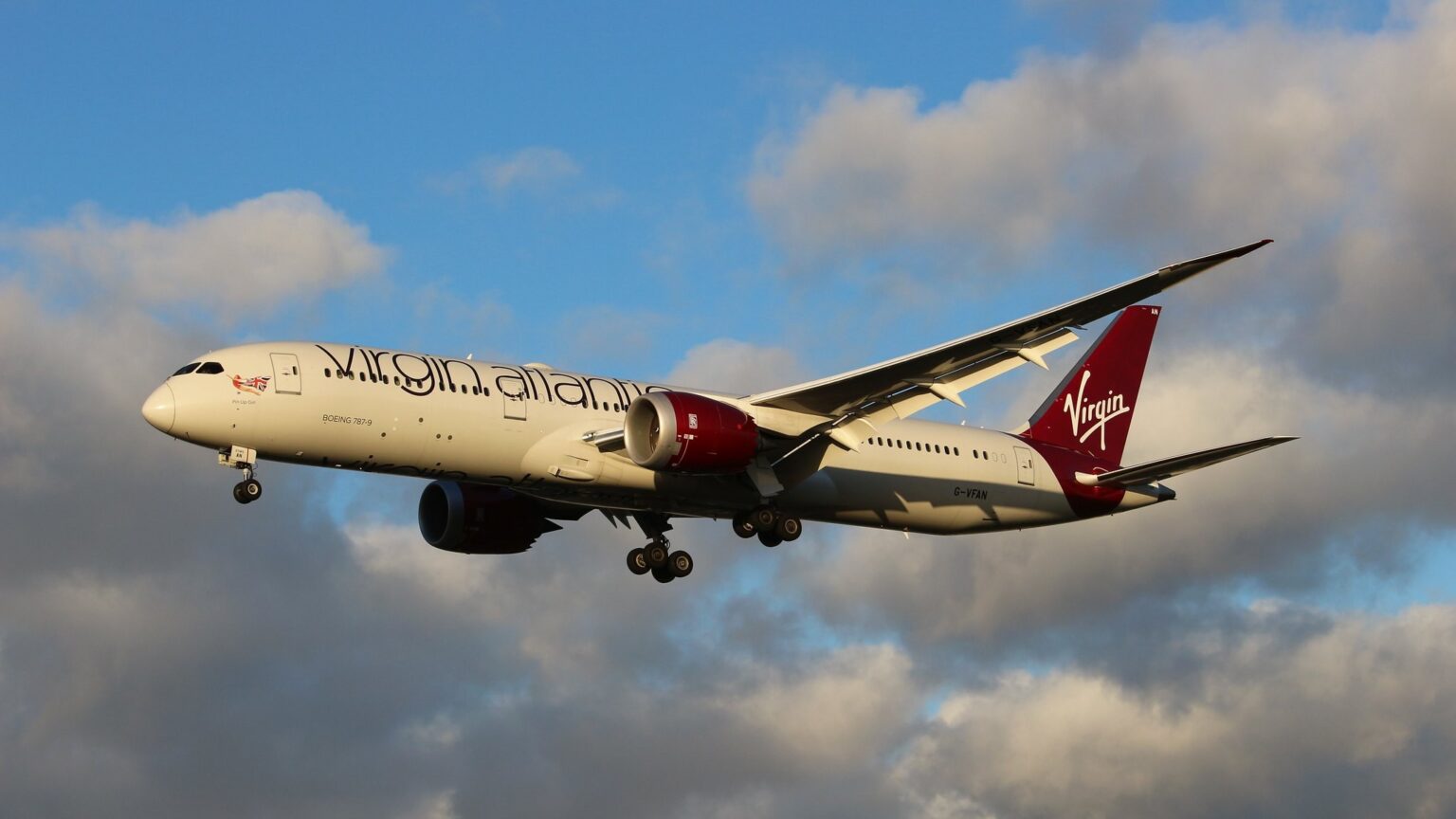
Virgin Atlantic flight VS3 from London Heathrow to New York JFK turned back on Friday, November 27, 2026, and landed at Heathrow again about three hours and 20 minutes after it took off. Flight-tracking data from Flightradar24 shows the Boeing 787-9, registered G-VFAN, leaving at 09:30 GMT and listed as diverted back to Heathrow.
Virgin Atlantic said the jet was returning “due to a minor technical issue” and that it was working to get passengers to New York later the same day. The airline has not said what the issue was.
What happened on VS3
VS3 was scheduled to leave at 09:05 GMT and got away about 25 minutes behind schedule, according to Flightradar24’s record for G-VFAN. AIRLIVE reported that it departed from runway 09R and climbed to 34,000 feet, and that the crew faced several technical faults shortly after departure.
Instead of heading out over the Atlantic, the Dreamliner flew over Wales and then down toward Cornwall, where people on the ground watched it circle above Penzance for more than half an hour, Cornwall Live reported. AIRLIVE put the holding at about two hours, at 25,000 feet southwest of the UK.
Flightradar24’s data shows the flight ending back at Heathrow at about 12:53 GMT, after 3 hours and 23 minutes in the air. AIRLIVE said it landed on runway 09L and parked on a remote stand.

Cornwall Live said it understood the crew had not declared an emergency.
What Virgin Atlantic said
“Our flight, the VS3 from London Heathrow to New York JFK is returning to Heathrow due to a minor technical issue. The safety of our customers and crew is always our top priority,” a Virgin Atlantic spokesperson said in the statement Cornwall Live published.
“We’re sorry for the disruption to our customers’ journeys and are working to get them on their way to New York as soon as possible today,” the statement continued. AIRLIVE separately reported that the airline confirmed the return and that ground teams were rebooking passengers.
The two accounts describe the problem differently. Virgin Atlantic called it a single “minor” issue, while AIRLIVE wrote of multiple faults; neither named a system.
What is not known yet
Virgin Atlantic has not said which system failed, how many passengers were on board, or when the replacement flight left. Whether the crew burned the extra fuel off or jettisoned part of it is also not confirmed: AIRLIVE described burning fuel, while Cornwall Live said it understood fuel was being released over Penzance.
Why a return can take three hours
A jet bound for New York leaves London heavy with fuel for a flight scheduled at more than eight hours, and it is heavier than it is allowed to land at. Boeing’s airport-planning data puts the Boeing 787-9’s maximum design landing weight at 425,000 pounds (192,776 kg), against a maximum design takeoff weight of up to 571,500 pounds (259,228 kg).
How heavy VS3 actually was is not public, but a transatlantic departure can sit well above that landing limit. When the problem is not urgent, crews usually take the time to get below it rather than land overweight, which usually means an inspection of the jet afterward.
There are two ways to shed that weight. The crew can fly a holding pattern and burn the fuel off, which is slow, or dump fuel overboard through a jettison system, which the 787 has and which crews use away from busy airspace and at altitude.
US certification rules (14 CFR 25.1001) require a jettison system only on aircraft that cannot meet go-around climb performance at close to their takeoff weight, which is why most narrowbodies such as the 737 and A320 have none. An earlier Alaska Airlines 787 return to Rome in July showed the long-haul version of the same routine.
A long hold is also a sign of how the crew rated the problem. A flight that has to land at once does not spend that long in a hold, so the timeline fits Virgin Atlantic’s description of an issue that made continuing to New York unwise rather than one that made landing urgent.
Another Virgin Atlantic turnback this fall
VS3 follows a similar Virgin Atlantic turnback in September, when flight VS127 from Manchester squawked 7700 and circled over Merseyside for about an hour before landing back at Manchester, also after what the airline called a minor technical issue.
In both cases the jet held for an hour or more before landing, and the airline has described the problem only as minor.
At the time of writing, on the afternoon of November 27, Virgin Atlantic had said nothing further about the cause, and no newer coverage had named it.
Sources and references used for research and fact-checking.
Get the Newsletter
The latest aviation news and stories sent to your inbox.
About the Author
AeroCorner News is the aviation news desk of AeroCorner.com. It covers accidents and incidents, safety rulings, airline and airport disruption, and new aircraft. It works from primary sources such as the NTSB, FAA, EASA and the manufacturers' own announcements.