

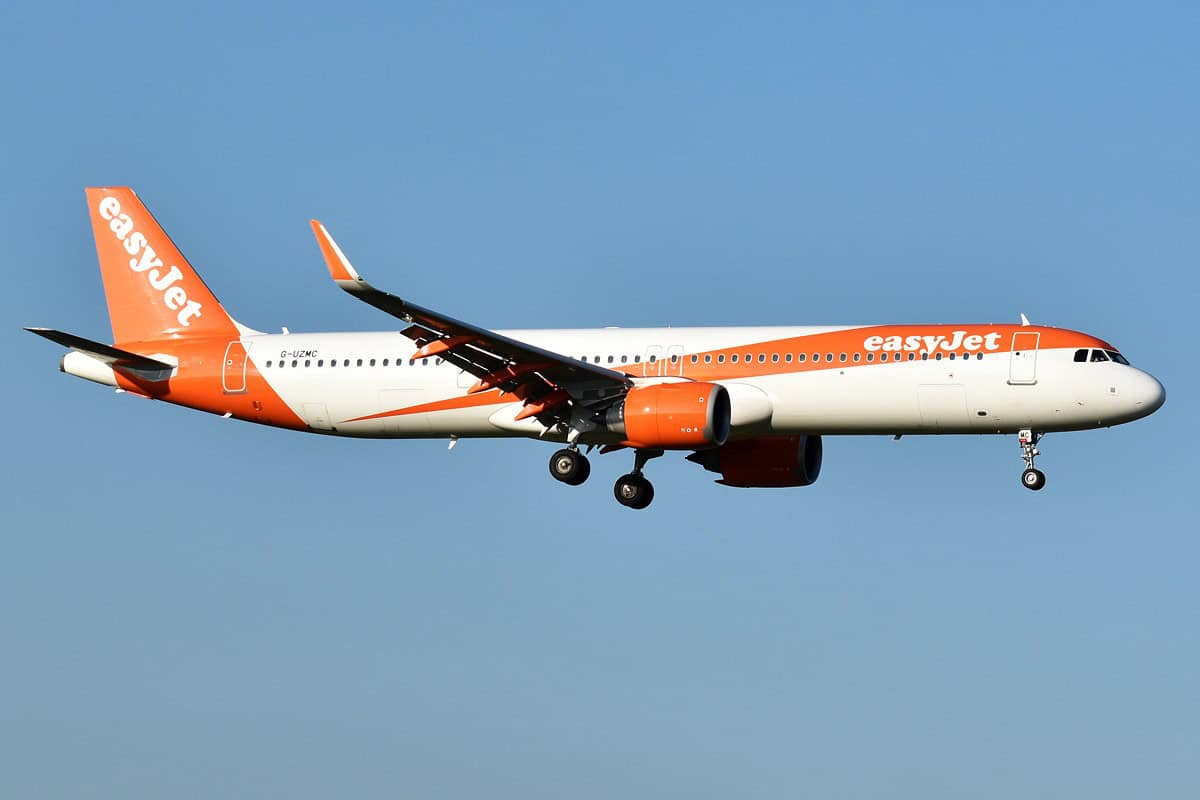
easyJet flight EZY816 from Edinburgh to London Gatwick declared an emergency shortly after takeoff on the evening of Thursday, November 26, 2026, and returned to land safely at Edinburgh. Residents in the area reported hearing a loud bang as the jet climbed out.
easyJet said the flight “was required to return to Edinburgh due to a technical issue” and landed normally. The airline did not say what the issue was.
What happened on EZY816
Flightradar24 lists the aircraft as G-UZMC, an Airbus A321neo flying the service as U2816 under the radio callsign EZY18NP. It took off at 8:46 p.m. GMT, one minute behind schedule, and its record ends back at Edinburgh at about 9:30 p.m.
That is roughly 44 minutes in the air by Flightradar24’s times. Flightdrama, the X account that flagged the emergency as it happened, put the landing at 53 minutes after departure, so the exact figure depends on which times are used.
The jet had already flown five sectors that day, including a round trip to Venice and one to Nice, before arriving in Edinburgh from Gatwick at about 7:38 p.m., according to its Flightradar24 history.
At 8:50 p.m., Flightdrama posted that ACARS messages, the automated reports an airliner sends to its operator, indicated an engine failure with multiple warnings on the No. 1 engine, and that the jet was squawking 7700. The account’s posts were quoted by Belfast Live.
In later updates, the account said the messages pointed to an engine stall and high exhaust gas temperatures, and that the left engine was shut down while the aircraft was at about 5,000 feet. None of this has been confirmed by easyJet or by investigators.
A witness in Livingston, west of Edinburgh, wrote on X that he heard an “engine blow” over his home shortly before 9 p.m. Flightdrama also shared doorbell-camera footage of a bang it believed was linked to the flight, and said a passenger described being “absolutely terrified” by a “huge bang”.
The aircraft circled several times before landing, and police and fire crews were waiting at Edinburgh Airport, the Manchester Evening News reported. Several nearby roads were closed while the emergency was under way.


What easyJet says
In its statement, easyJet said the aircraft “landed normally and was met by emergency services in line with procedures and a precautionary measure only.” It said a replacement aircraft had been arranged to operate the flight to Gatwick that evening.
The airline added that it operates its fleet “in strict compliance with manufacturers’ guidelines.” Its statement did not mention injuries or say how many people were on board.
At the time of writing, around 2 a.m. GMT on Friday, Flightradar24 showed the replacement U2816 due to leave Edinburgh at 2:10 a.m., more than five hours late. G-UZMC had no flight listed after its return.
Why an engine can bang, and why one engine is enough
A loud bang from a jet engine is most often a compressor stall or surge, according to the aviation safety reference SKYbrary. The airflow through the compressor breaks down and can briefly reverse, producing a backfire-like report and sometimes flames at the inlet or exhaust.
A stall can also send exhaust gas temperature up and cut thrust, which matches the warnings Flightdrama described. SKYbrary lists bird strikes and other foreign objects, worn or dirty compressor parts and icing among the usual causes; a sustained stall can damage the engine.
Flightradar24 lists G-UZMC as an A321-251NX, the A321neo model that an EASA airworthiness directive shows fitted with CFM International LEAP-1A32 engines. At the time of writing, no cause had been published for this event.
Losing one engine does not leave a twin-engine airliner without the power to fly. The FAA’s certification rules require a two-engine transport jet to keep climbing with its critical engine out, from the moment it lifts off.
The 7700 code is the transponder setting for a general emergency, which gives the flight priority with air traffic control; AeroCorner’s guide to aircraft transponder squawks explains the other codes.
Other recent easyJet emergencies
EZY816 is the third easyJet emergency AeroCorner has covered since November 18. That day, flight U2213 squawked 7700 and returned to Bristol after a bird strike on its way to Edinburgh.
Two days later, an A320 on flight U23443 declared a mayday and landed in Amsterdam after a reported shutdown of one of its CFM56 engines. Both of those jets were A320s, not A321neos, and nothing published so far ties the three events together.
Sources and references used for research and fact-checking.
Get the Newsletter
The latest aviation news and stories sent to your inbox.
About the Author

AeroCorner News is the aviation news desk of AeroCorner.com. It covers accidents and incidents, safety rulings, airline and airport disruption, and new aircraft. It works from primary sources such as the NTSB, FAA, EASA and the manufacturers' own announcements.