

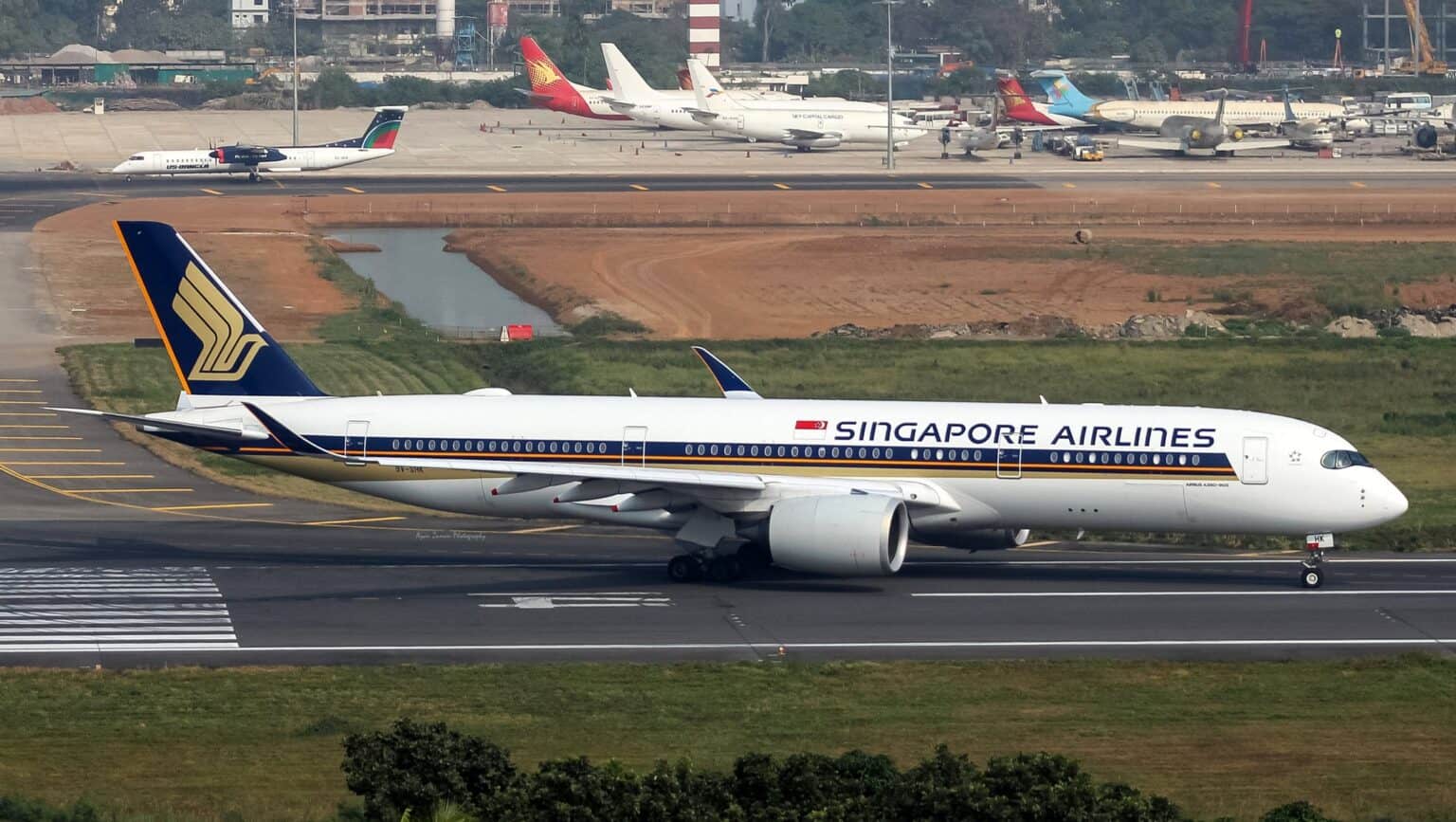
Singapore Airlines flight SQ213, an Airbus A350-900 arriving from Singapore, abandoned its first landing attempt at Perth Airport on Saturday, October 31, 2026. It climbed away and landed on its second approach about 14 minutes later, according to flight-tracking data.
A video of the go-around has spread on Facebook, showing 1.8 million views when Daily Mail embedded the post. The man who shared it, Chris Perry, said his sister was on board and blamed high winds.
What the tracking data shows
The FlightAware track log has SQ213 descending toward the runway from the south and logging 150 feet at 12:16:56 p.m. local time, around the start of the runway. Sixteen seconds later it logged 425 feet, and 1,250 feet 16 seconds after that.
The jet then flew a circuit at about 4,000 feet and settled back onto the same final approach track by about 12:26 p.m. FlightAware records its arrival at 12:30:50 p.m., which fits the “just after 12.30pm” landing reported by The West Australian; Daily Mail said about 12:35 p.m.
Flightradar24 and FlightAware’s aircraft history both place the A350 registered 9V-SHK on this flight. FlightAware shows it leaving Perth for Singapore at 2:05 p.m. the same day, though the logs do not say whether any inspection took place.
Those altitudes come from samples about 16 seconds apart, so they do not show the lowest point of the approach. They also say nothing about how close either wing came to the ground.
What the video does and does not establish
Daily Mail described the aircraft as appearing to bank to the right, bringing one wing closer to the ground. The West Australian’s headline called it a “scary near-miss”, and Perry’s caption read: “My sister’s plane almost crashes on landing.”
Neither report cites a measurement of the wing’s height, an official finding or an account from the crew. Neither mentions any contact with the ground.
Still unknown
The bank angle, the wing’s height above the ground and the crew’s reason for going around are not on record. The West Australian said Singapore Airlines and Perth Airport had been contacted, and Daily Mail said it had contacted the airline. Neither report carries a reply, and our searches found no statement as of November 1, 2026.
What the wind actually was
Official weather records confirm it was windy, though they cannot show that wind caused the go-around. The Bureau of Meteorology’s daily record for Perth Airport lists the day’s strongest gust as 31 mph (50 km/h) from the west-northwest at 12:00 p.m., about 17 minutes before the first attempt.
Both news reports quote winds of 32 km/h (20 mph). That closely matches the 17-knot reading in the 12:30 p.m. airport weather report, close to the second landing rather than the first attempt.
The direction matters as much as the speed. SQ213’s track lines up with runway 03, which OurAirports lists as 11,299 feet long and pointing 14 degrees true, so a wind from the west blows almost straight across it.


| Local time | Reported wind | Crosswind on runway 03 (our calculation) |
|---|---|---|
| 11:30 a.m. | 310 degrees, 12 knots, gusting 22 | 11 knots, gusting 20 |
| 12:00 p.m. | 270 degrees, 21 knots | 20 knots |
| 12:30 p.m. | 290 degrees, 17 knots | 17 knots |
The 12:00 and 12:30 reports also list visibility of at least 6 miles (10 km), broken cloud at about 3,900 feet and no thunderstorm. That leaves wind as the only notable weather in those reports, but only the crew or the flight data can say what triggered the decision.
Why a go-around is not a near-miss in itself
A go-around means the pilots stop the approach, add power and climb away to try again. A study of large European airports covering 2019 to 2023 found 1.5 to 6 of them per 1,000 landings, so they are uncommon on any one flight but routine across an airline’s operation.
Crosswinds are one reason the last seconds of an approach can look dramatic from outside. Airbus’s general crosswind briefing note recommends a wings-level approach with the nose pointed partly into the wind, then using rudder in the flare to line up with the runway and sidestick to counter any roll downwind.
The same note says manufacturers weigh bank limits that prevent wingtip or engine contact with the ground. That margin is real, as a Ryanair 737 MAX at Dublin showed in a gusty crosswind in September, when it touched a wingtip before going around.
Pilot-run site Ask Captain Lim gives the A350 a demonstrated crosswind limit of 40 knots with gusts, and notes that some airlines set lower limits. We did not find Singapore Airlines’ own figure, so this comparison cannot say how close to any company limit SQ213’s crew was.
Sources and references used for research and fact-checking.
Get the Newsletter
The latest aviation news and stories sent to your inbox.
About the Author

AeroCorner News is the aviation news desk of AeroCorner.com. It covers accidents and incidents, safety rulings, airline and airport disruption, and new aircraft. It works from primary sources such as the NTSB, FAA, EASA and the manufacturers' own announcements.