

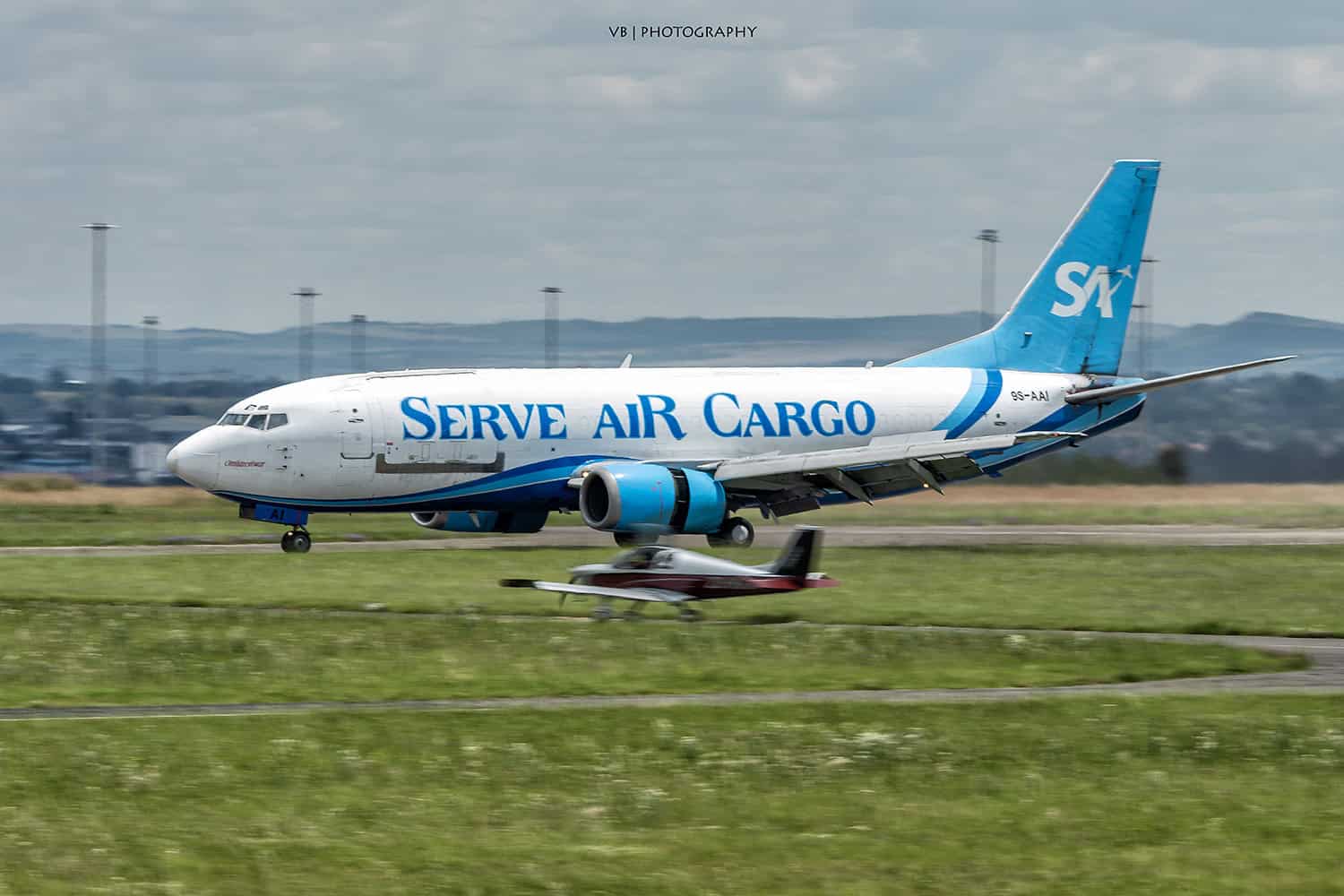
A Serve Air Cargo Boeing 737-300 freighter, registration 9S-AAI, suffered a right main landing gear collapse while taking off from Kindu in the Democratic Republic of the Congo on Thursday, September 17, 2026.
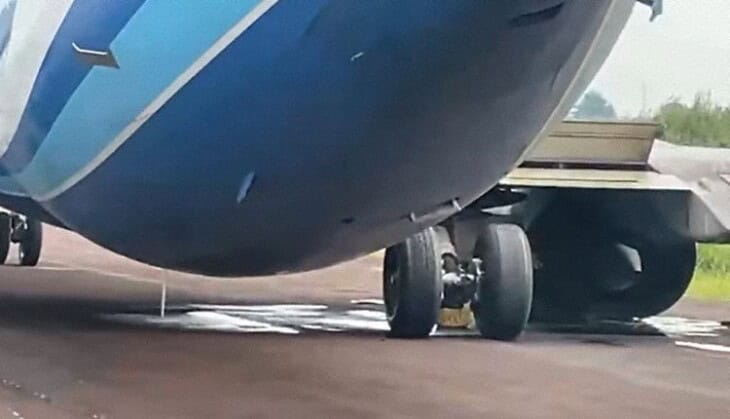
The aircraft was departing runway 36 for Kinshasa when the gear gave way and the jet veered right. The crew held it on the paved surface and brought it to a stop.
No deaths were reported. Local reporting from Maniema province said the airport stayed open while recovery of the aircraft was organized.
Congolese investigators are at the site
The Bureau Permanent d’Enquêtes d’Accidents et Incidents d’Aviation, the DRC’s accident investigation body, opened an inquiry and sent investigators to Kindu. It said the exact circumstances of the event remain to be determined.
The BPEA also asked that the aircraft be moved only under established procedures, so that evidence useful to the investigation survives the recovery. That request is routine, and it is the kind of thing that gets lost when a damaged jet is blocking a single-runway airport.
Beyond the collapsed right gear, the left inboard tire was also damaged, according to The Aviation Herald. No cause has been published.
Nothing here is a finding yet
A gear collapse has many possible roots: a structural failure, a maintenance error, an undercarriage overloaded by damage nobody caught, or a runway surface problem. Until the BPEA reports, any single explanation is a guess.
Why a gear failure on the takeoff roll is the harder version
Most landing gear collapses happen on landing, when the airframe is absorbing an impact and the aircraft is slowing down. A collapse during takeoff arrives while the energy is still building and the crew is committed to accelerating.
That leaves the crew rejecting a takeoff while the aircraft is simultaneously trying to depart the side of the runway on a broken leg. Keeping it on the pavement, as this crew did, is the outcome that separates an expensive repair from a hull loss.
Every 737-300 flying is at least 26 years old
Boeing delivered the last 737-300 to Air New Zealand on December 17, 1999, after building 1,113 of them, and closed the 737 Classic line entirely in February 2000. There is no such thing as a young one.
9S-AAI is a 737-36N(SF), meaning it was built as a passenger jet and later converted to carry freight. That is the standard second life for the type: airlines retire them from passenger service, converters strip the cabin, and the airframes go on hauling boxes into places where runway length and pavement quality rule out anything newer.
Age alone is not a safety verdict. A well-maintained 30-year-old freighter is not dangerous, and the inspection programs that govern these aircraft get more demanding as the airframe accumulates cycles, not less.
What age does change is the margin for a weak maintenance system, which is where the DRC’s record matters. Congolese operators have had a run of these events, including when one of the world’s last flying DC-8 freighters ran off the runway at Kinshasa.
The EU ban is about the regulator, not this airline
Every air carrier certified in the Democratic Republic of the Congo is barred from operating into or over the European Union under the EU Air Safety List, whose 48th update the European Commission published in June 2026.
That is worth reading precisely. Serve Air Cargo sits inside a group of 126 airlines banned across 16 states because the Commission judges the national authority’s safety oversight inadequate, not because Brussels has made a finding against any one of them.
Whether the Kindu gear collapse says anything about that oversight is exactly the question the BPEA now has to answer, and its report is the only document that will settle it.
Sources and references used for research and fact-checking.
Get the Newsletter
The latest aviation news and stories sent to your inbox.
About the Author

Tim is the owner and lead editor of AeroCorner since 2019, overseeing aviation content covering aircraft, airlines, airports, and the broader aviation industry. Through years of researching, writing, editing, and publishing aviation-focused content, he has developed extensive practical knowledge of commercial aviation and air travel. Based in Asia and a frequent traveler himself, Tim also brings firsthand passenger experience to AeroCorner’s coverage. Outside of publishing, he has also explored aviation firsthand through hands-on flight training in New Zealand.