

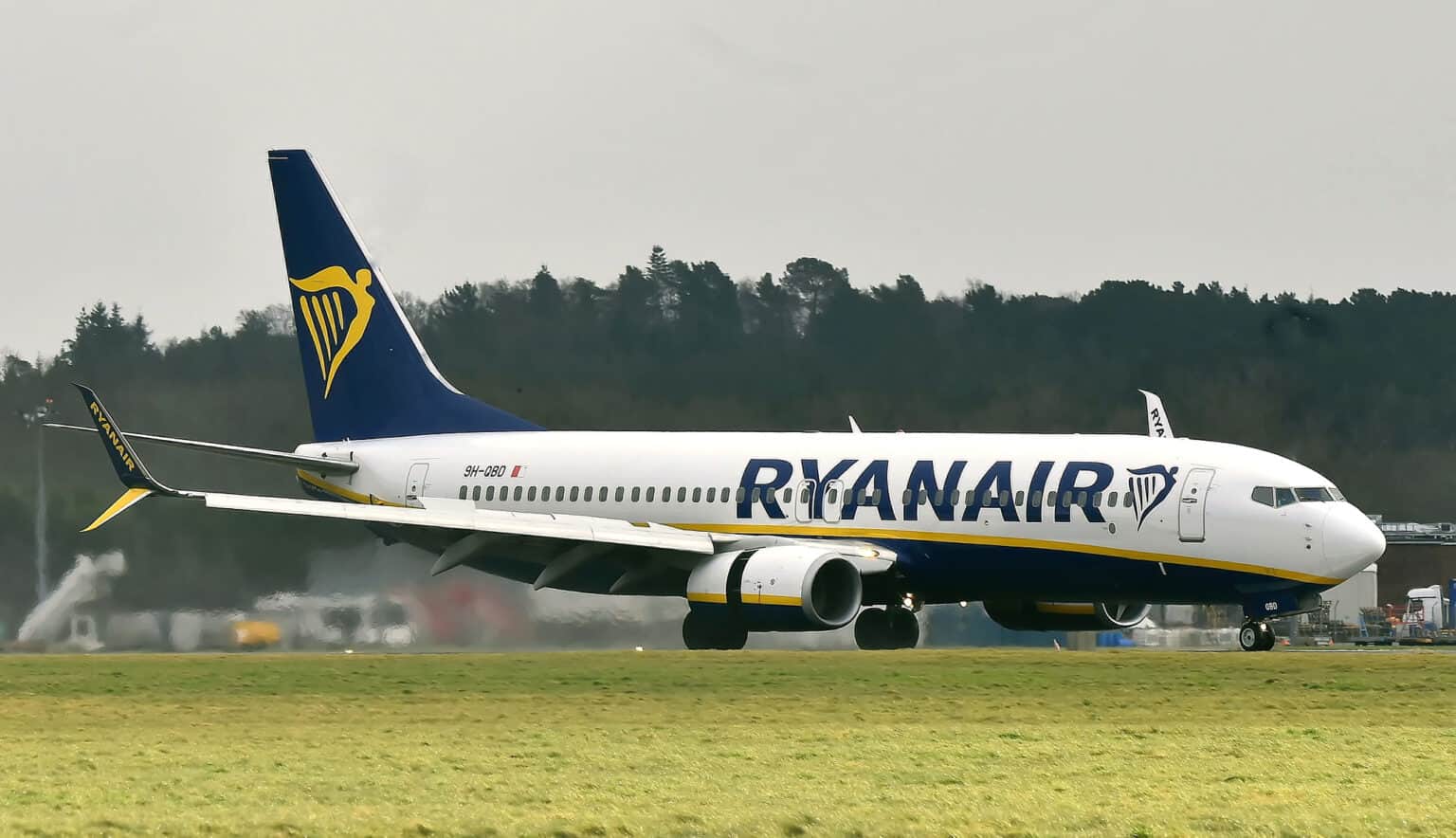
Ryanair flight FR3418 landed at Manchester in October 2025 with 800 pounds (363 kg) of fuel, a third of its final reserve, after three windshear warnings in Storm Amy. The UK Air Accidents Investigation Branch (AAIB) published its report on September 24, 2026.
A central finding: Manchester Airport turned down the crew’s first request to divert there, and under the airport’s own policy it should have said yes.
Four approaches, three windshear warnings
The Boeing 737-800, registered 9H-QBD and flown for Ryanair by Malta Air, left Pisa for Glasgow Prestwick on October 3, 2025, with 171 passengers and six crew. The commander had loaded 2,915 pounds (1,322 kg) of extra fuel for the forecast storm, roughly 72 more minutes of flying.
On the first approach to Prestwick, a windshear warning sounded at 215 feet, 0.7 nautical miles from the runway. The crew flew the escape maneuver, held for about 20 minutes, and tried again after another of the airline’s jets landed.
The second warning came at 50 feet. Company rules ban a third approach after two windshear escapes, so the crew asked to go to Manchester, their chosen alternate, where the forecast winds were lighter.
Manchester said no, and no reason was passed to the crew. The crew diverted to Edinburgh instead, where a third windshear warning triggered at 745 feet.
With about 4,630 pounds (2,100 kg) left and the flight computer predicting just 660 pounds (300 kg) on arrival at Manchester, the commander called “mayday mayday mayday fuel” at 19:12 UTC. The jet climbed to 23,000 feet, both low fuel alerts lit on the way, and it touched down on runway 23R at 19:51 UTC.
| Point in the flight | Fuel on board |
|---|---|
| First go-around, Prestwick | 4,608 kg |
| Second go-around, Prestwick | 3,515 kg |
| Third go-around, Edinburgh | 2,164 kg |
| Mayday declared, leaving Edinburgh | 2,036 kg |
| Touchdown, Manchester | 363 kg |
| Engine shutdown on stand | 240 kg |
Why Manchester said no
Manchester Airport‘s policy is to accept any diversion when it has parking space, with the decision made by its own Airfield Control. It had already taken in 19 Storm Amy diversions that day.
Five minutes after Manchester ATC passed on the request, Airfield Control said the handling agent could not accept the aircraft. That agent later told investigators its policy was to accept this operator’s diversions, and there is no record of what was said between them.
The AAIB could not establish how the refusal was made, but said it appeared to result from “a breakdown in communication between units within Manchester Airport.” The airport has since restated that handling agents play no part in the decision.
Minimum fuel, mayday fuel and final reserve
Final reserve fuel is a fixed 30 minutes of flying that the operator’s fuel policy aims to keep in the tanks at landing. On this flight it was 2,427 pounds (1,101 kg).
A “minimum fuel” call tells ATC the crew is committed to one airport and any further delay could push it into that reserve; it is not an emergency. A Mayday call for fuel means the crew expects to land below it, and Manchester’s policy is to accept every declared emergency.
After the second go-around, the crew discussed declaring either one to reach Manchester but decided their fuel did not meet the operator’s criteria for an emergency. The operator told the AAIB an emergency could have been justified if the crew doubted a safe landing at Edinburgh.
Each go-around was expensive. At go-around power the two engines burned about 265 pounds (120 kg) a minute, so the 363 kg on touchdown was roughly three minutes of go-around fuel.
The AAIB noted the crew did not consider nearer Newcastle, and that the first low fuel alert was a chance to turn back to Edinburgh, which was still closer. It said it is “possible” that the crew’s preference for Manchester from the outset influenced their decisions.
Early reports put the landing fuel at about 220 kg; AIRLIVE relayed that figure in October 2025. The recorded data shows 363 kg at touchdown and 240 kg at shutdown.
A storm also stacked up approaches for American Eagle flight AA3927 before its fuel emergency this summer.
Sources and references used for research and fact-checking.
Get the Newsletter
The latest aviation news and stories sent to your inbox.
About the Author

Tim is the owner and lead editor of AeroCorner since 2019, overseeing aviation content covering aircraft, airlines, airports, and the broader aviation industry. Through years of researching, writing, editing, and publishing aviation-focused content, he has developed extensive practical knowledge of commercial aviation and air travel. Based in Asia and a frequent traveler himself, Tim also brings firsthand passenger experience to AeroCorner’s coverage. Outside of publishing, he has also explored aviation firsthand through hands-on flight training in New Zealand.