

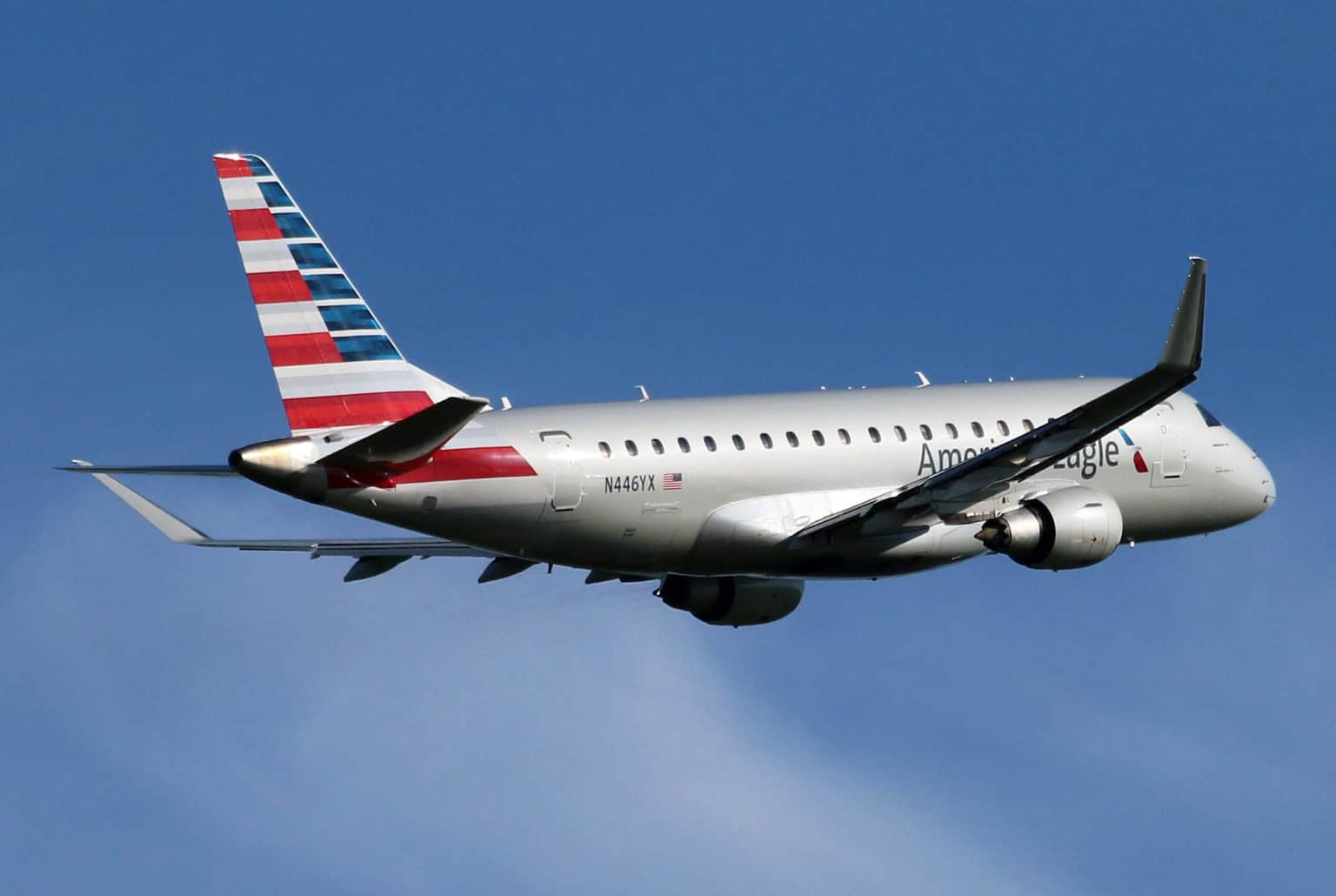
On August 12, 2026, an American Eagle regional jet declared a fuel emergency and diverted to Evansville, Indiana, after severe thunderstorms blocked three landing attempts at two different airports. Flight AA3927, an Embraer E175LR registered N285NN and operated by Envoy Air, was flying from Dallas/Fort Worth to Lexington, Kentucky, when the weather closed in.
The crew’s first attempt, on Lexington’s Runway 22, ended in a go-around after intense convective weather cut visibility too low for a safe landing, according to AirLive. Rather than try Lexington again, the crew diverted roughly 60 miles west to Louisville Muhammad Ali International Airport.
Louisville offered no better weather. On the approach to Runway 35R, the jet descended below 600 feet before air traffic control ordered a go-around, Paddle Your Own Kanoo reported. A second attempt, on Runway 35L, was abandoned the same way.
With roughly 30 minutes of fuel remaining after the third missed approach, the crew declared a fuel emergency, transmitting the standard emergency squawk code 7700. Controllers vectored the flight to Evansville Regional Airport, about 100 miles further west, where conditions were clear enough to land.
The aircraft touched down safely on Evansville’s Runway 22 roughly three hours after leaving Dallas. No injuries were reported, and emergency crews met the jet on the ground as a standard precaution.
Neither American Airlines nor Envoy Air had issued a public statement on the diversion at the time of writing.
What “declaring an emergency” actually means
US airliners fly domestic routes with enough fuel to reach their destination, then an alternate airport, then hold for 45 minutes more at normal cruise, under FAA reserve rules. Three missed approaches across two diversions eats into that reserve fast, which is why AA3927’s crew moved from informally advising ATC of tightening fuel to formally declaring an emergency.
A “minimum fuel” advisory only asks controllers to avoid further delay; it carries no guarantee of priority handling. Squawking 7700 is different: it obligates controllers to clear a direct path and prioritize the aircraft above other traffic, the same code an airliner low on fuel used to divert into a military airfield near Phoenix last month.
Squawk 7700
The universal transponder code for a general emergency, whatever the cause. It tells every controller watching the aircraft’s radar track to treat it as a priority.
Why Evansville, not somewhere closer
Controllers pick a diversion airport in real time, weighing weather, runway length, and how much traffic is already inbound. Evansville Regional was roughly 100 miles from Louisville, farther than either storm-hit airport the crew had already tried, but it was clear of the same convective cell working through Kentucky. A shorter diversion into worsening weather would have defeated the purpose of declaring the emergency in the first place.
Reality check
A fuel emergency is a formal declaration, not proof the aircraft came close to running dry. It exists precisely so crews get priority handling before reserves are threatened, not after.
Get the Newsletter
The latest aviation news and stories sent to your inbox.
About the Author

Tim is the owner and lead editor of AeroCorner since 2019, overseeing aviation content covering aircraft, airlines, airports, and the broader aviation industry. Through years of researching, writing, editing, and publishing aviation-focused content, he has developed extensive practical knowledge of commercial aviation and air travel. Based in Asia and a frequent traveler himself, Tim also brings firsthand passenger experience to AeroCorner’s coverage. Outside of publishing, he has also explored aviation firsthand through hands-on flight training in New Zealand.