

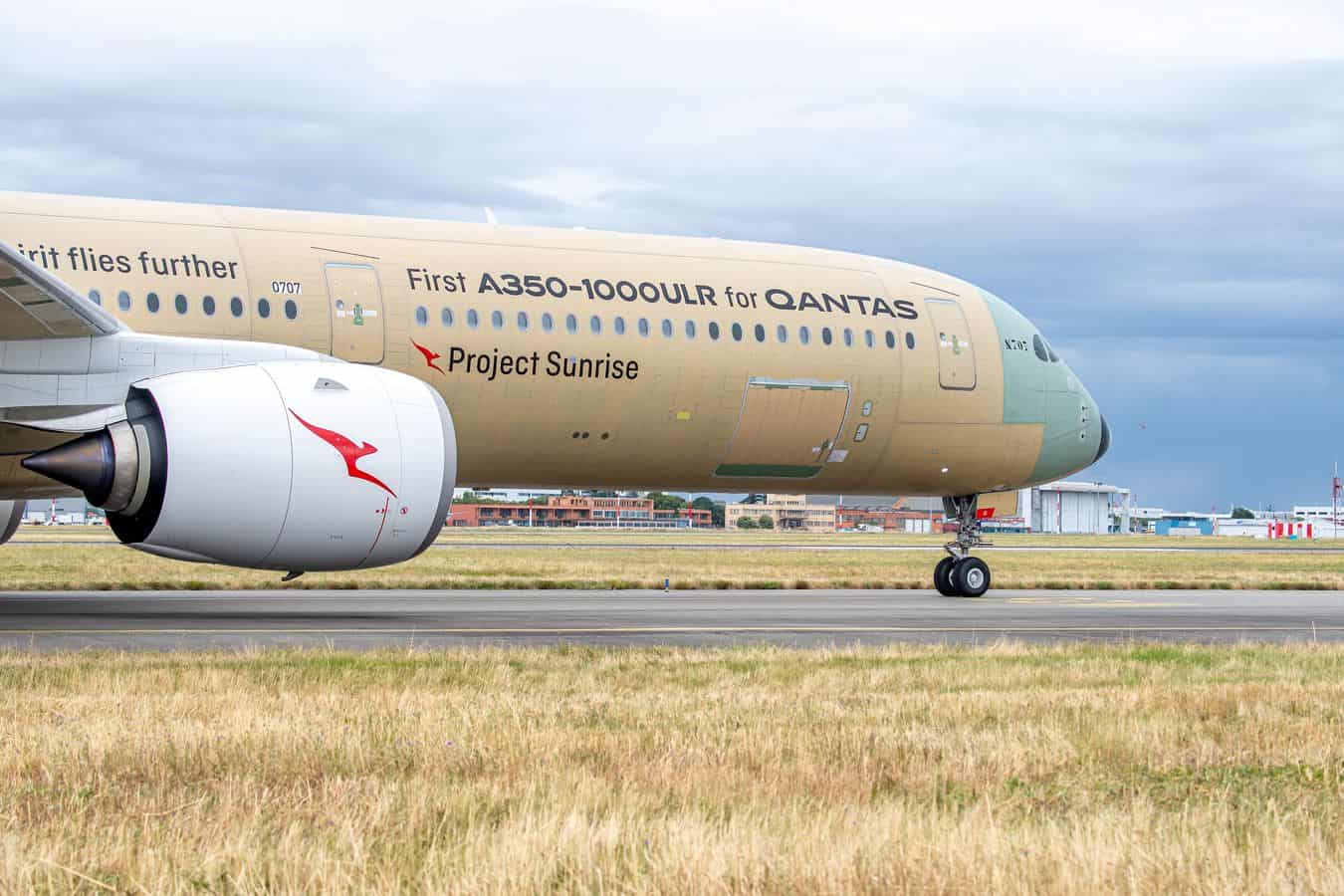
The first Airbus A350-1000ULR built for Qantas landed in Melbourne on Friday, July 24, 2026, the first time a Project Sunrise aircraft has touched down in Australia. It arrived after a nonstop test flight from Airbus’ home base in Toulouse, France, one of the longest flights the manufacturer has ever operated.
A 19-hour flight from summer to winter
According to Qantas and Airbus, the aircraft departed Toulouse at 7:33 local time on Thursday, July 23, and landed in Melbourne at 10:46 local time the next day. The flight lasted 19 hours and 12 minutes and covered about 10,560 miles (17,000 km).
Nine people were on board: four Airbus flight test pilots and five flight test engineers. This particular jet is a flight-test airframe, not the aircraft Qantas will fly. The first delivery aircraft, named Vega and painted in full Qantas livery, is still being built on the Airbus assembly line.
The aircraft is scheduled to fly back to Toulouse on Monday, July 27, with two Qantas pilots joining the Airbus test crew for the return leg. Both flights are part of the certification and validation campaign for the ultra-long-range variant.
Why this A350-1000 can fly farther
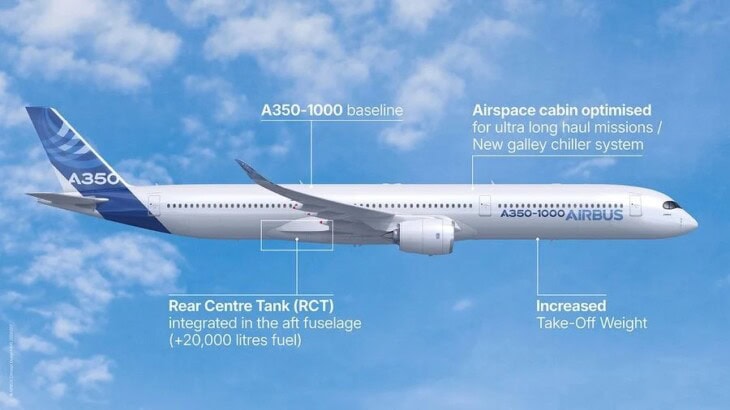
The ultra-long-range, or ULR, version is a modified A350-1000. Airbus adds a roughly 5,300-gallon (20,000-liter) rear center fuel tank, which extends the aircraft’s range by about 1,000 nautical miles, along with a higher maximum takeoff weight. Airbus says the changes push the jet’s range to around 11,150 miles (18,000 km) and let it fly commercially for up to 22 hours.
Carrying that much fuel comes at a cost, and it explains the aircraft’s most unusual number. Qantas has configured each jet with 238 seats, far fewer than the 300-plus a standard A350-1000 typically holds.
This is the core tradeoff of ultra-long-haul flying. Every pound of fuel an aircraft must carry to reach the far end of a route is weight it cannot spend on passengers and cargo. To make a 20-hour flight possible at all, an airline gives up seats, which is why these routes were commercially out of reach until an airframe was built specifically for them.
What makes it a ULR
An extra rear fuel tank and a higher takeoff weight are the difference between a standard A350-1000 and the Project Sunrise version. The reward is roughly 1,000 more nautical miles of range; the price is about 60 fewer seats than a normal layout.
The road to Sydney to London
Project Sunrise is Qantas’ long-running plan to fly nonstop from Australia’s east coast to Europe and North America. From October 2027, the airline says these aircraft will operate the world’s first scheduled nonstop Melbourne and Sydney services to London, which would become the longest nonstop commercial flights in the world, with nonstop Sydney to New York flights also planned.
Qantas has ordered 12 A350-1000ULRs in total, each built specifically for the project. The airline expects to take delivery of Vega in April 2027 and says seats on the new routes will go on sale in February 2027.
This week’s arrival follows the start of the ULR flight-test program earlier in the summer, when the aircraft began ultra-long-range testing. The Melbourne run is the campaign’s most visible proof point yet, but there is still more than a year of testing, certification, and cabin fit-out between this test aircraft and a paying passenger.
Reality check
This was a flight-test aircraft on a validation flight, not a service launch. Commercial Sydney to London flights are still scheduled for October 2027, and tickets do not go on sale until February 2027, so the record-setting routes remain more than a year away.
Sources and references used for research and fact-checking.
Get the Newsletter
The latest aviation news and stories sent to your inbox.
About the Author

Tim is the owner and lead editor of AeroCorner since 2019, overseeing aviation content covering aircraft, airlines, airports, and the broader aviation industry. Through years of researching, writing, editing, and publishing aviation-focused content, he has developed extensive practical knowledge of commercial aviation and air travel. Based in Asia and a frequent traveler himself, Tim also brings firsthand passenger experience to AeroCorner’s coverage. Outside of publishing, he has also explored aviation firsthand through hands-on flight training in New Zealand.