

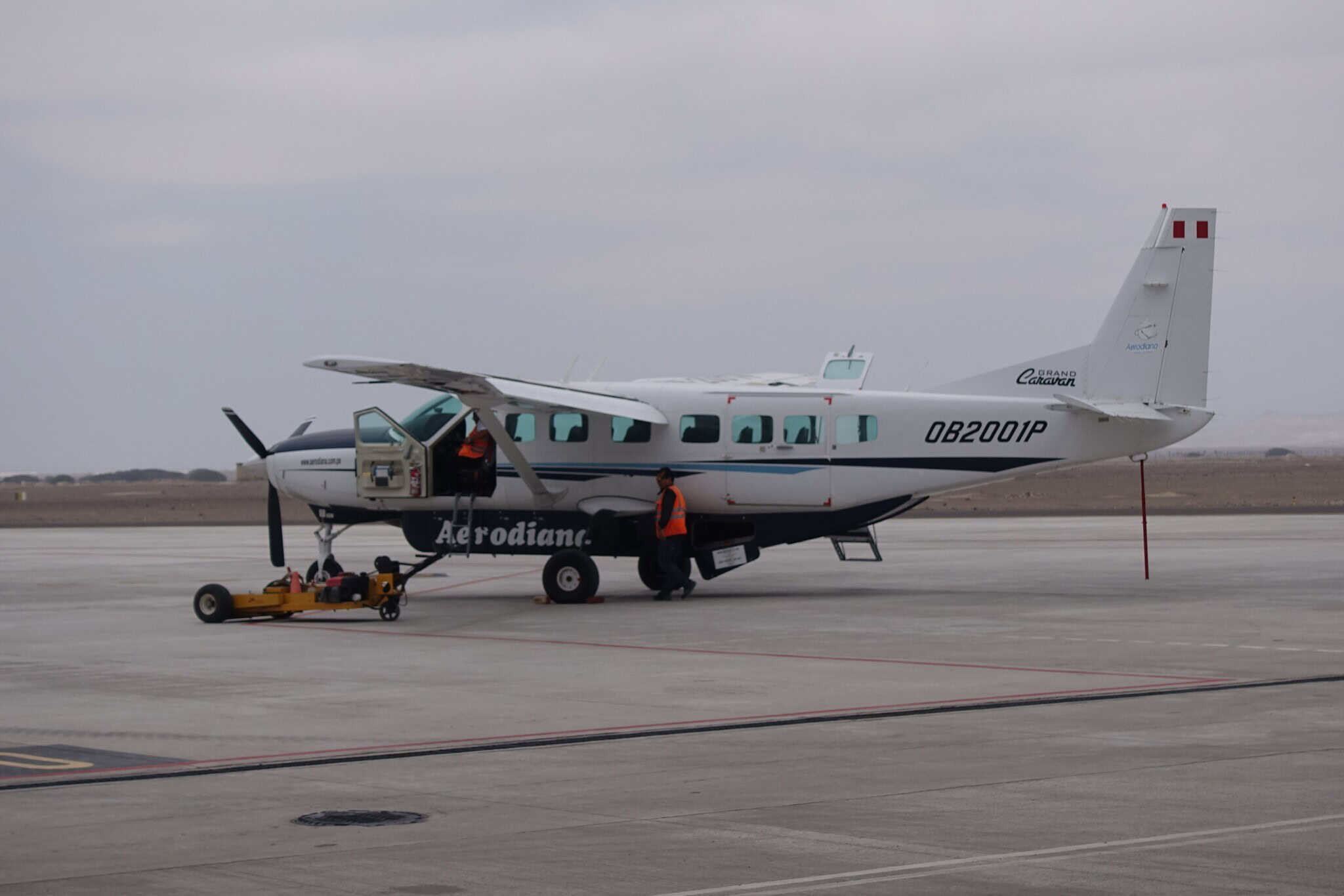
On August 1, 2026, a Cessna 208B Grand Caravan operated by the Peruvian sightseeing carrier Aerodiana crashed in the desert near Nazca, killing all 13 people on board. A day later, Peru’s Ministry of Transport and Communications suspended the company’s operations as a preventive measure while the country’s civil aviation authority checks its compliance with aeronautical rules.
The aircraft, registered OB-2001, was flying the standard tourist circuit over the Nazca Lines, the UNESCO-listed geoglyphs cut into the coastal desert of southern Peru.
What is known about the flight
According to the transport ministry’s account of the accident, the aircraft left Pisco airport at about 12:10 p.m. local time with two crew and eleven passengers, bound for the Nazca overflight and a return to Pisco.
Around 1:00 p.m., near the town of Socos in the Pueblo Nuevo district, the crew reported an emergency to the control tower at the Nazca aerodrome. Radio contact was lost immediately afterward.
The wreckage was found near Pueblo Viejo, roughly 7 miles (12 km) from the lines themselves, and was consumed by a post-impact fire. There were no survivors.
Peruvian authorities identified the dead as seven Italian, two Spanish and two German tourists, along with the two Peruvian pilots. The cause has not been established, and no official has publicly speculated about one.
12:10 p.m., Aug 1
Departure from Pisco. The Grand Caravan takes off with two pilots and eleven passengers for the Nazca Lines circuit.
About 1:00 p.m.
Emergency call, then silence. The crew reports an emergency to the Nazca tower near the town of Socos. Radio contact is lost.
Aug 1
Wreckage located. The aircraft is found near Pueblo Viejo, destroyed by fire. All 13 on board are killed.
Aug 2
Operations suspended. The transport ministry preventively suspends Aerodiana while the DGAC verifies the operator’s compliance.
Why the regulator grounded the operator before knowing the cause
A preventive suspension is not a finding of fault. It is an administrative pause that lets the regulator audit an operator’s maintenance records, crew licensing and operating procedures without aircraft flying in the meantime.
In Peru that audit falls to the DGAC, the civil aviation directorate, which is separate from the body investigating the crash itself. Aerodiana said it would cooperate with the official investigation and adjust its operations to whatever the authorities decide.
Peru’s foreign trade and tourism minister, Rogers Valencia, said the company held all the permits the DGAC requires for Nazca sightseeing work, in remarks reported by the Peruvian business daily Gestion. The ministry’s own published operations specification for Aerodiana authorizes tourist flights under visual flight rules in Class G airspace over the Nazca circuit.
What investigators have to work with
The technical investigation belongs to Peru’s Aircraft Accident Investigation Commission, the CIAA. Two of its investigators were sent to the site for a planned three days of evidence collection and interviews before moving material to Lima for analysis.
They will not have the recorders most travelers assume every aircraft carries. A single-engine turboprop of this size is generally not required to fly with a cockpit voice recorder or a flight data recorder, because those mandates are written around larger aircraft and higher passenger counts.
Investigators are instead evaluating whether they can recover a data storage card from the aircraft’s avionics, which on a modern Cessna Grand Caravan can log engine and systems parameters. That, plus the wreckage and the tower recording, may be most of the technical evidence available. The NTSB faced a similar limitation in the Bering Air Caravan crash in Alaska, where the weight and icing findings had to be rebuilt largely from wreckage and performance data.
This is a developing investigation
No cause has been determined. The emergency call has been confirmed by the transport ministry, but its content has not been released, and nothing published so far establishes a mechanical, weather or crew factor. Early reporting on accidents is frequently revised.
A pattern over the Nazca Lines
This is the third fatal Nazca sightseeing crash in about 16 years. In October 2010, an AirNasca aircraft went down with four British tourists and two Peruvian crew on board. In February 2022, a Cessna 207 flown by the tour operator Aerosantos crashed shortly after takeoff, killing all seven aboard.
The flight profile itself is demanding in a way an airline sector is not. To let passengers on both sides of a narrow cabin photograph the same figure, pilots fly repeated steep turns at low altitude, in hot desert air that thins the margin available to a piston or turboprop single.
None of that is a cause here, and the Grand Caravan is one of the most widely operated utility aircraft in the world with a long service record. But it explains why each of these accidents reopens the same argument in Peru about how closely the Nazca overflight business is supervised.
Sources and references used for research and fact-checking.
- Ministerio de Transportes y Comunicaciones (Peru), MTC expresa su profundo pesar por la perdida de vidas en el accidente aereo ocurrido en Nasca
- Ministerio de Transportes y Comunicaciones (Peru), Aerodiana S.A.C. operations specifications
- Ministerio de Comercio Exterior y Turismo (Peru), Comunicado: Sobre accidente aereo en Nasca
Get the Newsletter
The latest aviation news and stories sent to your inbox.
About the Author

Tim is the owner and lead editor of AeroCorner since 2019, overseeing aviation content covering aircraft, airlines, airports, and the broader aviation industry. Through years of researching, writing, editing, and publishing aviation-focused content, he has developed extensive practical knowledge of commercial aviation and air travel. Based in Asia and a frequent traveler himself, Tim also brings firsthand passenger experience to AeroCorner’s coverage. Outside of publishing, he has also explored aviation firsthand through hands-on flight training in New Zealand.