

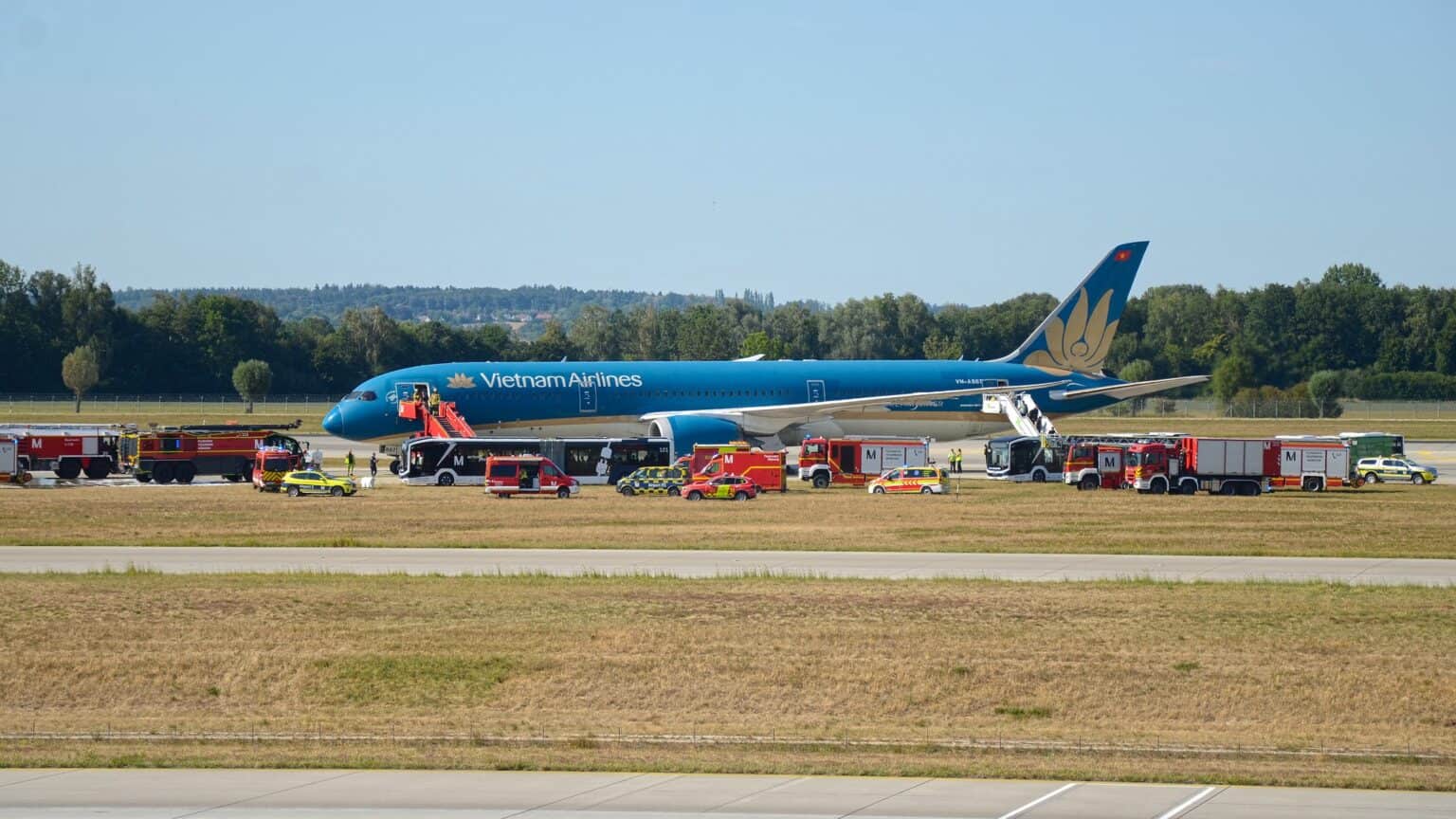
The Vietnam Airlines Boeing 787-9 that struck its tail leaving Munich as flight VN34 had its brakes applied during the takeoff roll, Germany’s accident investigation agency, the BFU, said in an interim report published on September 28, 2026. The jet then rotated at 163 knots, 12 knots below the 175-knot rotation speed calculated for that takeoff.
The report, file number BFU26-0757-AX, classifies the August 15 event as an accident, with the aircraft substantially damaged. Its account also differs from parts of the early picture, including our first report on the flight.
What the Flight Recorders Show
The 787 took off from runway 26L, which is 13,123 feet (4,000 m) long, carrying 271 passengers, 12 cabin crew and four pilots. The crew’s own calculation set V1 at 169 knots, the rotation speed (Vr) at 175 knots and the takeoff safety speed (V2) at 180 knots.
Three seconds after the takeoff mode was engaged, the flight recorders logged movement of both brake pedals at the left-hand seat, where the pilot flying sat. Tire tracks from both main landing gears were found on the runway at about its intersection with taxiway B4.
Further brake pedal inputs were recorded later in the roll, and the brake control units peaked at about 27% brake command on the left side and 17% on the right. From 1:57:03 p.m. local time, airspeed hovered at about 168 knots for roughly 18 seconds, with brief dips.
Rotation began at 163 knots, with the jet about level with the runway’s far threshold. It left the ground from the grass, and its tire tracks ran past the 200-foot (60 m) clearway to end about 790 feet (240 m) beyond the runway’s end.
1:56:12 p.m.
Takeoff mode engaged. The takeoff/go-around mode is activated for the roll on runway 26L.
1:56:15 p.m.
First brake input. Both left-seat brake pedals move; the brake units command 15% left and 6% right.
1:57:12 p.m.
Peak braking. Brake command reaches about 27% left and 17% right, with airspeed near 168 knots.
1:57:14 p.m.
Rotation at 163 knots. The nose comes up about level with the far threshold, 12 knots below Vr.
1:57:19 p.m.
V1 reached in the air. The jet hits 169 knots at 11 feet above the ground.
1:57:21 p.m.
Stall protection. The leading-edge slats extend automatically as stall protection activates.
1:57:29 p.m.
Tailstrike recorded. The recorder logs its “TAIL_STRIKE” parameter.
The tail and the wheels of both main gears hit parts of the approach lighting beyond the runway end, and 20 lamps were damaged in all. The BFU’s second media release says the on-site inspection found damage that compromises the aircraft’s structural integrity.
Rotation Speed, V1 and Why the Numbers Matter
US federal rules define V1 as the highest speed by which the pilot must take the first step to stop, such as braking or cutting thrust, for the jet to halt within the accelerate-stop distance.
Vr is the speed at which the pilot raises the nose, and V2 is the takeoff safety speed for the climb. On VN34, V1 was reached only at 11 feet above the ground, so the jet never reached its decision speed on the runway.
Manufacturer guidance treats early rotation as a leading tailstrike risk. An Airbus briefing note on the subject lists it first: rotating before the correct Vr means a higher nose-up attitude at liftoff and less room between tail and runway.
On VN34, the pitch reached 12.2 degrees at 15 feet, and the 787’s stall protection extended the slats on its own two seconds after V1.
It was a hot afternoon, 91°F (33°C) at the field. The 787-9 weighed about 531,000 pounds (240,857 kg), roughly 14,000 pounds under its maximum takeoff weight of 545,000 pounds (247,207 kg).
Pilot Input or a Brake System Fault?
The report records the pedal movement but does not say why it happened or whether it was intended. The pilot flying the takeoff was 64, with 27,182 hours in total and 7,795 hours as a 787 captain, according to the airline’s figures in the report.
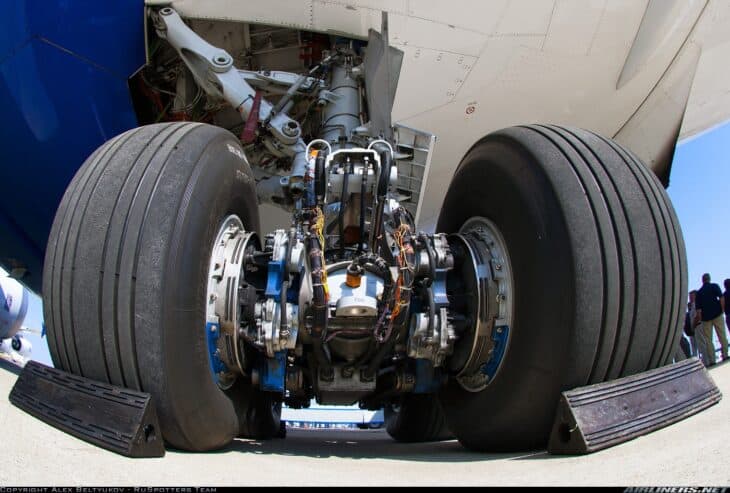
The BFU has also seized the brake system control units and the electric brake actuator controllers for detailed examination. Where conventional airliner brakes are pressed by hydraulic pistons, the 787’s use electromechanical actuators driven by electronic control units, a design supplier Safran says was the first on a commercial aircraft.

The BFU says it is still gathering facts on the human, technical and other factors, and that its final report will analyze them and name the causes.
One gap will not be filled. The takeoff audio was overwritten, the BFU says, because the jet landed and was powered down more than two hours after takeoff.
Interim, not final
An interim report sets out facts, not conclusions. The BFU has not said what caused the brake inputs, and its reports make no finding of fault. Its analysis and the cause will come in the final report.
The Return to Munich
About three and a half minutes after takeoff, the crew’s first call to controllers, which opened with “pan pan”, asked for radar vectors to dump fuel. They later said they expected a flat tire.
At 9,000 feet, the pilot the airline had named as pilot in command, who had been in a jumpseat, took over as pilot flying. The crew dumped 62 metric tons (about 137,000 pounds) of fuel over some 45 minutes.
They then flew two approaches to runway 26R with the gear down, the first so ground staff could inspect it, and went around both times. The jet landed on 26R just before 4 p.m. local time and taxied to taxiway A6, where it stopped.
Early accounts, including ours, described a second overrun on landing. The interim report describes none.
Four left main gear tires were found damaged after landing, and smoke came from that gear, though firefighters found no fire. Passengers left by mobile stairs, and the BFU reports that no one was injured.
The aircraft, registered VN-A867, was built in 2016. The BFU has not given a date for its final report on the Munich Airport accident, which Vietnamese and US investigators are also taking part in.
Sources and references used for research and fact-checking.
- BFU (German Federal Bureau of Aircraft Accident Investigation), Interim Report BFU26-0757-AX, Boeing 787-9, Munich Airport, 15 August 2026
- BFU, 2nd Media Release on the Status of the Investigation into a Serious Incident involving a Boeing B787-9 on 15 August at Munich Airport
- BFU, Media Release on the Status of the Investigation into a Serious Incident involving a Boeing B787-9 on 15 August at Munich Airport
- eCFR via Cornell LII, 14 CFR 1.2, Abbreviations and symbols
- Airbus (via SKYbrary), Flight Operations Briefing Notes: Preventing Tailstrike at Takeoff
- Safran, Boeing 787 electric brake: an advanced technology that meets airline requirements
Get the Newsletter
The latest aviation news and stories sent to your inbox.
About the Author

Tim is the owner and lead editor of AeroCorner since 2019, overseeing aviation content covering aircraft, airlines, airports, and the broader aviation industry. Through years of researching, writing, editing, and publishing aviation-focused content, he has developed extensive practical knowledge of commercial aviation and air travel. Based in Asia and a frequent traveler himself, Tim also brings firsthand passenger experience to AeroCorner’s coverage. Outside of publishing, he has also explored aviation firsthand through hands-on flight training in New Zealand.