


On July 30, 2026, the National Transportation Safety Board released its final report on Bering Air Flight 445, the commuter flight that went down on the sea ice off Nome, Alaska in February 2025 and killed all 10 people aboard. The board concluded that the single-engine turboprop was flown too slowly in severe icing while carrying hundreds of pounds more than it was legally allowed to.
What the board concluded
The NTSB put the probable cause on the pilot’s inadequate airspeed management, which it tied to high workload and degraded situational awareness, and on improper control inputs leading up to and during the aerodynamic stall.
Contributing to that, the board said, was operating the aircraft above its maximum gross weight, along with Bering Air’s safety management, which allowed overloaded flights to depart as a matter of routine. Inadequate FAA oversight of the carrier was also cited as a factor.
Flight 445, a Cessna 208B Grand Caravan EX registered N321BA, left Unalakleet at about 2:38 p.m. on February 6, 2025, bound for Nome roughly 150 miles (240 km) away. Radar contact was lost around 40 minutes later, and the wreckage was found on pack ice in Norton Sound about 34 miles (55 km) southeast of Nome.


The weight numbers
The final report puts the Caravan about 736 pounds (334 kg) over its maximum takeoff weight, and about 991 pounds (450 kg) over the lower weight limit that applies to flight into known icing. Investigators also found the pilot had logged 1,000 pounds of fuel when the aircraft was actually carrying roughly 1,464 pounds.
The overloading was not a one-off. Investigators sampled 16 flights flown by the accident aircraft in the 10 days before the crash and found that 44 percent of individual legs departed above the maximum gross takeoff weight.
The board also faulted the FAA for failing to increase its surveillance of Bering Air as the company expanded and took on more complex operations after the pandemic.
The tragedy of Flight 445 was not the result of a single failure, but a series of preventable breakdowns that eroded critical safety margins.
NTSB Chairwoman Jennifer Homendy
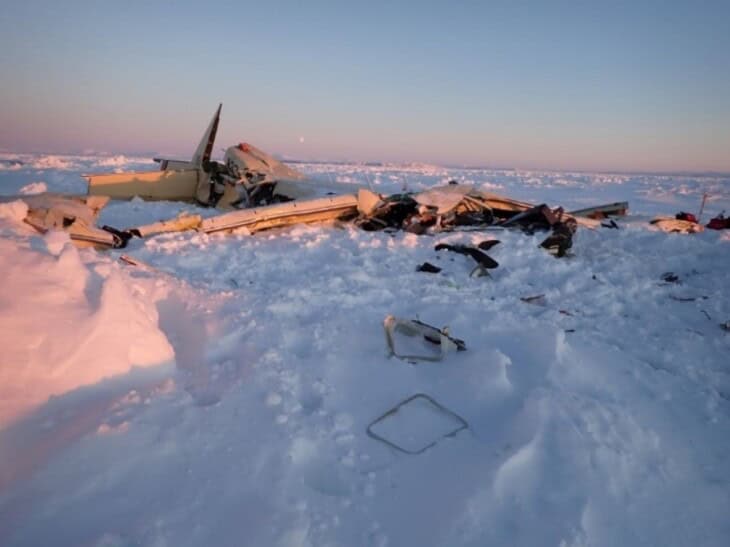
Why the icing weight limit is a separate number
Most aircraft have one maximum takeoff weight. Aircraft approved for flight into known icing frequently carry a second, lower one, and Cessna’s stretched utility single is one of them.
The reason is aerodynamic. Ice on the wing changes its shape and raises the speed at which it stalls, and a heavier airplane already stalls at a higher speed than a light one. Put both together and the gap between normal flying speed and the stall shrinks from comfortable to thin.
Recorded data shows how little of that margin was left. Airspeed drifted from about 160 knots down to 99 knots as the pilot worked the ice protection system and set up for an approach into an airport whose runways had been temporarily closed for deicing.
Another pilot flying the area that day described the worst icing environment she had ever seen, with supercooled large droplets building spiky accumulations on the airframe. Flight 445’s last transmission was that it was icy over there.
What the NTSB wants changed
The recommendations are aimed largely at Part 135, the rules covering commuter and on-demand carriers that fly a large share of Alaska’s passenger traffic. The board asked the FAA to require certified dispatchers for these operators and to expand load manifest and recordkeeping requirements.
It also called for mandatory upset prevention and recovery training, wider use of flight data monitoring, and crash-resistant flight recorders on aircraft that today carry neither. A further recommendation asks the FAA to set explicit criteria for stepping up oversight of operators that grow quickly.
None of that is self-executing. Recommendations are advisory, and the FAA said only that it takes NTSB recommendations seriously and will review them, the same posture that has left the board pressing Congress on open safety items from other investigations.
Reality check on the weight figures
Published numbers for this flight differ because more than one limit is involved. The NTSB’s 2025 preliminary report put the aircraft roughly 1,058 pounds over the icing limit at departure; the final report’s figures are 736 pounds over the standard maximum takeoff weight and 991 pounds over the icing limit. Both describe the same problem, measured against different ceilings.
Bering Air declined to comment on the report. The carrier has since introduced manager sign-offs for departures in hazardous weather, tighter weight limits, and aircraft substitution when icing is forecast.
Sources and references used for research and fact-checking.
Get the Newsletter
The latest aviation news and stories sent to your inbox.
About the Author

Tim is the owner and lead editor of AeroCorner since 2019, overseeing aviation content covering aircraft, airlines, airports, and the broader aviation industry. Through years of researching, writing, editing, and publishing aviation-focused content, he has developed extensive practical knowledge of commercial aviation and air travel. Based in Asia and a frequent traveler himself, Tim also brings firsthand passenger experience to AeroCorner’s coverage. Outside of publishing, he has also explored aviation firsthand through hands-on flight training in New Zealand.