

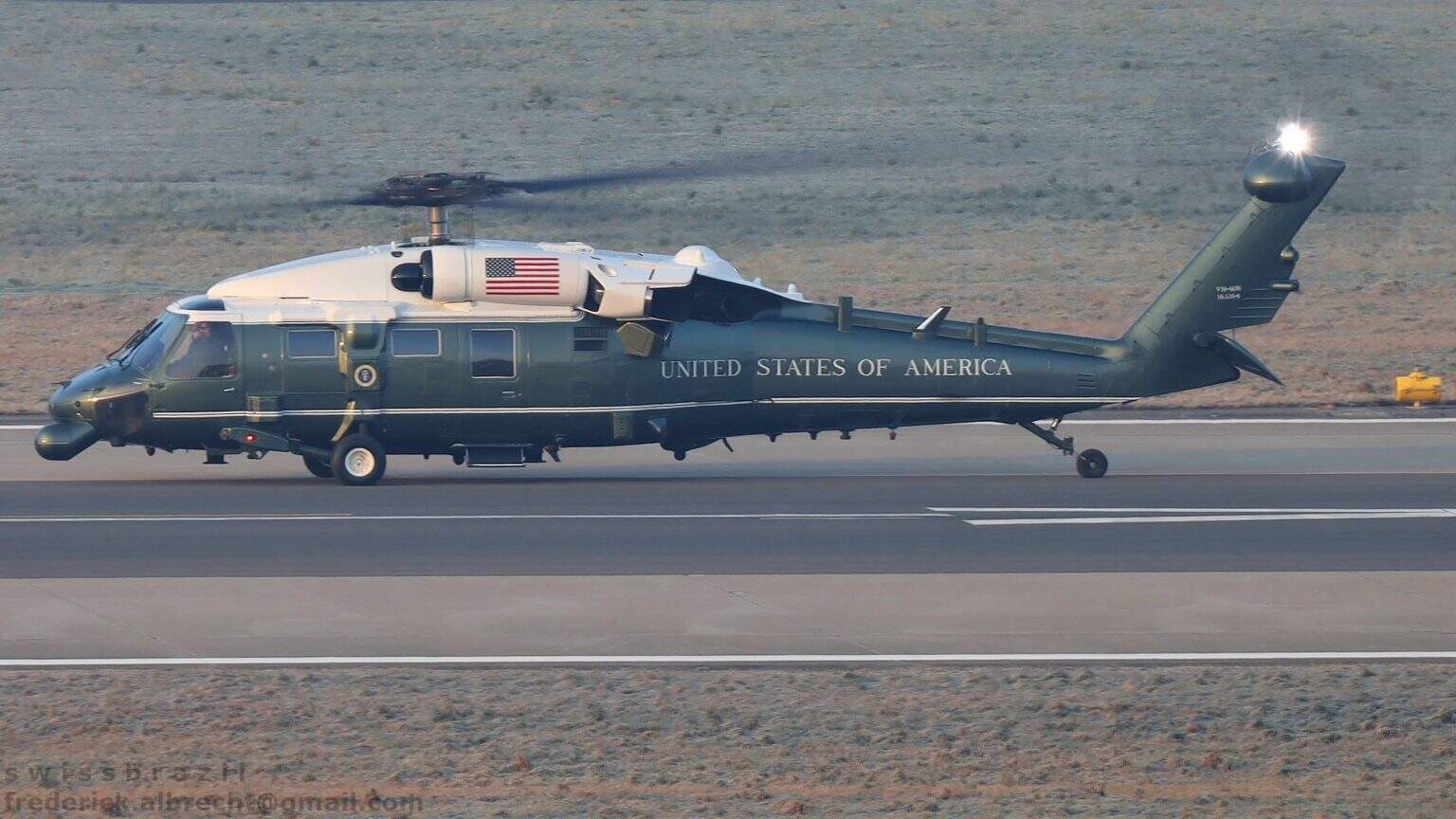
On August 4, 2026, the presidential helicopter Marine One and an Envoy Air regional jet lost separation about two miles north of Ronald Reagan Washington National Airport. A National Transportation Safety Board preliminary report released on August 27 traces the close pass to a radio dead zone that kept the helicopter crew from reaching the control tower.
The board is still investigating and its findings are preliminary. But the sequence it lays out shows how a single unheard radio call removed the traffic hold that normally clears the sky for a presidential movement.
What the preliminary report found
Marine One was operating from a temporary pad on the Ellipse, just south of the White House, because construction on the grounds has displaced its usual South Lawn departure point. Crews are required to give the tower a three-minute warning before lifting off so controllers can pause airport traffic.
That call never got through. The NTSB says Marine One’s first transmission to the tower’s helicopter frequency was not received, a second was broken and unreadable, and a backup attempt routed through Joint Base Anacostia-Bolling also failed.
With no warning in hand, controllers kept launching departures. Envoy Air Flight 3742, an Embraer E170 bound for Pensacola, was cleared off Runway 1 and began climbing as Marine One crossed north of the field.
The FAA estimated the two aircraft came within 0.82 nautical miles laterally and 700 feet vertically. The NTSB noted that the gap still met the Class B radar separation standard, that neither aircraft was damaged, and that no one was hurt.
The radios were in the wrong place
FAA technicians later found there was not enough line-of-sight coverage between the Ellipse and the antenna site used for the tower’s helicopter-control frequency, which sat in a nearby residential neighborhood. The agency moved those radios to the top of the Reagan National tower, and follow-up checks with two Marine helicopters found no further problems.
The trouble was not a surprise. On July 30, five days before the incident, tower officials met with Marine Helicopter Squadron One after controllers had stopped receiving the required three-minute notifications. The squadron said communications had been spotty, and an alternate procedure agreed at that meeting did not work on August 4.
Why one missed call matters
Presidential helicopter movements get a protective bubble. For a few minutes around each departure or arrival, controllers hold airport traffic on the ground or keep it well clear, so the helicopter flies through a sanitized block of airspace. The crew’s three-minute call is what starts that clock.
When the call does not arrive, controllers have no reason to stop anything, and the bubble never forms. That is what happened here: the equipment and procedures worked as designed, but the instruction to protect Marine One was never received.
Reagan National’s airspace has been under intense scrutiny since a midair collision there in January 2025 killed 67 people. When the Marine One close pass first came to light in early August, it renewed questions about how helicopter traffic is managed around the field.
Reality check
The two aircraft never lost radar separation, and the NTSB says the applicable standard was met. The failure was procedural: the traffic hold that normally shields a presidential flight was never triggered, because the crew’s radio call did not reach the tower.
The problem may not be fully solved. On August 27, the same day the report came out, controllers again struggled to reach Marine One before a White House departure and relayed messages through other helicopters, CNN reported. The FAA said contact was established before the helicopter took off and there was no loss of separation.
The NTSB investigation remains open. A final report, with a probable cause and any further safety recommendations, is likely more than a year away.
Sources and references used for research and fact-checking.
Get the Newsletter
The latest aviation news and stories sent to your inbox.
About the Author

Tim is the owner and lead editor of AeroCorner since 2019, overseeing aviation content covering aircraft, airlines, airports, and the broader aviation industry. Through years of researching, writing, editing, and publishing aviation-focused content, he has developed extensive practical knowledge of commercial aviation and air travel. Based in Asia and a frequent traveler himself, Tim also brings firsthand passenger experience to AeroCorner’s coverage. Outside of publishing, he has also explored aviation firsthand through hands-on flight training in New Zealand.