


Cirrus SR22 N313DG declared an emergency about a minute after receiving its departure clearance from Lee C. Fine Memorial Airport on November 3, 2026, then crashed in Lake of the Ozarks State Park, according to the National Transportation Safety Board’s preliminary report. The pilot and passenger, a Simpsonville, Kentucky, couple, were killed.
The report, case CEN27FA037, was posted in the NTSB’s CAROL database this week and gives no cause. It confirms the registration that our first report on the crash could tie to the wreck only through tracking data.
What the preliminary report says happened
The flight left Clark Regional Airport in Jeffersonville, Indiana, at about 10:01 a.m. Central time, bound for Wichita, Kansas. The NTSB describes the landing at Lee C. Fine (AIZ) at about 12:57 p.m. as an intermediate stop.
Airport camera footage shows the airplane taxiing onto the fixed-base operator’s ramp at 1:02 p.m. An employee then filled it from the 100LL truck by about 1:10 p.m. after the pilot asked for the tanks to be topped off, and records show 47 gallons (178 liters) dispensed.
At about 2:07 p.m., the pilot called Springfield Approach for an instrument flight rules clearance to Wichita and was released with instructions to fly a heading of 240 degrees on entering controlled airspace.
Shortly after takeoff, about a minute after the clearance, the pilot told the controller the flight was returning to AIZ and declared an emergency. When the controller asked what the emergency was, only a short, distressed transmission came back, and radio and radar contact were then lost.
A witness driving nearby saw the airplane pitch down and descend in a right turn toward the ground, but did not see the impact. The NTSB puts the accident time at 2:09 p.m.
The NTSB says no FAA or commercial ADS-B track data was available for the flight, though FlightAware had logged one position, as our earlier story noted.
The wreckage, the engine and the fuel
The Cirrus SR22 came down in woods about 0.43 nautical miles, roughly half a mile (800 m), southwest of the departure end of runway 22, and about 245 feet (75 m) right of the extended centerline. A post-impact fire destroyed most of the composite fuselage, wings and tail.
Investigators found the flaps fully retracted. Control cable continuity could not be confirmed, but every separation they saw was consistent with overstress, heat or cuts made during recovery.
On the Continental IO-550-series engine, crankshaft continuity was confirmed, and a borescope check of all six cylinders found no mechanical failure of the pistons or valves. The top spark plugs showed no failure, and the crankcase had no holes or cracks.
The fuel system itself could not be examined because of the fire. The fuel truck had passed its documented inspection earlier that day, and samples taken from it after the accident were blue and showed no sign of contamination.
Two of the three propeller blades stayed on the hub, bent aft and twisted toward low pitch, and all three showed rotational scoring. Investigators also found three tree branches with 45-degree angular cuts at the site.
The report does not say what either finding indicates.
At 1:56 p.m., Lee C. Fine reported 10 miles of visibility, a few clouds at 1,600 feet and wind from 180 degrees at 12 knots gusting to 19. The NTSB says visual conditions prevailed.
What the report says about the parachute
N313DG carried the Cirrus Airframe Parachute System (CAPS), and the report’s account of it is not simple.
The parachute was found under the horizontal stabilizer, still packed in its deployment bag and damaged by heat. Its enclosure cover lay about 5 feet north of the tail, the rocket was not found on site, and no parachute straps were seen in the wreckage.
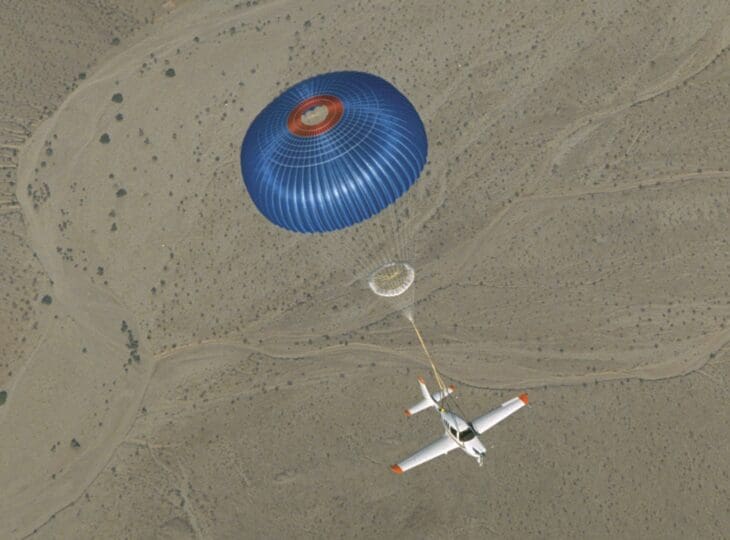

In the cockpit, the activation handle had melted around the cable end, with no safety pin observed. The cable was continuous from the handle to the ignition switch, and the switch’s fire-pin actuator was found pulled down.
Like other airframe parachutes, the Cirrus parachute is fired from a cockpit handle whose cable leads to an igniter and a rocket that extracts the parachute, AOPA explains. Cirrus’s official minimum deployment height is 400 feet above the ground in level flight, AOPA adds.
The NTSB has not said whether the handle was pulled in flight, and the report gives no altitude for the moment the emergency was declared.
A preliminary report, not a finding
The NTSB marks every page of this report as preliminary and subject to change. It lists facts gathered so far, draws no conclusions and does not say why the pilot declared an emergency.
Who was on board and what comes next
The Miller County Coroner’s Office identified the two who died as John Peterson, 52, and Michelle Peterson, 51, of Simpsonville, KRCG reported. The NTSB report names neither of them and does not say which one was flying.
FAA records list N313DG as a 2005 SR22 registered to 3DG Aviation LLC. The NTSB names the operator as Thoroughbred Flying Club Inc., on a personal Part 91 flight.
The damaged primary and multifunction displays, autopilot controller and navigation and communication units have gone to the NTSB’s Vehicle Recorder Laboratory for examination and possible data extraction.
Cirrus Aircraft, Hartzell Aviation and Continental Aerospace Technologies are parties to the NTSB investigation, alongside the FAA’s Kansas City office. The board generally aims to complete an investigation within 12 to 24 months.
Sources and references used for research and fact-checking.
Get the Newsletter
The latest aviation news and stories sent to your inbox.
About the Author

AeroCorner News is the aviation news desk of AeroCorner.com. It covers accidents and incidents, safety rulings, airline and airport disruption, and new aircraft. It works from primary sources such as the NTSB, FAA, EASA and the manufacturers' own announcements.