

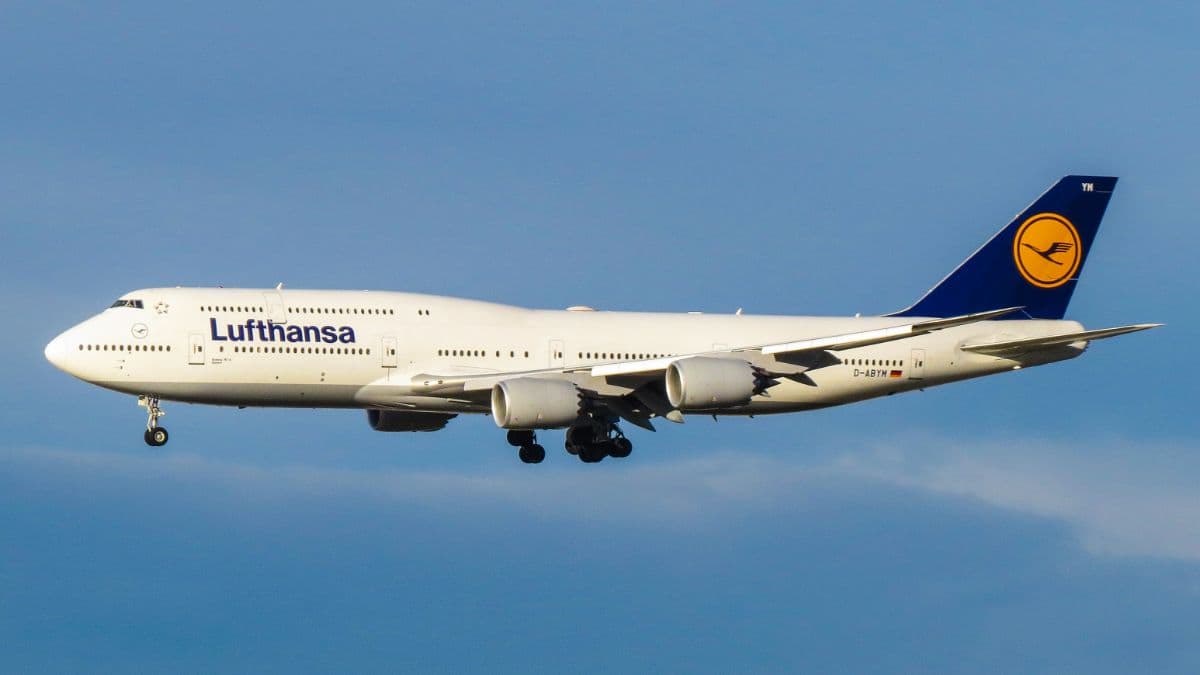
On August 6, 2026, a Lufthansa Boeing 747-8 flying from Johannesburg to Frankfurt diverted to Brazzaville, Republic of the Congo, after the crew reported an unidentified smell in the cabin. All 363 passengers and the crew aboard flight LH573 landed safely, and no injuries were reported.
What happened on flight LH573
The Boeing 747-8, registration D-ABYO, left Johannesburg’s O.R. Tambo International Airport at around 7:00 p.m. local time. About four hours into the flight, cruising at 34,000 feet roughly 380 miles (610 km) northeast of Brazzaville over the Democratic Republic of the Congo, the crew reported an unidentifiable smell in the cabin.
The pilots squawked 7700, the universal emergency code, and requested a diversion to Brazzaville’s Maya-Maya Airport. The jumbo jet landed safely on runway 23 about 50 minutes later, according to AVherald, which tracks aviation incidents in real time.
Passengers and crew disembarked without further incident and were put up in hotels in Brazzaville overnight. Lufthansa sent a replacement 747-8 from Frankfurt the next day to fly them the rest of the way home.
Lufthansa confirmed the smell prompted the diversion but has not identified its cause. The airline said it acted out of caution, and the aircraft remained in Brazzaville for a technical inspection covering its cabin systems, electrical equipment, air conditioning and wiring before returning to service.
Why an unexplained smell grounds a flight immediately
Airline procedures treat a cabin smell of unknown origin with the same urgency as visible smoke, whether or not anyone can find a source. A fire hidden behind a panel or above a ceiling liner can spread faster than a crew can trace it, and at cruise altitude there is no way to reach the ground except by landing.
So the checklist response is simple: get the aircraft down at the nearest suitable airport, without waiting to confirm whether a fire actually exists. That is exactly what happened on a SWISS A330 that diverted to Bangor after smoke filled its business-class cabin over the Atlantic.
The same logic sent a Delta A220 diverting to Vancouver over an odor that was later traced to a faulty water heater. In both cases, crews acted on the smell alone.
Why Brazzaville was the answer
Widebody flights crossing Central Africa have few large airports to choose from if something goes wrong mid-route. Brazzaville’s Maya-Maya Airport has a long runway and handles international widebody traffic, which made it the nearest realistic option for a jet over the Democratic Republic of the Congo, even though it sits well off Lufthansa’s usual route map.
The cause of the smell remains unresolved. Flight-tracking data cited by several outlets pointed to a possible electrical source, but Lufthansa has not confirmed that characterization, and the aircraft’s onward movement from Brazzaville is a repositioning flight, not a finding.
Still a developing story
Lufthansa has not released a formal cause. Until the inspection is complete, any explanation for the odor, including speculation about an electrical origin, is provisional.
Get the Newsletter
The latest aviation news and stories sent to your inbox.
About the Author

Tim is the owner and lead editor of AeroCorner since 2019, overseeing aviation content covering aircraft, airlines, airports, and the broader aviation industry. Through years of researching, writing, editing, and publishing aviation-focused content, he has developed extensive practical knowledge of commercial aviation and air travel. Based in Asia and a frequent traveler himself, Tim also brings firsthand passenger experience to AeroCorner’s coverage. Outside of publishing, he has also explored aviation firsthand through hands-on flight training in New Zealand.