

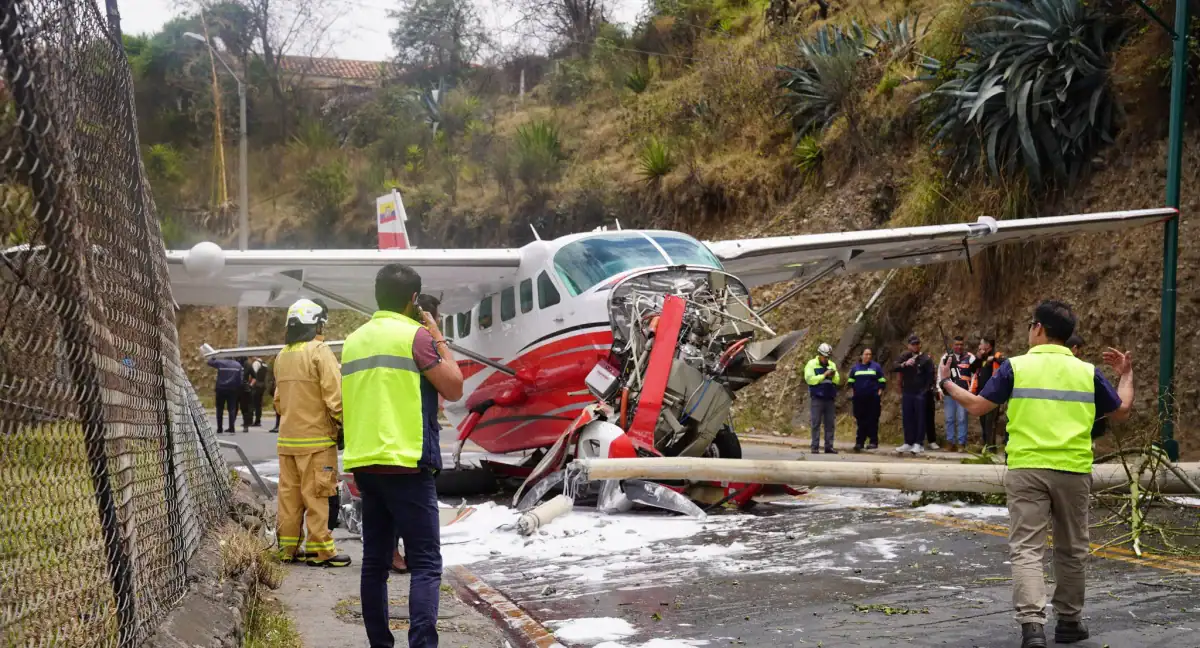
On October 8, 2026, the Cessna 208B Grand Caravan EX HC-CYM ran off the end of the runway at Mariscal Lamar International Airport in Cuenca, Ecuador, and fell down an embankment onto Avenida Hurtado de Mendoza. Both people aboard survived and were in stable condition, Ecuador’s civil aviation authority (DGAC) said.
The aircraft was arriving from Guayaquil on a flight hired by the Banco Central del Ecuador to carry valuables. The central bank said the cargo was intact, insured and in custody.
What happened at Mariscal Lamar
Ecuador’s ECU 911 emergency service logged the alert at 12:13 local time. According to Expreso, the Caravan was operated by Cuencana Airlines and left the runway at its northern end.
ECU 911 video shows the turboprop dropping onto a road that cars had crossed moments earlier. It came to rest across the avenue beside a fallen electricity pole, with its nose and propeller badly damaged.
The two crew members were treated by health ministry staff and firefighters, Cuenca police chief Pablo Inga told the news agency EFE. Their names have not been released, and the extent of their injuries has not been officially detailed.
Cuenca’s traffic agency closed Avenida Hurtado de Mendoza, Paseo Milchichig and its junction with Calle España, El Comercio reported. The central bank did not say how much money or what securities the aircraft was carrying.
The airport authority, Corpac, suspended operations until 2:30 p.m., and arriving and departing flights showed delays. The DGAC later said the airport was back to full operation and that removing the wreck was being coordinated with the central bank, prosecutors and police to keep the cargo in custody.
No cause has been given. One local outlet raised a possible mechanical failure, but no official source has confirmed it, and the central bank said the authorities would establish the causes through their investigation.
Why Cuenca’s runway leaves little margin
Mariscal Lamar sits inside the city at 8,306 feet (2,532 m) above sea level. It has a single runway, 05/23, that is 6,234 feet (1,900 m) long.
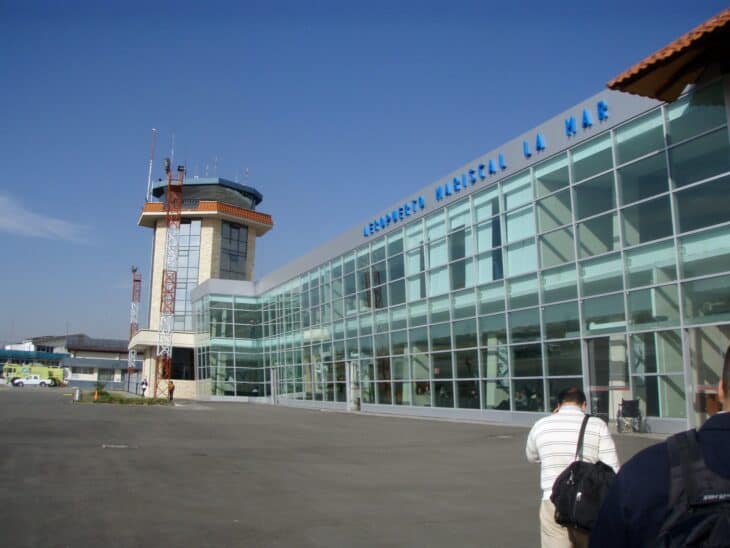

Altitude matters on landing because the air is thinner. The FAA explains that at a high density altitude an aircraft flies the same indicated airspeed on approach but a higher true airspeed, so it touches down faster over the ground and needs a longer landing roll.
For a Grand Caravan EX, Textron Aviation publishes a landing ground roll of 1,004 feet (306 m) and a landing distance of 1,836 feet (560 m). Those book figures are a fraction of Cuenca’s runway even allowing for altitude, and the authorities have not yet said what made this landing different.
The airport has seen this kind of accident before. On April 28, 2016, a TAME Embraer 190 from Quito skidded off the runway on landing in heavy rain with 93 people aboard, and Fox News reported two light injuries.
That jet stopped just short of and above a public street, AIN reported at the time. The 2026 Caravan went one step further and reached the avenue itself.
Runway requirements are built around the worst day rather than the average one, as our guide to runway length explains. In July, an Enugu Air jet overran the runway at Benin in Nigeria, and all 68 aboard escaped unhurt.
Cuenca has started looking for an alternative. Corpac is running a weather study in Tarqui parish, south of the city, to assess a possible new airport site, Expreso reported, and the study needs five years of data, of which a little over one has been collected.
Sources and references used for research and fact-checking.
Get the Newsletter
The latest aviation news and stories sent to your inbox.
About the Author

Tim is the owner and lead editor of AeroCorner since 2019, overseeing aviation content covering aircraft, airlines, airports, and the broader aviation industry. Through years of researching, writing, editing, and publishing aviation-focused content, he has developed extensive practical knowledge of commercial aviation and air travel. Based in Asia and a frequent traveler himself, Tim also brings firsthand passenger experience to AeroCorner’s coverage. Outside of publishing, he has also explored aviation firsthand through hands-on flight training in New Zealand.