

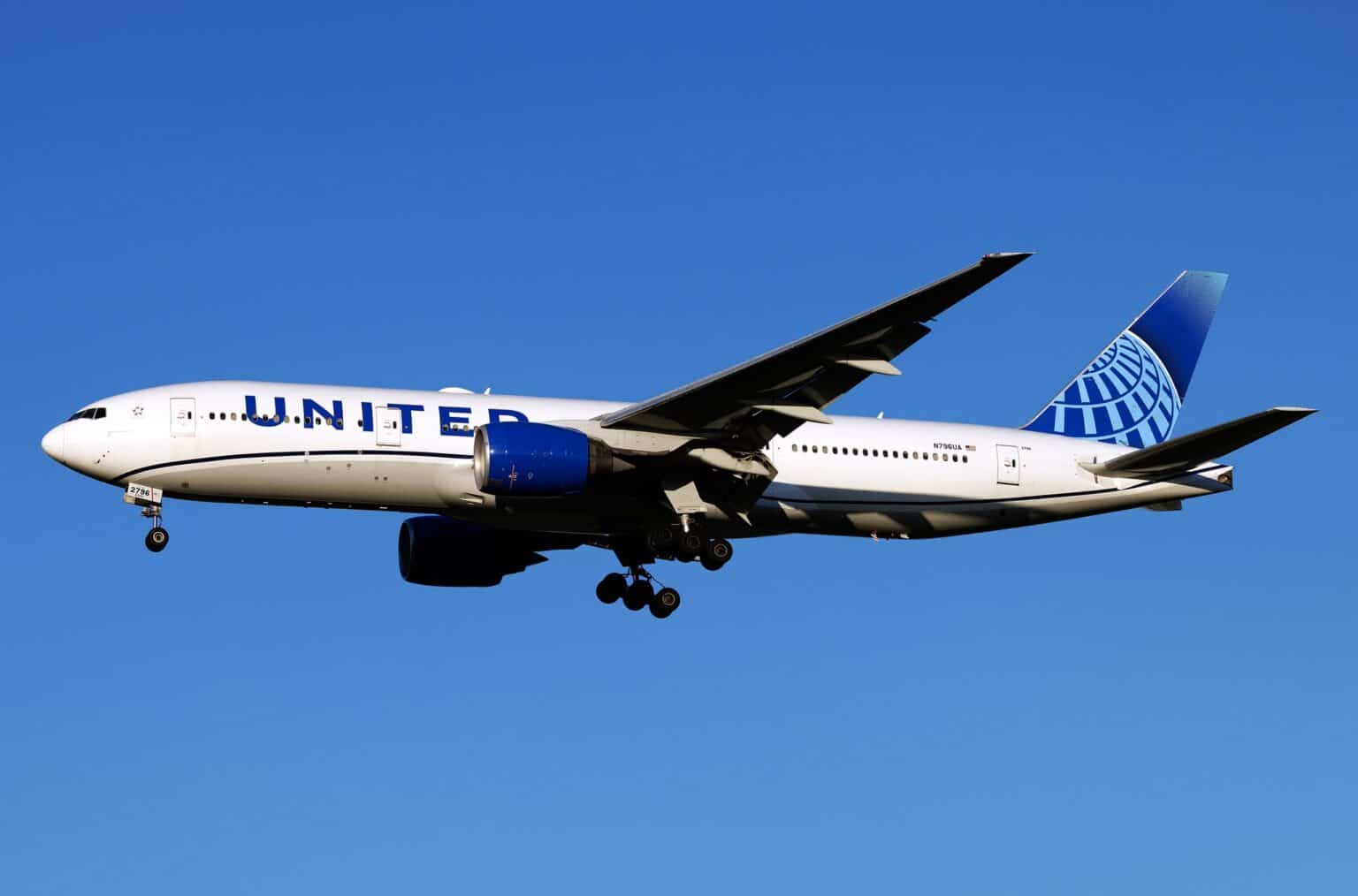
United Airlines flight UA888 from San Francisco to Beijing returned to San Francisco on Tuesday, October 6, 2026, after the crew shut down one of the Boeing 777’s two engines in the climb. The jet landed safely about an hour and a half after it left.
The aircraft, a 777-200 registered N796UA, had still not flown again two days later. No cause for the engine problem has been made public.
What happened on the climb
UA888 departed San Francisco International Airport at 11:34 a.m. local time, according to FlightAware’s history for the flight. The same record shows it back at San Francisco at 1:00 p.m., with the Beijing leg marked as diverted.
Passing about 28,000 feet, the right-hand engine began making loud noises and vibrating severely, The Aviation Herald reported. The crew stopped the climb, shut the engine down and turned back, landing on runway 28R.
The Aviation Herald’s report labels the flight UA-7, but its own tracking link points to UAL888. FlightAware’s record for N796UA confirms the jet flew the San Francisco to Beijing service as UA888 that morning, while United’s flight 7 operated between Houston and Tokyo Narita that day.
The Aviation Herald reported that the aircraft was still on the ground at San Francisco about 48 hours after landing, and FlightAware lists no flight for N796UA since the return. A later UA888 departure that evening appears in FlightAware’s history as canceled, so it is not clear how or when the Beijing passengers continued their trip.
The jet and its engines
The FAA registry lists N796UA as a 777-222 built in 1998, owned by United and fitted with Pratt & Whitney PW4000-series engines. The Aviation Herald identified the engine that was shut down as a PW4090.
The PW4090 belongs to the PW4000-112 family, named for its 112-inch fan, which powers the first generation of 777s: the 777-200, 777-200ER and 777-300. The engine type entered service with United on June 7, 1995, and was approved from the start for 180-minute ETOPS, the rules that let twin-engine jets fly long routes far from a diversion airport.
That approval rests on the 777 being able to keep flying safely on one engine. An in-flight shutdown is serious, but it is a scenario crews train for, and a return to the departure airport is a standard response when it happens early in a long flight.
A familiar picture at San Francisco
UA888 closely matches a United return three months ago. On July 9, flight UA926 to Frankfurt, another PW4090-powered 777-200, N228UA, shut down its right-hand engine after a loud bang passing about 29,000 feet and landed back on runway 28R, Aviation A2Z reported.
No cause has been published for either shutdown, and two events on the same engine type are not, on their own, evidence of a shared fault.
The PW4000-112 has a well-known history at United. In February 2021, United Airlines Flight 328, a 777-200 with PW4077 engines, lost a fan blade to metal fatigue over Broomfield, Colorado, scattering engine cowling over the town before landing safely at Denver.
The FAA ordered fan blade inspections, United parked its PW4000-powered 777s, and the FAA cleared them to fly again in May 2022. The NTSB later found that blade inspections had been too infrequent to catch the cracks. Nothing published so far links UA888 to a fan blade problem.
Sources and references used for research and fact-checking.
Get the Newsletter
The latest aviation news and stories sent to your inbox.
About the Author

Tim is the owner and lead editor of AeroCorner since 2019, overseeing aviation content covering aircraft, airlines, airports, and the broader aviation industry. Through years of researching, writing, editing, and publishing aviation-focused content, he has developed extensive practical knowledge of commercial aviation and air travel. Based in Asia and a frequent traveler himself, Tim also brings firsthand passenger experience to AeroCorner’s coverage. Outside of publishing, he has also explored aviation firsthand through hands-on flight training in New Zealand.