

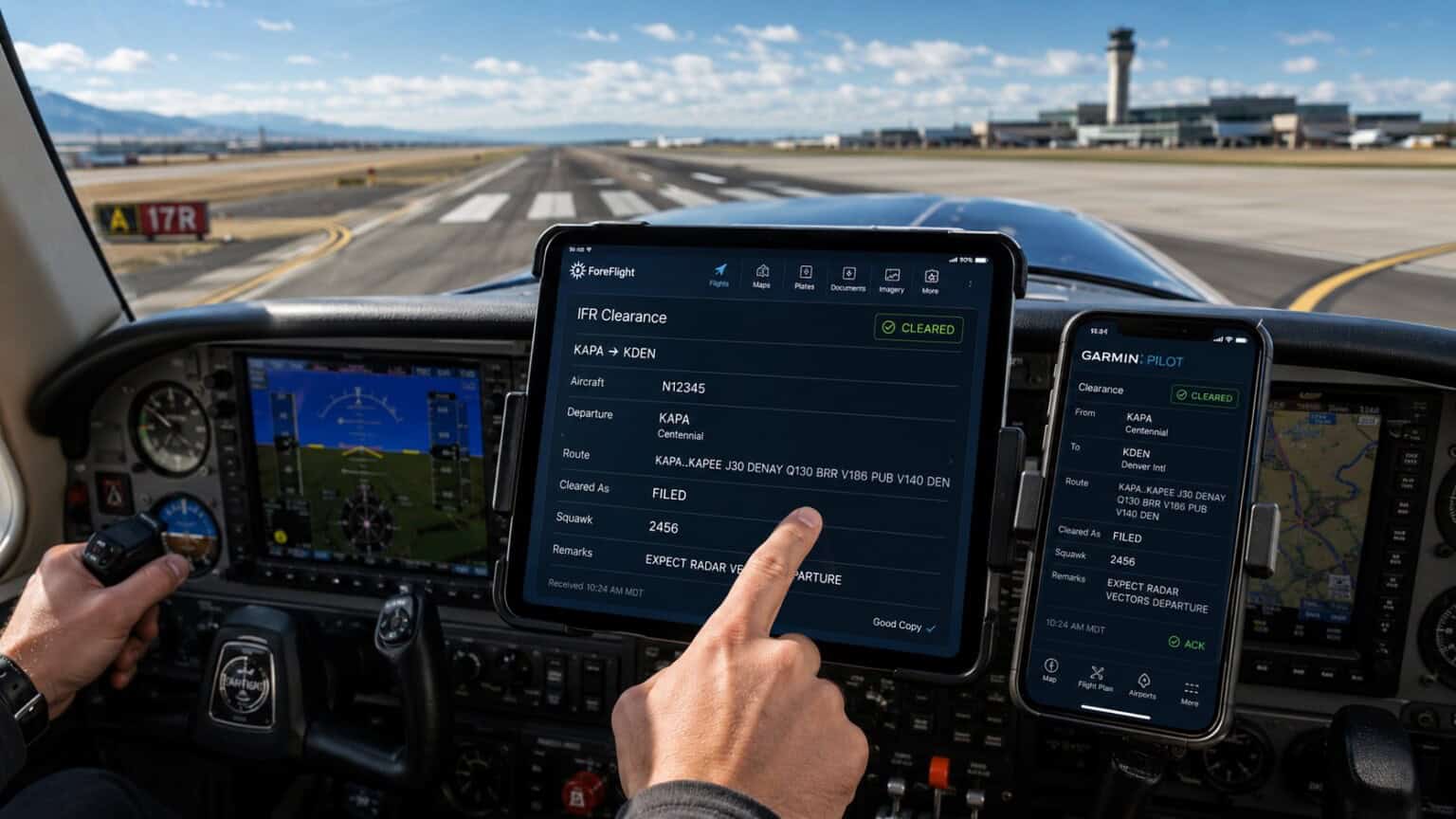
On July 23, 2026, Garmin said its Garmin Pilot app can now deliver instrument flight rules clearances electronically, letting pilots pull a departure clearance from a phone or tablet instead of copying it over the radio. ForeFlight, a Boeing subsidiary, added its own version of the feature. Both apps are front ends for an FAA program called Mobile Clearance.
The move brings a capability that has been in FAA testing since spring to the two most widely used electronic flight bag apps, so pilots on either platform can now request a clearance the same way.
What Mobile Clearance Does
Mobile Clearance was built by the FAA with the research group MITRE and is still in operational testing, according to the agency. It lets a pilot who has filed an IFR flight plan receive the clearance as text, review it, and accept it with a tap.
In Garmin Pilot, the pilot files the plan, gets the clearance electronically, and responds with a WILCO, Garmin said. The cleared route then loads onto the moving map and can be sent to the aircraft’s avionics, so the routing does not have to be retyped by hand.
Why Getting a Clearance Was a Hassle
At a towered airport, a pilot normally calls clearance delivery on the radio to get a route clearance, copies the route, altitude, frequency and transponder code by hand, and reads it all back for the controller to confirm. Those readbacks are a known source of error.
At the many airports with no control tower, it is clumsier. Pilots often phone a clearance delivery line and then sit on the ground waiting for a release, because there is no one at the field to issue an IFR clearance in person.
Delivering the clearance through an app cuts the radio readback out of the loop and gives controllers time back for the job that only they can do, separating traffic. That matters at a time of a chronic controller shortage.
The FAA is expanding the trial in stages rather than switching it on everywhere at once.
May 2026
First live test. The FAA began evaluating Mobile Clearance in the Houston area, according to the agency.
Summer 2026
Trial widens. Evaluation expanded to Appleton International in Wisconsin and New Century AirCenter in Kansas.
August 2026
Canceling IFR added. Pilots will also be able to cancel an IFR flight plan through the apps, the FAA said.
Early fall 2026
More metros. The trial is set to reach airports around Kansas City and Austin.
2027
Nationwide goal. The FAA plans to begin rolling Mobile Clearance out across the country.
For now this is a narrow program aimed at general aviation and business aviation, not the airline world, and it works only where the FAA has switched it on and only in an app that supports it.
Reality check
This is still a limited operational trial at a handful of airports, not a nationwide system. Mobile Clearance works only at participating fields and only through an equipped app, and the FAA has not committed to a firm nationwide date beyond a 2027 start.
Even so, it is a concrete step toward the digital, less voice-dependent air traffic system the FAA has talked about for years. It lands the same week the FAA finalized its 5G altimeter retrofit rule, part of a broader modernization push.
It also folds a routine, error-prone task into the same app pilots already use to plan and fly, which is where the value is.
Sources and references used for research and fact-checking.
Get the Newsletter
The latest aviation news and stories sent to your inbox.
About the Author

Tim is the owner and lead editor of AeroCorner since 2019, overseeing aviation content covering aircraft, airlines, airports, and the broader aviation industry. Through years of researching, writing, editing, and publishing aviation-focused content, he has developed extensive practical knowledge of commercial aviation and air travel. Based in Asia and a frequent traveler himself, Tim also brings firsthand passenger experience to AeroCorner’s coverage. Outside of publishing, he has also explored aviation firsthand through hands-on flight training in New Zealand.