

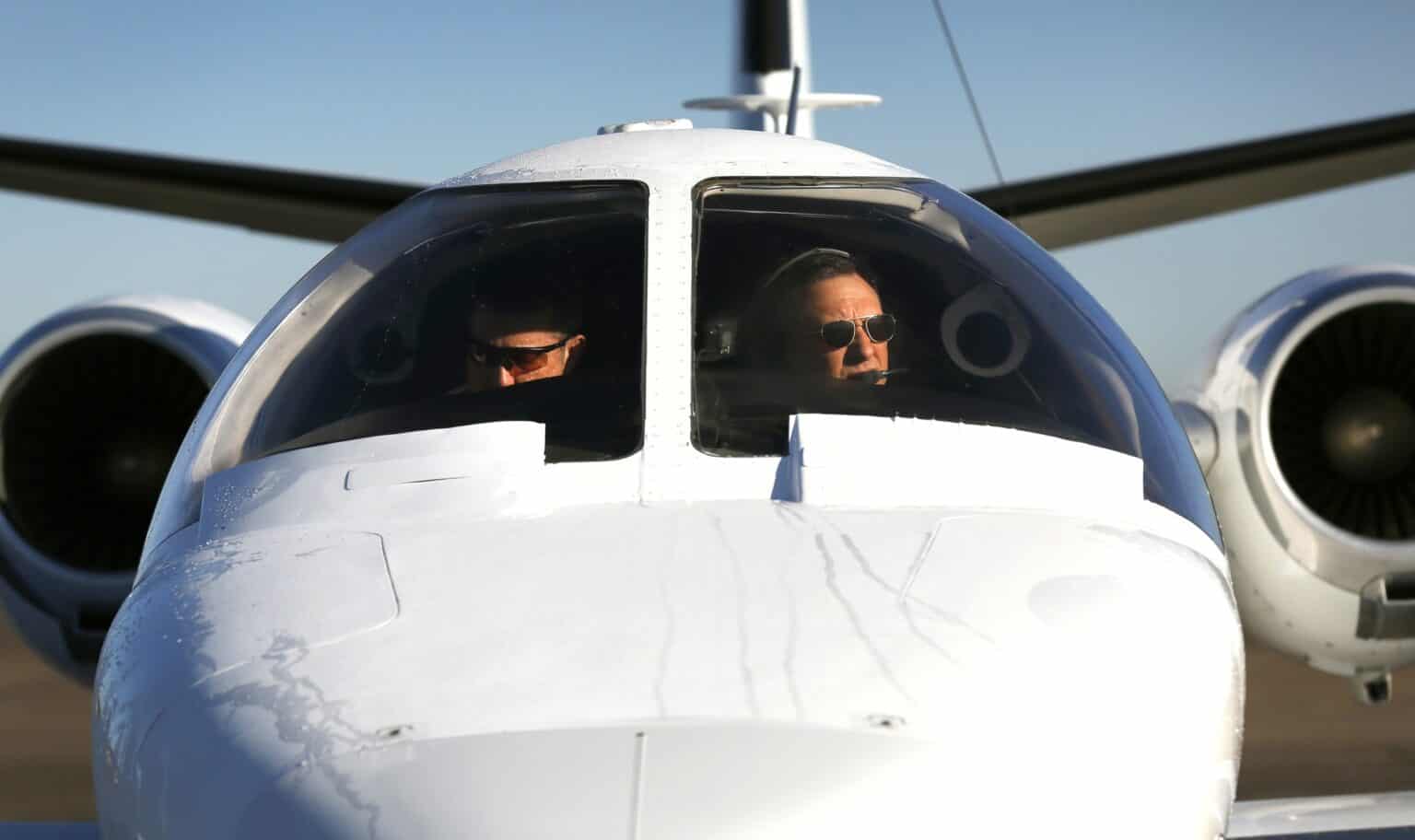
The FAA is ending the exemptions that let one pilot fly older Cessna Citation jets certified for a crew of two. The policy notice went on public inspection on September 25, 2026, is scheduled for publication in the Federal Register on September 28, and takes effect on September 29.
From that date, pilots holding a single-pilot logbook endorsement for these Citations must fly with a qualified second in command. The FAA cites widespread non-compliance by the training providers that held the exemptions, a higher accident rate and two fatal crashes.
Which Citations are covered
The notice covers the transport category members of the CE-500 family. All of them weigh more than 12,500 pounds (5,670 kg), and all are type certificated for two pilots.
| Cessna model | Name | Required pilots |
|---|---|---|
| 500 | Citation and Citation I | 2 |
| 550 | Citation II | 2 |
| S550 | Citation S/II | 2 |
| 552 | US Navy T-47A | 2 |
| 560 | Citation V and Citation Ultra | 2 |
| 550 | Citation Bravo | 2 |
| 560 | Citation Encore and Encore+ | 2 |
That puts the Citation II and its siblings in scope. The notice separates out the Part 23 CE-501 and CE-551 variants, which one pilot can fly when they carry the equipment their flight manual specifies.
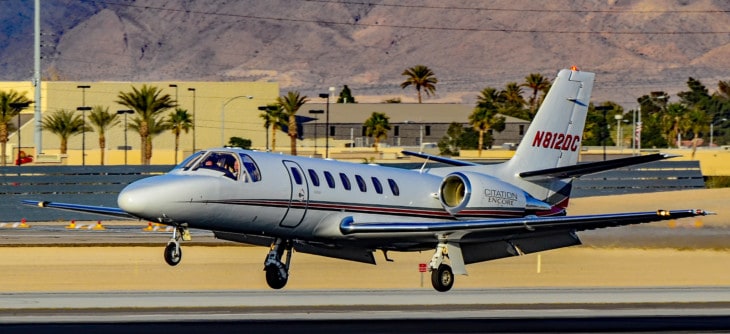
The Citation Mustang and the CitationJet family, which NBAA identifies as the CE-510 and CE-525, were certified for a single pilot and are untouched. Citing registry data, AeroTime reports that roughly 1,250 US-registered Citations fall under the policy.
How a two-pilot jet came to be flown by one
Two rules normally put a second pilot in these cockpits. Section 91.9 requires every aircraft to be flown within its operating limitations, and section 91.531 requires a second in command in an airplane type certificated for more than one pilot or weighing over 12,500 pounds.
The FAA first exempted Cessna itself from that requirement in 1984. At the time it said no data showed single-pilot Part 23 Citations were less safe than two-pilot Part 25 ones.
It later granted the same relief to training providers under Parts 61, 141 and 142, which could check a pilot and sign a single-pilot logbook endorsement. The exemption belongs to the school, but the pilot is the one who needs it.
Because the school has no ongoing role in the pilot’s flying, the FAA says a pilot is likely to be unaware when the school’s exemption expires or is terminated.
What the FAA found
The FAA began a compliance review in 2024 after learning that providers without an exemption were training under another company’s. It found incomplete records, required flight training done in an advanced aviation training device against the exemption’s conditions, and examiner checks that included falsified records.
Of the 14 Part 61 exemption holders, 13 were denied an extension or had the exemption rescinded. Where records had been falsified, the FAA terminated the examiner’s designation.
An 18-year accident review found that the Part 25 Citations flown by one pilot have about twice the accident rate of Part 23 Citations flown solo, counted per aircraft. The FAA says that undercuts the legal test for an exemption: equivalent safety, or no adverse effect on it.
The first crash it names is Citation S550 N666DS, which struck power lines on approach to Montgomery-Gibbs Executive Airport in San Diego on May 22, 2025. The pilot and five passengers were killed, and eight people on the ground received minor injuries.
The NTSB’s preliminary report says the pilot received his exemption to fly the S550 single-pilot on December 15, 2024. The FAA says he had received an improper check about six months before the crash, from an examiner employed by a Part 61 exemption holder.
The second is Citation 550 N257BW, which struck approach lights and came to rest short of runway 28 at Statesville Regional Airport, North Carolina, on December 18, 2025. All seven aboard were killed, among them former NASCAR driver Greg Biffle, his wife and their two children, AeroTime noted.
According to the NTSB, the pilot’s CE-500 type rating carried the limitation “CE-500 Second in Command Required.” His son in the right seat held a private pilot certificate and was not qualified to act as second in command.
Neither crash has a probable cause yet
Both NTSB investigations are still open. The FAA cites the San Diego and Statesville accidents as part of its reasoning, but the NTSB has not yet determined what caused either one.
What pilots have to do now
The FAA says single-pilot endorsements issued under these exemptions are no longer valid. The affected Citations must be flown in the two-pilot configuration their type certificate data sheet requires.
A section 61.58 proficiency check completed under the exemption still counts toward pilot-in-command requirements for two-pilot CE-500 operations.
Training providers that still hold a valid exemption will receive rescissions after the notice is published. For solo flights already made on endorsements from providers that lost their exemptions earlier, the FAA says it will apply its Compliance Program to decide how to respond.
Industry pushback
NBAA and the Citation Jet Pilots association (CJP) responded the same day. Heidi Williams, NBAA’s senior vice president of operations, backed the FAA acting on safety evidence but said rescinding the exemptions “in full, effective immediately upon publication in the Federal Register and without direct notice to affected operators, raises serious questions.”
NBAA wants the FAA to share its safety analysis, talk directly to affected operators and explain the immediate effective date.
Rob Balzano, chief executive of CJP, said the group has filed Freedom of Information Act requests for the data behind the FAA’s review. “Our goal is to understand the facts and analysis behind the FAA’s actions so we can assess their impact on our members and respond constructively,” he said.
Sources and references used for research and fact-checking.
- FAA / Federal Register, Notice of Policy Change and Rescission of Single-Pilot Training Exemptions for Certain Cessna Aircraft (Docket FAA-2026-12343, FR Doc. 2026-19843)
- NTSB, Aviation Investigation Preliminary Report WPR25FA161, Cessna S550 N666DS, San Diego, CA
- NTSB, Aviation Investigation Preliminary Report WPR26MA063, Cessna 550 N257BW, Statesville, NC
Get the Newsletter
The latest aviation news and stories sent to your inbox.
About the Author

Tim is the owner and lead editor of AeroCorner since 2019, overseeing aviation content covering aircraft, airlines, airports, and the broader aviation industry. Through years of researching, writing, editing, and publishing aviation-focused content, he has developed extensive practical knowledge of commercial aviation and air travel. Based in Asia and a frequent traveler himself, Tim also brings firsthand passenger experience to AeroCorner’s coverage. Outside of publishing, he has also explored aviation firsthand through hands-on flight training in New Zealand.