

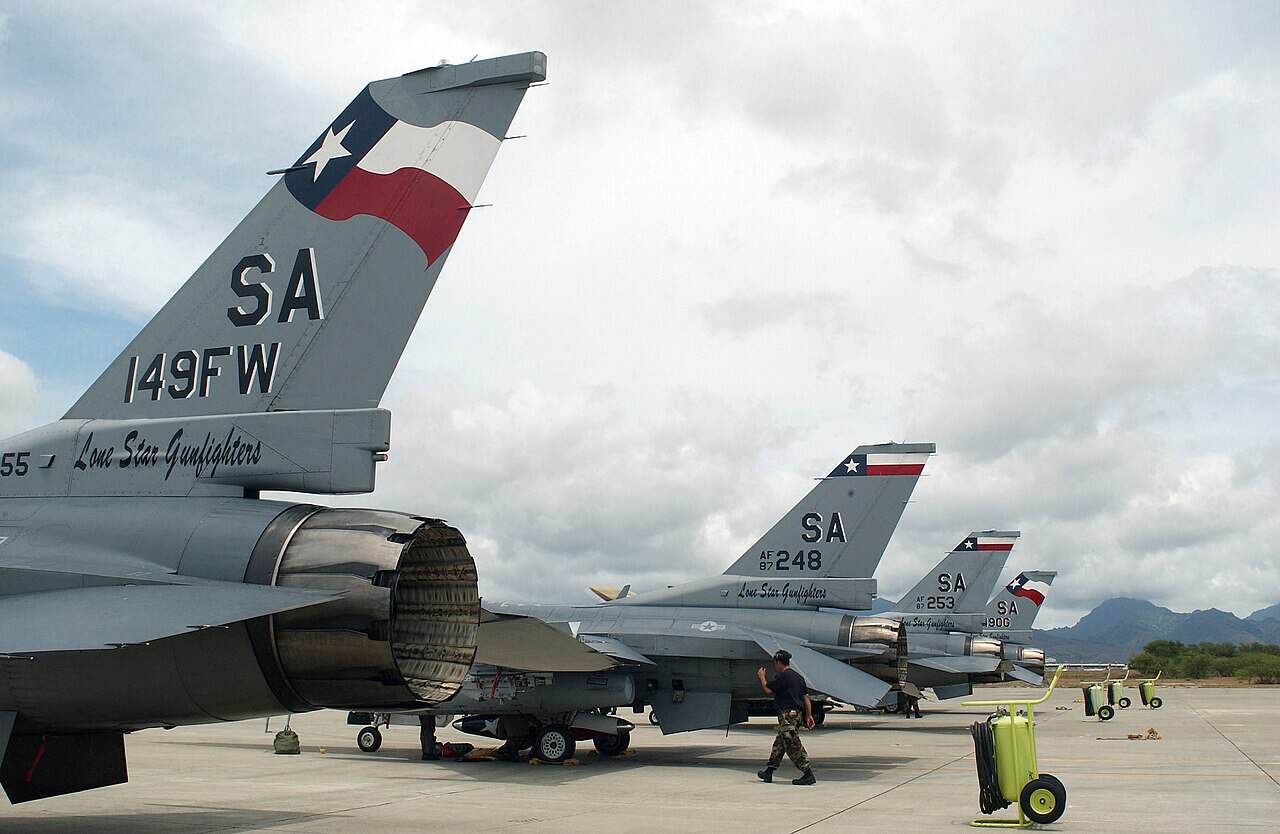
A Texas Air National Guard F-16 Fighting Falcon crashed in Green Lake Township, Michigan, shortly before 2 p.m. Eastern on Thursday, September 17, 2026. The pilot ejected before impact and survived.
The Texas Military Department said the pilot “successfully ejected the aircraft and is receiving care at a nearby hospital.” No injuries were reported on the ground.
The jet belonged to the 149th Fighter Wing at Joint Base San Antonio-Lackland, Texas, and was flying a training mission from the Air National Guard’s Combat Readiness Training Center at Alpena, Michigan.
A one-mile evacuation near Grawn
The aircraft came down near County Road 633 and Blair Townhall Road, a few miles east of Interlochen State Park in Grand Traverse County. That site sits roughly 110 miles (175 km) west of the Alpena training center the flight launched from.
🚨🇺🇸 F-16 crashes into a Michigan field after possible bird strike, pilot ejects safely
— Mario Nawfal (@MarioNawfal) September 18, 2026
A Texas Air National Guard F-16 went down Thursday afternoon in Blair Township near Traverse City, sending a fireball into a field beside people's homes.
The wingman's radio call caught it… pic.twitter.com/LOY8gHIomP
Michigan State Police ordered everyone within a mile of the wreckage to leave over a hazardous chemical spill tied to the crash. The evacuation order was lifted at about 9:45 p.m., ABC News reported, which also said the Texas Air National Guard grounded all of its aircraft in Michigan for roughly 24 hours.
Grand Traverse County Sheriff Michael Shea said the pilot was conscious and speaking with law enforcement at the hospital. Blair Township Supervisor Nicole Blonshine said there were no reports of civilian injuries.
The bird strike account is not confirmed
Air traffic control audio captured a possible mayday call, a reference to the jet having “taken a bird,” and reports of heavy black smoke, according to NBC News. The same audio suggested the aircraft may have lost its engine before the pilot ejected.
Military officials have not confirmed any of that. The Texas Military Department has said only that the aircraft experienced an incident and that the cause is under investigation.
Treat the cause as unsettled
Radio calls made in the first seconds of an emergency are a crew’s best guess under pressure, not a finding. Nothing about a bird strike or an engine failure is established until the Air Force’s accident board publishes, which usually takes months.
Why one engine changes the math
The F-16 carries a single engine, either a Pratt & Whitney F100 or a General Electric F110, according to the Air Force’s own fact sheet. That is the design bargain the jet has always made: one engine is cheaper to buy, cheaper to run, and leaves nothing in reserve.
A twin-engine fighter that loses one powerplant flies home on the other. Single-engine fighters have no such option, so a failure at low altitude turns immediately into a question of whether there is enough energy left to reach anything flat.
Birds are a persistent contributor to that problem. The Air Force Safety Center’s own ranking of its costliest wildlife strikes puts Canada geese alone at more than $81 million in mishap costs between fiscal 1995 and fiscal 2016, ahead of black vultures at about $75 million.
Civil operators face the same hazard with more margin. When an American Airlines 737 ingested a bird on departure earlier this year, the crew shut the affected engine down and returned on the other one.
What happens next
Under Defense Department rules, destroying an aircraft automatically makes a mishap Class A, the most serious category, alongside any event costing $2.5 million or more or causing a fatality. That triggers a formal Accident Investigation Board whose report is eventually released publicly.
The unit involved makes the loss more awkward than a line squadron’s would be. The 149th Fighter Wing is a training wing, one of two Air National Guard units that teach pilots to fly the F-16, and it had sent students and instructors to Michigan for the Operation Northern Cactus exercise.
The wing had also been scheduled to fly a POW/MIA Recognition Day flyover over a Michigan football game on Friday night. Whether that goes ahead after a 24-hour grounding of the detachment is the smallest of the questions now in front of the Air Force.
Sources and references used for research and fact-checking.
Get the Newsletter
The latest aviation news and stories sent to your inbox.
About the Author

Tim is the owner and lead editor of AeroCorner since 2019, overseeing aviation content covering aircraft, airlines, airports, and the broader aviation industry. Through years of researching, writing, editing, and publishing aviation-focused content, he has developed extensive practical knowledge of commercial aviation and air travel. Based in Asia and a frequent traveler himself, Tim also brings firsthand passenger experience to AeroCorner’s coverage. Outside of publishing, he has also explored aviation firsthand through hands-on flight training in New Zealand.