

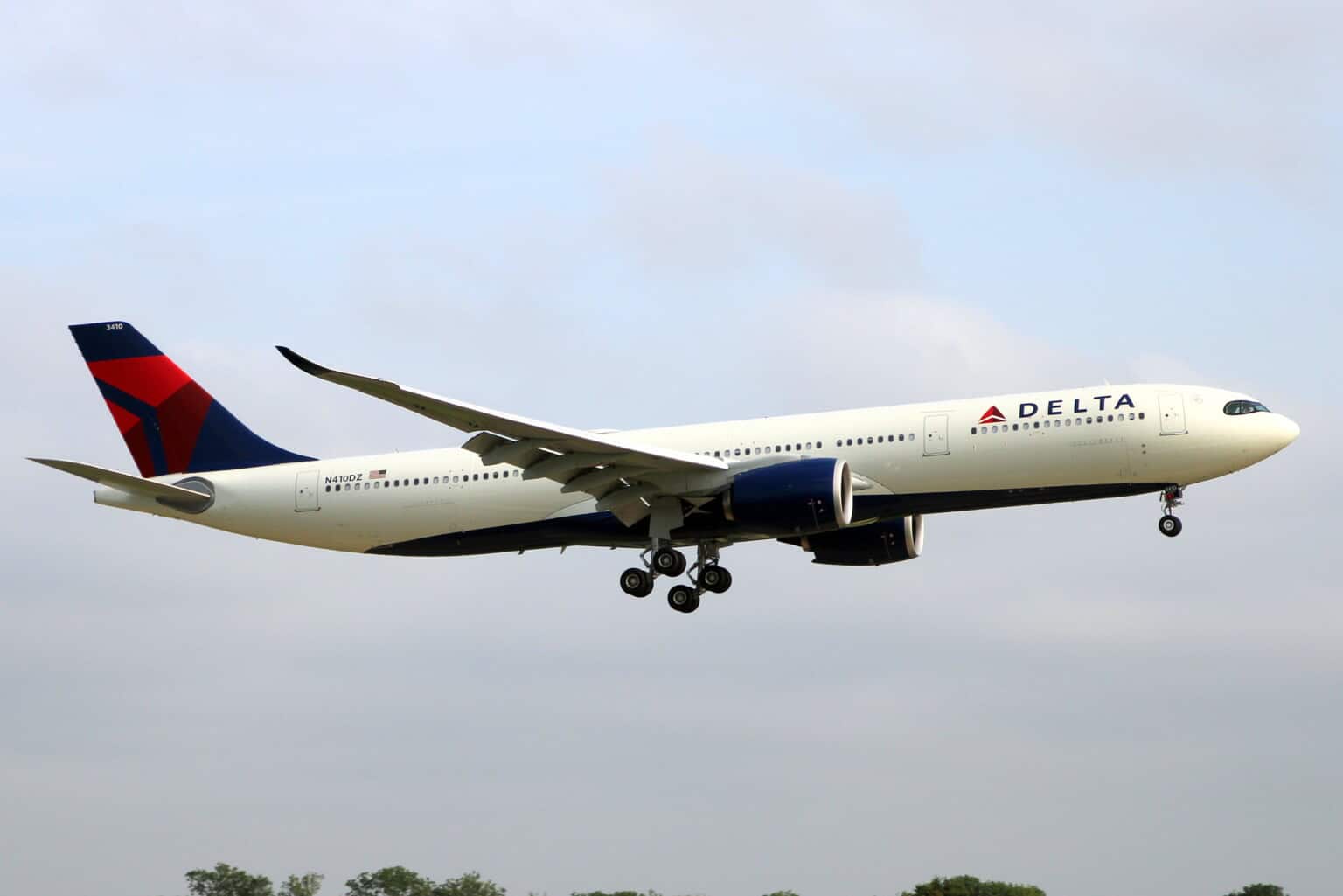
On Thursday, August 13, 2026, Delta Air Lines flight 81 left Paris-Charles de Gaulle Airport for Seattle-Tacoma International Airport, then diverted twice before its 209 passengers reached Seattle nearly ten hours behind schedule.
What happened
About 40 minutes after the 4:30 p.m. departure, the crew reported a mechanical problem with an onboard lavatory that sent liquid into the cabin. Passengers described the smell as sewage, though Delta has said only that the fault involved “an onboard lavatory.”
The Airbus A330-900, registered N410DZ, diverted to London Heathrow Airport. Because the jet was still carrying most of the fuel loaded for a 10.5-hour transatlantic crossing, the crew declared an emergency for what would be an overweight landing, not for any loss of control or engine problem.
The aircraft landed safely at Heathrow around 5:08 p.m. and stayed on the ground for roughly three hours while cleaning crews worked, according to a timeline tracked by Simple Flying. The meals loaded in Paris were discarded because of the contamination, and only snacks were served for the rest of the trip.
Rather than fly on to Seattle, DL81 continued to New York’s JFK Airport so a fresh crew could take over within legal duty-time limits, then completed the trip. The delayed routing put the aircraft’s Seattle arrival nearly ten hours behind its scheduled landing.
Delta apologized in a statement to Fox News, saying it was “focused on getting our customers to their destinations as quickly and safely as possible.”
What's confirmed so far
Delta has described the fault only as a mechanical issue involving an onboard lavatory. The airline has not said whether the liquid that spread through the cabin came from the waste system, a water line, or elsewhere.
Why land overweight instead of dumping fuel
Widebody jets like the A330 are certified to land above their normal maximum landing weight in a genuine emergency, at the cost of a mandatory post-landing inspection for stress on the landing gear and structure. AeroCorner’s explainer on fuel dumping covers the alternative, burning off or jettisoning fuel first, which takes time a crew dealing with a flooding cabin may not want to spend.
The A330-900 had just taken off with a full load of fuel for an ocean crossing, the same tradeoff that leads long-haul crews to choose the nearest suitable airport over completing a lengthy fuel burn-down. AeroCorner covered the opposite choice last month, when an Alaska Airlines 787 dumped fuel over the English Channel before returning to Rome rather than land overweight. Here, Delta’s crew accepted the overweight landing at London Heathrow instead.
Because the flight originated in the European Union and arrived more than four hours late, passengers may be entitled to compensation under EU261 rules, which View From the Wing estimated could total roughly $144,000 across the flight if every passenger filed a claim. Delta has not said whether it will pay automatically or require passengers to request it.
Get the Newsletter
The latest aviation news and stories sent to your inbox.
About the Author

Tim is the owner and lead editor of AeroCorner since 2019, overseeing aviation content covering aircraft, airlines, airports, and the broader aviation industry. Through years of researching, writing, editing, and publishing aviation-focused content, he has developed extensive practical knowledge of commercial aviation and air travel. Based in Asia and a frequent traveler himself, Tim also brings firsthand passenger experience to AeroCorner’s coverage. Outside of publishing, he has also explored aviation firsthand through hands-on flight training in New Zealand.