

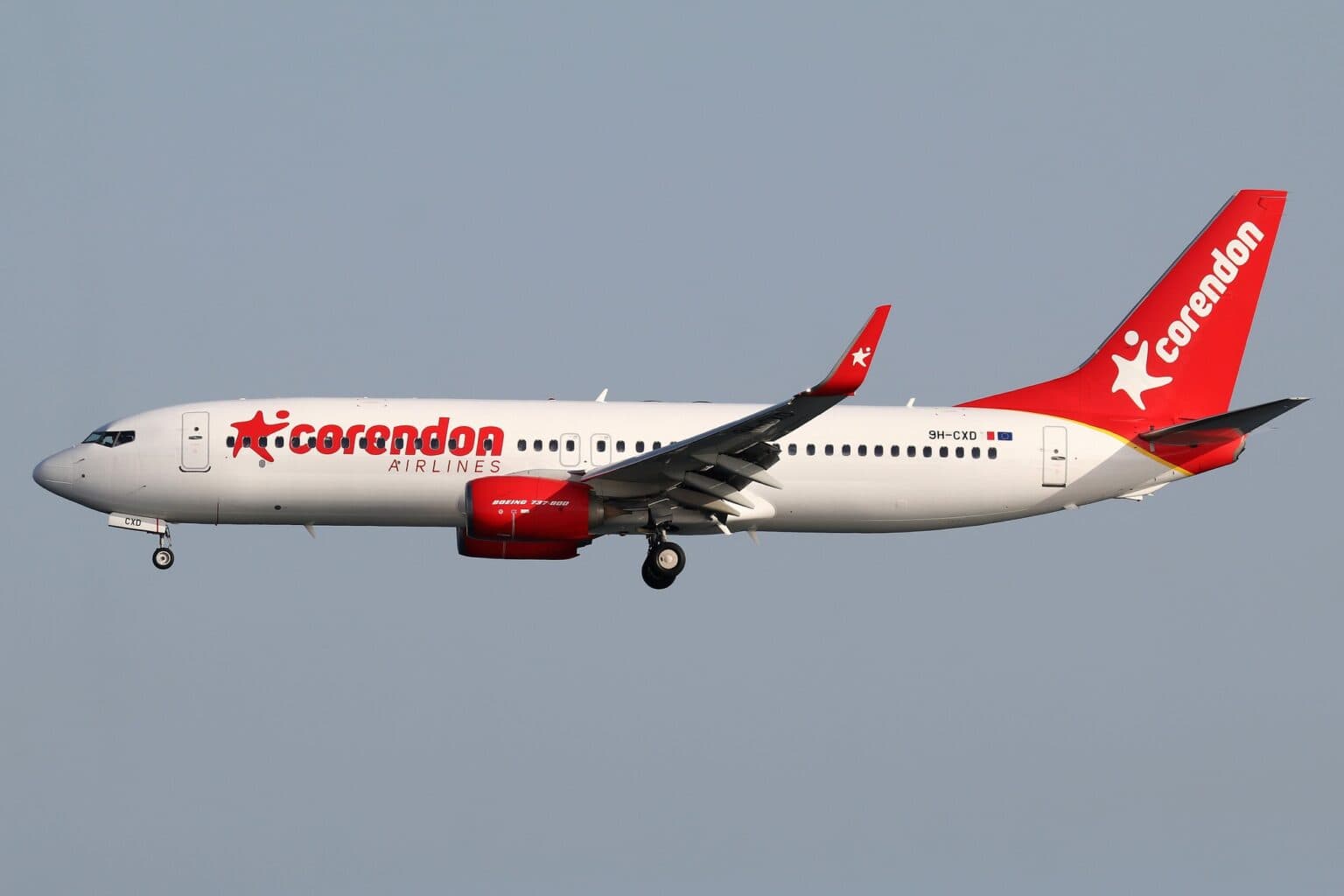
Corendon flight XR456, a Boeing 737-800 registered 9H-CXD, transmitted the hijack transponder code 7500 on its way from Corfu to Nuremberg on Tuesday, October 13, 2026, and for a time the crew could not be reached by radio. Fighter jets from two countries escorted it, and Nuremberg Airport stopped all flights while police special forces waited for it on the ground.
The 737 landed safely at about 12:15 p.m. local time. Middle Franconia police said the code had been sent by accident and that their checks after landing found no sign of a real threat.
What happened on flight XR456
Police spokesman Michael Petzold said the code arrived from the cockpit roughly halfway through the flight, and that the tower then could not reach the crew. “We had to assume the worst,” he said, in comments carried by dpa, which also gave the flight number as XR456.
Croatia’s Ministry of Defense said one of its Rafale fighters intercepted a Maltese-registered Boeing over Korenica at 11:02 a.m., identified it visually and made radio contact with it. The ministry said NATO’s air operations center at Torrejón, Spain, ordered the launch, and that a reporting center in Italy had the jet squawking 7500.
The Rafale followed the Boeing between Rijeka and Delnice, and the airliner entered Slovenian airspace at 11:20 a.m. The ministry did not name the flight, though its route, timing and code match XR456.
Over Germany, two Eurofighters of Tactical Air Force Wing 74 at Neuburg an der Donau took over, according to German air navigation service DFS. A Luftwaffe spokesman said they stayed with the 737 until it landed and then circled the airport until a fresh takeoff could be ruled out.
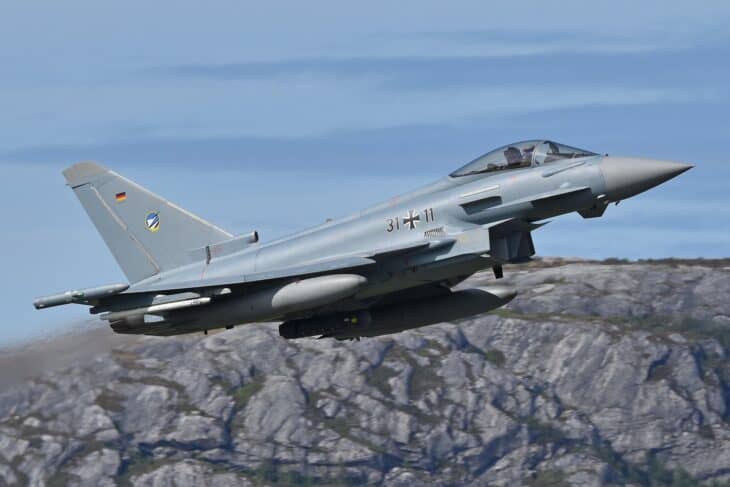
The Aviation Herald also reported an intercept by Austrian Eurofighters from Zeltweg, and said the crew told the fighters their radio was faulty and the code had been set in error. At the time of writing, no official Austrian statement confirming that intercept had been found.
11:02 a.m.
Croatian Rafale intercepts. A Croatian Air Force Rafale identifies the Boeing over Korenica, Croatia, on an order from NATO’s Torrejón air operations center.
11:20 a.m.
Into Slovenia. The airliner leaves Croatian airspace, the Croatian Ministry of Defense says.
About 12:15 p.m.
Landing at Nuremberg. Escorted by Luftwaffe Eurofighters, the 737 lands at a closed airport and is parked on a remote stand.
About 1:25 p.m.
All clear. Passengers leave the aircraft and regular flights resume, police say. Road closures lift around 1:30 p.m.
Nuremberg Airport shut down
Police closed the airport and its access roads and called in special forces units, and Nuremberg arrivals were diverted elsewhere. Bayerischer Rundfunk put the shutdown at about two hours.
Airport chief executive Michael Hupe said the jet was parked on a far-off apron stand before anyone left it. Passengers then came down the stairs and rode buses to the terminal, where a team trained for emergencies, including pastoral care, met them.
Corendon said there had been no emergency and that passengers, crew and aircraft were never in danger, Novi list reported. The airline put the code down to a brief failure in the radio communication system while the jet was over Croatia.
Why the transponder showed 7500 rather than a code for a technical problem is still under investigation, Nordbayern reported. According to t-online, Germany’s air accident investigation agency, the BFU, is examining the equipment.
It was a rough day for Nuremberg Airport. Overnight, three pilots had reported a possible drone, which delayed six flights and sent two arrivals to Cologne and Prague, and police said early findings showed no link between the two events.
Why 7500 brings out the fighters
Three transponder squawk codes are reserved for trouble: 7700 for an emergency, 7600 for a lost radio and 7500 for unlawful interference, which means a hijacking. The FAA’s Aeronautical Information Manual notes that 7500 is the only code decoded as a hijack.
That is why a crew that loses its radios is told to set 7600, not 7500. The same manual warns pilots against selecting any of the three by accident, even briefly while changing codes, because each sets off alarms on the ground.
A hijack code from a cockpit that will not answer leaves the authorities little choice but to assume the worst, as Petzold put it. Interceptors usually work in pairs, approaching from behind, then closing only as far as they need to identify the aircraft.
From there, the interceptors try the emergency frequency, 121.5 MHz, and the ICAO visual signals. Rocking the wings from just ahead and to the left means “you have been intercepted, follow me,” and the airliner answers by rocking its own wings.
Germany keeps two Eurofighters on round-the-clock alert at Neuburg, according to DFS. Croatia has policed its own airspace with Rafales since January 1, 2026, its defense ministry said.
Malta-registered 9H-CXD is a Boeing 737-800 flown by Corendon Airlines Europe. Two weeks earlier, a separate Corendon Airlines jet was in the news in Germany when Corendon flight XC185 hit an airport fire truck while taxiing at Friedrichshafen.
Sources and references used for research and fact-checking.
- Polizeipräsidium Mittelfranken, Luftnotlage am Flughafen Nürnberg löste größeren Polizeieinsatz aus (press release 883, 13.10.2026)
- Polizei Mittelfranken (X), #NUE1310 posts on the 7500 code and radio contact
- Croatian Ministry of Defense (MORH), Hrvatski Rafale presreo malteški putnički avion koji je bio označen kao moguća prijetnja
- FAA, Aeronautical Information Manual 4-1-20, Transponder and ADS-B Out Operation
- FAA, Aeronautical Information Manual 6-4-2, Transponder Operation During Two-way Communications Failure
- FAA, Aeronautical Information Manual 5-6, Interception procedures and ICAO signals
- FAA, Aeronautical Information Manual 6-2-2, Transponder Emergency Operation
Get the Newsletter
The latest aviation news and stories sent to your inbox.
About the Author

Tim is the owner and lead editor of AeroCorner since 2019, overseeing aviation content covering aircraft, airlines, airports, and the broader aviation industry. Through years of researching, writing, editing, and publishing aviation-focused content, he has developed extensive practical knowledge of commercial aviation and air travel. Based in Asia and a frequent traveler himself, Tim also brings firsthand passenger experience to AeroCorner’s coverage. Outside of publishing, he has also explored aviation firsthand through hands-on flight training in New Zealand.