

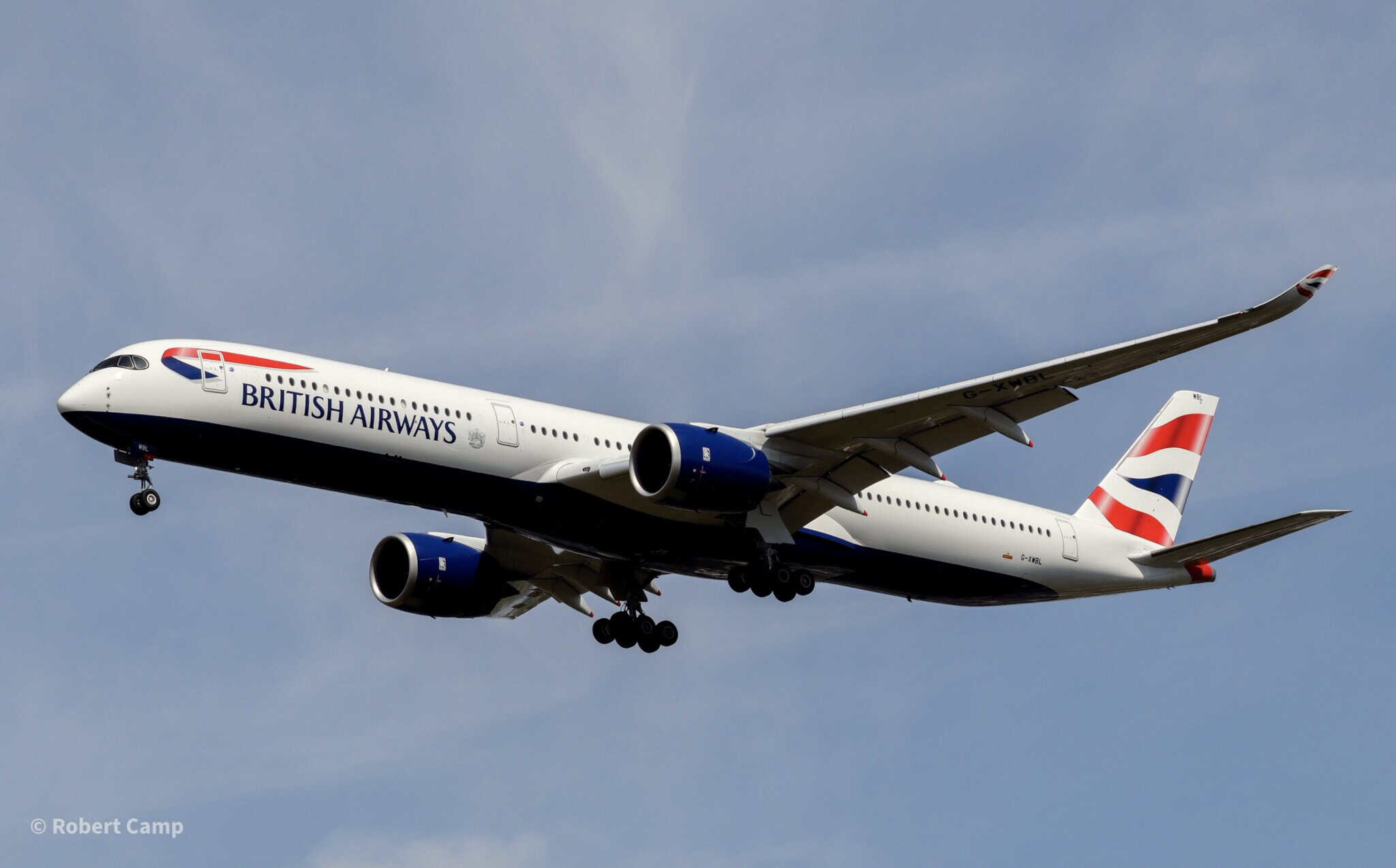
On August 18, 2026, a British Airways Airbus A350-1000 flying from Las Vegas to London declared an emergency while descending toward Heathrow, squawking the international emergency code 7700 over a possible hydraulic failure. The jet, registration G-XWBL operating as flight BA274, landed safely and taxied to a remote stand under escort from emergency vehicles.
Flight BA274 left Harry Reid International Airport in Las Vegas the previous day for the roughly ten-hour flight to Heathrow. As the jet began its descent over the Birmingham area, the flight crew alerted air traffic control to a possible hydraulic problem and set the transponder to 7700.
What happened on approach
Air traffic control gave BA274 priority routing ahead of other Heathrow arrivals. Airport fire crews and ambulance teams were positioned along the field as a precaution while the aircraft was vectored in. The jet touched down normally on runway 27R and vacated the runway without incident.
Rather than taxiing to its usual gate, the aircraft was directed to a remote stand at Terminal 5, escorted by emergency vehicles so ground engineers could inspect it before passengers disembarked. No injuries were reported. British Airways has not said what caused the hydraulic indication, and the incident remains under review.
Why a “possible” problem still gets a full emergency
A widebody jet leans on hydraulic power to move its landing gear, wheel brakes, nosewheel steering, and much of its flight control surfaces. The A350 uses a simplified two-circuit hydraulic system, rather than the three separate circuits found on older Airbus jets, backed up by electrically powered actuators that can drive key control surfaces if both hydraulic circuits are lost.
That layered redundancy is exactly why a squawk 7700 for a suspected hydraulic fault does not mean the aircraft was in danger of losing control. Crews are trained to treat any hydraulic caution message as serious enough to declare an emergency immediately, because a system that looks fine at cruise altitude can behave differently once gear, flaps, and brakes are all being commanded during landing.
Landing gear and brakes are the parts of that chain crews worry about most on a hydraulic squawk, since both are needed within seconds of touchdown and neither can simply be deferred to a later stage of flight. Declaring early buys the crew a longer, unhurried approach, priority use of the runway, and rescue crews already in position, none of which cost anything if the fault turns out to be minor.
Squawk 7700 is a precaution, not a verdict
Declaring an emergency gives a flight priority handling and guarantees rescue crews are ready on arrival. It does not confirm how serious the underlying fault actually is, and most hydraulic-related squawks end exactly like this one: a normal landing followed by a maintenance inspection.
Heathrow has handled several precautionary approaches this year, including another British Airways jet that squawked an emergency after a separate cockpit warning in July. In each case, the aircraft landed without incident and the underlying cause was left to a technical investigation rather than the crew’s initial report.
Get the Newsletter
The latest aviation news and stories sent to your inbox.
About the Author

Tim is the owner and lead editor of AeroCorner since 2019, overseeing aviation content covering aircraft, airlines, airports, and the broader aviation industry. Through years of researching, writing, editing, and publishing aviation-focused content, he has developed extensive practical knowledge of commercial aviation and air travel. Based in Asia and a frequent traveler himself, Tim also brings firsthand passenger experience to AeroCorner’s coverage. Outside of publishing, he has also explored aviation firsthand through hands-on flight training in New Zealand.