

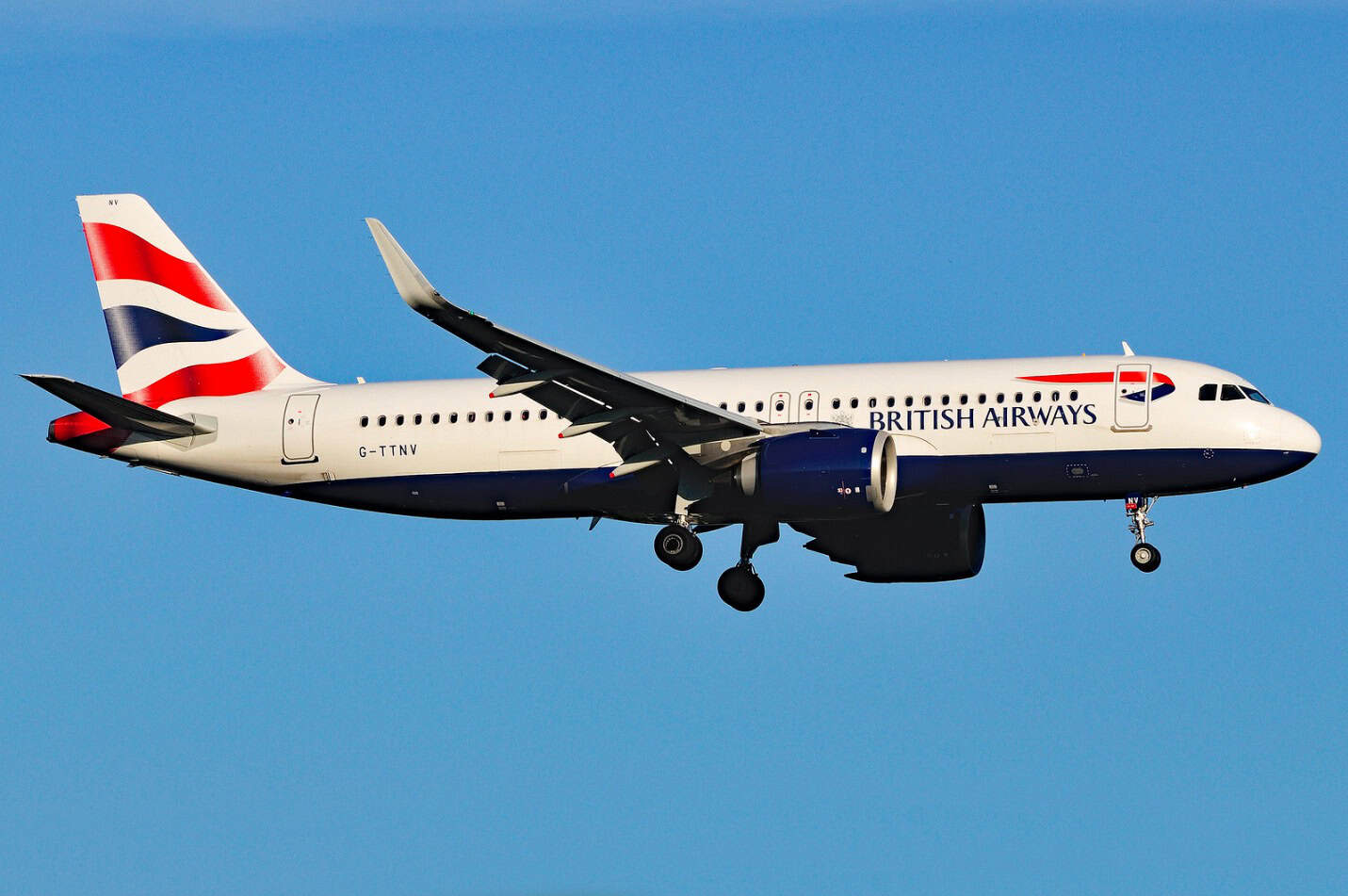
British investigators are examining a British Airways Airbus A320 that received two stall warnings while approaching London Heathrow on July 6, 2026. The UK Air Accidents Investigation Branch has classified the event as a serious incident, and the flight landed safely with no injuries and no damage.
The investigation became public on July 30, when FlightGlobal reported the AAIB’s summary of what happened. The aircraft was operating flight BA919 from Düsseldorf.
What the crew was dealing with
According to the AAIB’s account, an air data reference failure during the approach triggered a stall warning. The crew flew the aircraft under alternate law and declared a PAN, the international urgency call that sits one step below a Mayday.
The approach was broken off and the aircraft held while the crew worked the problem. On a second approach, the AAIB said, a further stall warning occurred at 3,000 feet, accompanied by a “potentially abrupt recovery manoeuvre.”
Secondary reporting on the event says the jet descended to roughly 2,200 feet during that recovery before the crew stabilized it, upgraded the call to a Mayday and landed. The aircraft was registered G-EUUN, with about 180 people on board.
What the AAIB has said so far
“During the approach phase, an ADR failure triggered a stall warning; the crew flew the aircraft under alternate law and declared a PAN. A further stall warning occurred at 3,000 feet, accompanied by a potentially abrupt recovery manoeuvre.”
Why alternate law changes the pilots’ job
The A320 was the first airliner built around fly-by-wire controls, meaning the sidestick sends an electrical request to a set of flight control computers rather than moving a surface directly. Those computers decide what the aircraft is actually allowed to do.
In the aircraft’s normal mode, called normal law, one of those limits is angle-of-attack protection. Pull back hard enough to stall the wing and the computers simply will not let the aircraft go there, which is why the type is often described as very difficult to stall.
That protection is only as good as the air data feeding it. Airspeed and angle-of-attack values come from air data reference units, and when the computers can no longer agree on which source to trust, they degrade to alternate law and hand the aircraft back to the pilots.
In alternate law the hard protection is gone, replaced by an aural stall warning. A crew that has spent a career inside an envelope the aircraft polices for them is suddenly flying one that does not.
There is a second complication. When air data is unreliable, a stall warning is not proof the wing was near stalling, because the warning is computed from the same suspect information. Telling a genuine low-speed condition from a false alarm, by hand, at 3,000 feet, is the hardest version of that problem.
Reality check
The AAIB has not determined a cause, and it has not said the aircraft stalled. The 2,200-foot figure, the passenger count and the runway in use come from secondary reporting rather than the investigators, and early accounts of events like this are often revised.
The accident sitting behind this investigation
Investigators have an obvious reference point. Air France 447 was lost in 2009 after iced-over pitot tubes cost the crew reliable airspeed, dropped the A330 into alternate law and left the pilots to interpret a stall warning that came and went as the computers gained and lost valid data.
That accident is the reason unreliable airspeed and manual handling in degraded control laws became standard recurrent training items across the industry. The BA919 crew got a real one, at low altitude, and brought the aircraft back.
The AAIB is expected to examine why the air data reference failed, what the flight data and cockpit voice recorders show about the recovery, and the aircraft’s maintenance history. British Airways has said it is cooperating with the investigation.
It is the second British Airways A320 to draw attention at Heathrow this summer, after a separate emergency on July 22 involving a different aircraft and a different technical problem. The two events are not connected.
No timescale has been given. Serious incident inquiries of this kind normally end in an AAIB bulletin report rather than a full formal report, and typically take months to appear.
Get the Newsletter
The latest aviation news and stories sent to your inbox.
About the Author

Tim is the owner and lead editor of AeroCorner since 2019, overseeing aviation content covering aircraft, airlines, airports, and the broader aviation industry. Through years of researching, writing, editing, and publishing aviation-focused content, he has developed extensive practical knowledge of commercial aviation and air travel. Based in Asia and a frequent traveler himself, Tim also brings firsthand passenger experience to AeroCorner’s coverage. Outside of publishing, he has also explored aviation firsthand through hands-on flight training in New Zealand.