

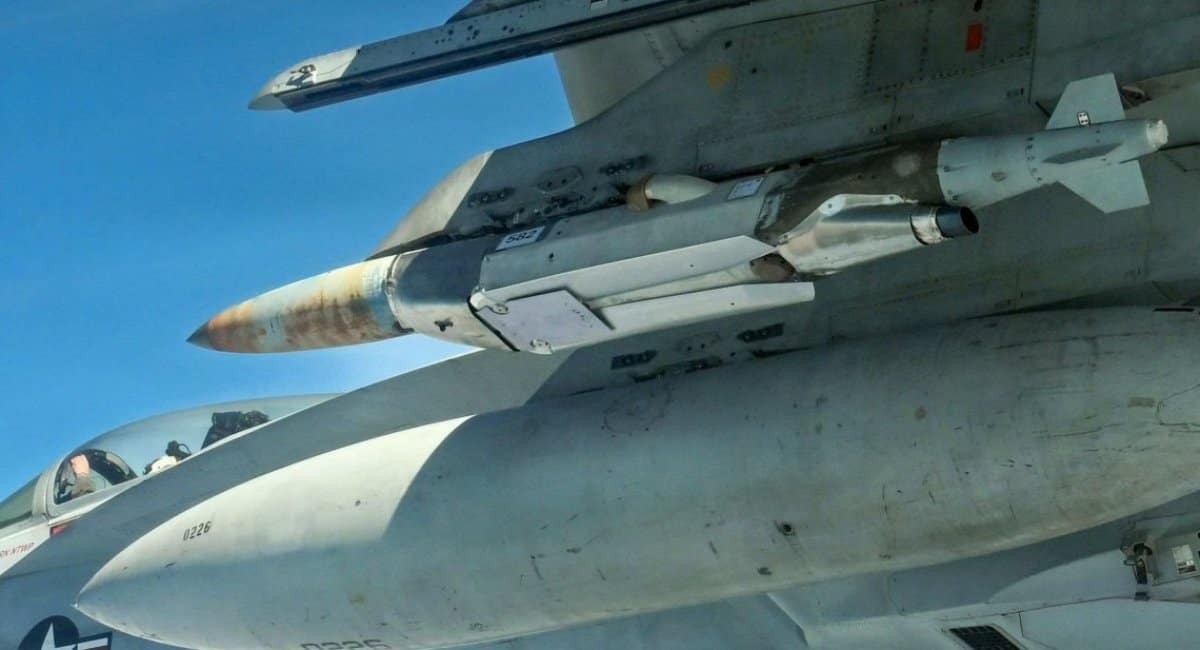
Boeing said on August 5, 2026, that the U.S. Air Force had awarded it a $75 million contract to begin production of the JDAM LR, a version of America’s standard guided bomb that adds a small turbojet engine to reach targets more than 300 nautical miles (556 km) away.
From a 15-mile glide to a 300-mile flight
The Joint Direct Attack Munition, or JDAM, started as a tail kit that bolts GPS and inertial guidance onto an existing 500 or 2,000-pound bomb body, turning a gravity bomb into a precision weapon with roughly 15 nautical miles of glide range when dropped from altitude.
An extended-range version added pop-out wings a decade ago, stretching that to about 45 nautical miles. The LR variant goes further still: a compact Boeing munition designated GBU-75 that adds a Kratos TDI-J85 turbojet producing 200 pounds of thrust, turning a glide bomb into a genuinely powered weapon that can fly under its own engine for over 300 nautical miles.
The JDAM family's growing reach
Standard JDAM (GBU-38): about 15 nautical miles, unpowered glide. JDAM-ER: about 45 nautical miles, with pop-out wings. JDAM LR (GBU-75): over 300 nautical miles, with a turbojet engine.
Why the Pentagon wants a bomb that can fly itself further
The $75 million award covers what the Air Force calls an Undefinitized Contract Action for the BSU-111/B payload delivery unit, the hardware that turns a standard bomb body into a JDAM LR.
It follows nearly $100 million Boeing had already invested in the program on its own, and clears the way for initial production of units for the Navy as well as the Air Force.
Bob Ciesla, vice president of Boeing Precision Engagement Systems, called it “a major milestone for the JDAM LR program, demonstrating our ability to deliver long-range precision-strike capability at a significantly lower cost.”
The weapon was developed jointly with the Navy and first flight-tested on F/A-18 Super Hornets off the California coast on April 1 and 3, 2026, sustaining powered flight over roughly 200 nautical miles while meeting accuracy requirements for military-code GPS navigation.
The appeal is standoff distance. As integrated air defense systems push further from the front line and can threaten strike aircraft from well beyond visual range, a weapon that lets a fighter or bomber release from over 300 nautical miles out keeps the launching aircraft further from danger without the cost of a cruise missile.
Retired Air Force Colonel Mark Gunzinger, reviewing the contract for Air & Space Forces Magazine, called the capability “a good decision, though long overdue,” giving crews “new options to conduct strikes from medium-range standoff distances” at a fraction of the cost of a purpose-built cruise missile.
Sources and references used for research and fact-checking.
Get the Newsletter
The latest aviation news and stories sent to your inbox.
About the Author

Tim is the owner and lead editor of AeroCorner since 2019, overseeing aviation content covering aircraft, airlines, airports, and the broader aviation industry. Through years of researching, writing, editing, and publishing aviation-focused content, he has developed extensive practical knowledge of commercial aviation and air travel. Based in Asia and a frequent traveler himself, Tim also brings firsthand passenger experience to AeroCorner’s coverage. Outside of publishing, he has also explored aviation firsthand through hands-on flight training in New Zealand.