

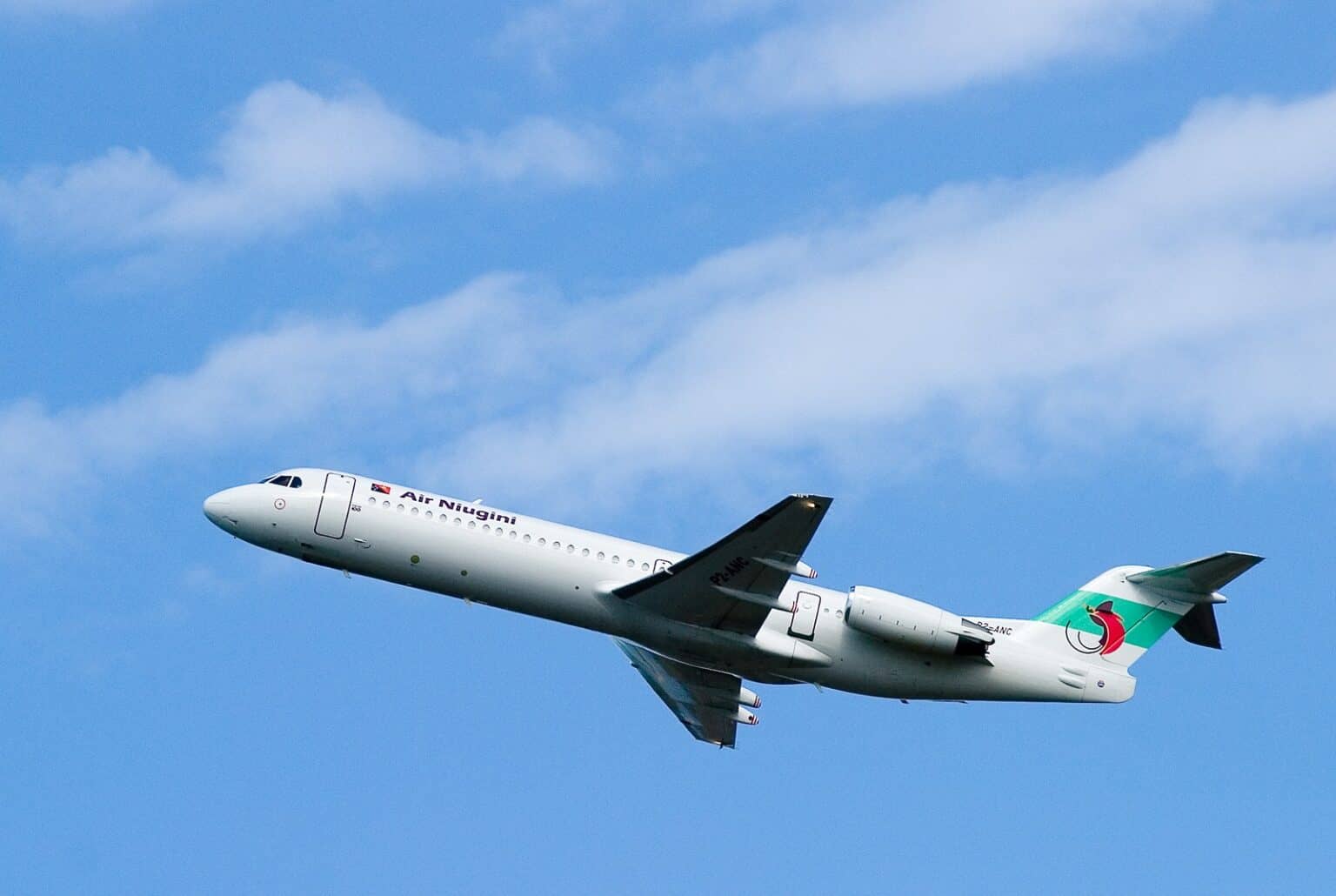
Air Niugini flight PX141, operated by Fokker 100 P2-ANH according to The Aviation Herald, rejected its takeoff at Vanimo, Papua New Guinea, on November 21, 2026, after a reported engine problem. The country’s Accident Investigation Commission (AIC) is assessing whether the event warrants an independent safety investigation.
The AIC disclosed the event in a media release dated November 21, describing it as a reported engine-related aborted takeoff at Vanimo Airport earlier that day. The release does not name the airline, aircraft or flight involved.
What is known about PX141
PX141 is an early-morning service that starts in Vanimo, in Sandaun Province, and continues through Wewak to Port Moresby. FlightStats lists a scheduled 6:30 a.m. departure on November 21, with a Fokker 100 as the planned aircraft.
The tracker has no departure or arrival time for that leg and gives its final status as unknown. It has no tail number for the flight either.
The next morning’s PX141 did fly. FlightStats shows Fokker 100 P2-ANJ taking off from Vanimo at 7:51 a.m. on November 22 and landing at Wewak at 8:22 a.m.
What is not known yet
The AIC’s release does not say which engine was involved, what went wrong, how fast the aircraft was moving or how many people were on board. It also does not say whether anyone was hurt.
An assessment is not yet an investigation
The AIC has not said it is opening an investigation at Vanimo. If it decides one is not warranted, its release says, the matter will go to the Civil Aviation Safety Authority of Papua New Guinea (CASA PNG) “for appropriate regulatory safety assessment and follow-up.”
The two bodies do different jobs. The AIC investigates accidents and serious incidents on a no-blame basis, while CASA PNG is the regulator that sets safety standards and monitors whether they are followed.
Under international rules, a serious incident is one whose circumstances indicate a high probability of an accident, as SKYbrary explains. An engine-related rejected takeoff does not establish that by itself, so the details of what happened on the runway matter.
Why speed matters in a rejected takeoff
Most manufacturers set a speed check, usually at 80 or 100 knots, that divides the takeoff roll into low-speed and high-speed phases, according to SKYbrary. Before that call, crews are normally expected to stop for any significant malfunction.
After the check, the bar rises, and a takeoff is usually rejected only for a major problem such as an engine failure or fire. Beyond the decision speed, known as V1, crews should stop only if they have strong reason to believe the aircraft will not fly.
The Aviation Herald reports that PX141 stopped at very low speed, which the AIC has not confirmed. Earlier in November, a KLM 777 rejected its takeoff at Amsterdam after a loud engine bang.
A separate event from the PX19 diversion
The Vanimo event came on the same day that Air Niugini’s PX19 diverted to Davao in the Philippines. The crew of that Boeing 767, flying from Hong Kong to Port Moresby, shut down the right engine after a fire indication.
The AIC used the same release to confirm that it will take part in the Philippine-led PX19 investigation. It said some passengers were reportedly injured during that slide evacuation, and that the right main landing gear wheel assembly overheated during the landing roll.
The commission was explicit that the two events are separate, “with no established connection between them.” It asked the media and the public to refrain from speculation while the authorities establish the facts.
P2-ANH and Air Niugini’s Fokker fleet
P2-ANH was flying scheduled services in the weeks before the event. On September 30, it operated one to Buka and became the first aircraft to refuel at a new Jet A-1 facility at Buka Airport, Air Niugini said.
The Fokker 100 is a twinjet with rear-mounted Rolls-Royce Tay engines, and production of the type stopped in 1997. Air Niugini said in February that it plans to move away from its aging Fokker jets as it introduces the Airbus A220.


Three A220s had been delivered as of September, according to chief executive Alan Milne. Nothing published so far links the age of P2-ANH to what happened at Vanimo.
At the time of writing on November 22, U.S. time, no statement on the Vanimo event appeared in Air Niugini’s online newsroom. The next step rests with the AIC, which must decide whether to investigate or hand the case to the regulator.
Sources and references used for research and fact-checking.
- Papua New Guinea Accident Investigation Commission, Media Release 17/2026: PNGAIC confirms participation in investigation into Air Niugini flight emergency landing in the Philippines
- Papua New Guinea Accident Investigation Commission, About the AIC
- Civil Aviation Safety Authority of Papua New Guinea, Roles and functions
- Air Niugini, Air Niugini Boosts Capacity to Buka following Establishment of Jet A1 Refuelling Facility
- Air Niugini, Air Niugini Appoints Alan Milne as Chief Executive Officer
- Air Niugini, Air Niugini CEO Highlights Growth, Fleet Modernisation and Customer Transformation at POMCCI Breakfast
Get the Newsletter
The latest aviation news and stories sent to your inbox.
About the Author

AeroCorner News is the aviation news desk of AeroCorner.com. It covers accidents and incidents, safety rulings, airline and airport disruption, and new aircraft. It works from primary sources such as the NTSB, FAA, EASA and the manufacturers' own announcements.