

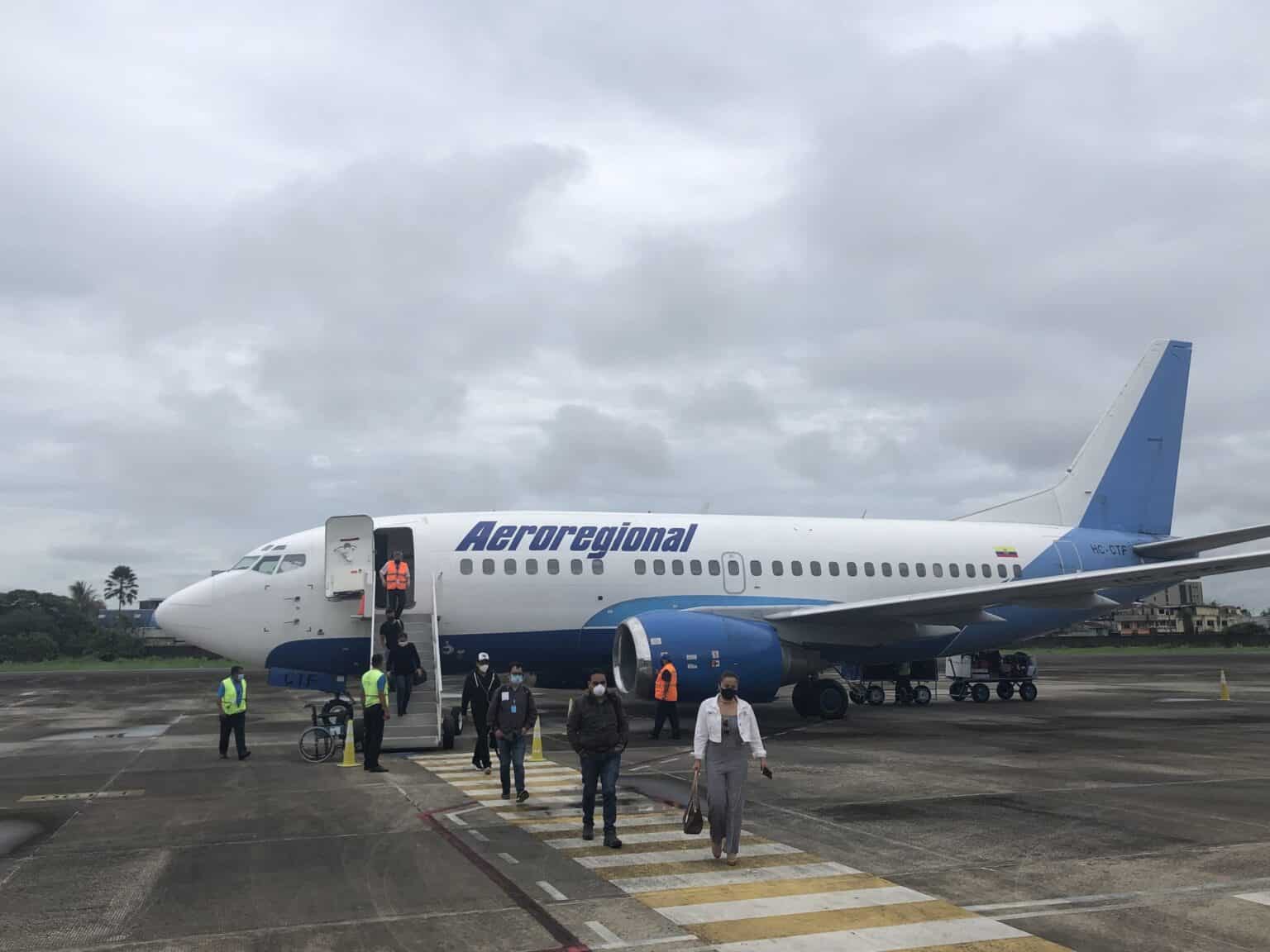
Aeroregional flight 6G853, a Boeing 737-500 registered HC-CTF, ran off the side of the runway while landing at Santa Rosa, Ecuador, on the night of November 20, 2026. The jet had flown in from Quito and came to rest in the brush beside the runway, with heavy rain and thunderstorms over the airport.
A police report from the Santa Rosa district recorded no injuries or deaths and only material damage to the fuselage, according to Extra. Some passengers suffered panic attacks and were looked after in the terminal.
What happened on the landing
The flight left Mariscal Sucre Airport in Quito at about 7:15 p.m. local time, as El Universo reported. The Aviation Herald puts the landing on runway 25 at 8:19 p.m. local time (01:19 UTC on November 21), with the 737 veering off the right side and stopping with all of its landing gear in soft ground.
One passenger told Extra that the jet circled the city while waiting for clearance to land, and that it seemed unsteady once the descent began. The same passenger said that “the plane lost control completely,” and credited the pilot with keeping it from tipping over.
The Santa Rosa fire department, airport staff and a medical rescue unit responded. Police said they were sent to the airport by Ecuador’s ECU 911 emergency service and helped coordinate moving the passengers, Extra reported.
Ecuador’s Directorate General of Civil Aviation (DGAC) closed runway 07/25, the airport’s only runway, from 8:48 p.m. local time, Metro Ecuador reported, stopping all takeoffs and landings while the closure lasts. No reopening time had been announced at the time of writing.
How many people were aboard, and what officials have said
The count of people on board differs by source. Santa Rosa mayor Larry Vite Cevallos said 63 people were on the flight and that they came through “without major problems,” according to an EFE report.
The same EFE report cites airport supervisor Leonel Tenesaca as giving 65 passengers, and the police report in Extra also gives 65. Whether either figure includes the crew has not been stated.
Vite said the aircraft lost the runway “apparently” because a tire burst on landing. That is the mayor’s early account, not a finding: neither the DGAC nor Aeroregional had published a statement on the cause at the time of writing.
A crew member who asked not to be named told Extra that the airline had warned crews the runway was wet because of the weather.
The weather at Santa Rosa that evening
The airport’s weather reports turned sharply in the hour before the landing. At 6 p.m. local time Santa Rosa reported more than 6 miles (10 km) of visibility and light winds, but by 7 p.m. rain had moved in.
The 8 p.m. report, about 20 minutes before the landing, showed a thunderstorm with rain, visibility of about 0.6 miles (1,000 m), an overcast deck at 2,300 feet and wind from 250 degrees at 12 knots. Later reports logged by The Aviation Herald show the wind backing to about 180 degrees at 7 knots, a crosswind from the left on runway 25, by 8:20 p.m.
Weather is the setting, not a cause. Nothing in the public record yet links the storm, the wet runway or the reported tire failure to the excursion, and those are the questions an investigation would have to answer.
Why jets leave the side of a runway
Runway excursions come in two kinds: an overrun, where the aircraft cannot stop before the end, and a veer-off, where it leaves the side. Santa Rosa was a veer-off, and those usually come down to directional control in the first seconds after touchdown.
Water on the runway cuts the grip of the tires, gusts and a shifting crosswind push the jet sideways, and a failed tire on one main gear can pull it toward that side under braking. Investigators typically read the flight data recorder for the touchdown speed, the point of touchdown and the use of brakes, reverse thrust and rudder before they weigh any of those.
That sequence is also why runway length rules add margin for a wet surface rather than assuming a dry day. The same storm can leave one landing routine and the next one off the pavement.
The aircraft and the airline
The Boeing 737-500 is the shortest member of the 737 Classic family, first flown in 1989 and in service from 1990, with two CFM56 engines and typically 108 to 132 seats. HC-CTF’s age and history have not been reported in coverage of the incident.
Quito-based Aeroregional began flying in 2019 with a small fleet built mostly on 737-400s and 737-500s, and flies between Quito and Santa Rosa, the airport serving the El Oro province capital, Machala.
It comes about six weeks after another Ecuadorian runway excursion: in October, a Cessna Caravan overran the runway at Cuenca and dropped onto a city avenue.
Sources and references used for research and fact-checking.
Get the Newsletter
The latest aviation news and stories sent to your inbox.
About the Author

AeroCorner News is the aviation news desk of AeroCorner.com. It covers accidents and incidents, safety rulings, airline and airport disruption, and new aircraft. It works from primary sources such as the NTSB, FAA, EASA and the manufacturers' own announcements.