


Overview
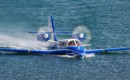
The Bombardier 415 is a twin-turboprop amphibious firefighting aircraft, built from 1993 to 2015 and known to crews as the Super Scooper. It skims across a lake or the sea, fills its tanks in seconds, and drops the load on a fire. It descends from the Canadair CL-215, and its successor, the DHC-515, is now in assembly.
Live Fleet Activity (CL2T)
📡
Fetching live data…
Specifications
- Engine
- 2 × Pratt & Whitney Canada PW123AF
- Engine type
- Turboprop
- Power
- 2 × 2,380 shp · 1,775 kW
- Avionics
- Honeywell EFIS, Primus II Nav/Comm Radio System
- Wing tips
- No winglets
- Seats
- 18
- Crew
- —
- Cabin width
- 7 ft 10 in · 2.40 m
- Cabin height
- 6 ft 3 in · 1.90 m
- Cabin length
- 30 ft 10 in · 9.40 m
- Exterior length
- 65 ft 0 in · 19.80 m
- Tail height
- 29 ft 6 in · 9.00 m
- Fuselage diameter
- 8 ft 10 in · 2.69 m
- Wing span
- 93 ft 10 in · 28.60 m
- Baggage volume
- 49 ft³ · 1.4 m³
- Gross weight
- —
- Empty weight
- 30,000 lb · 13,608 kg
- Max takeoff weight
- 43,800 lb · 19,900 kg
- Max landing weight
- 37,000 lb · 16,800 kg
- Max payload
- 6,400 lb · 2,900 kg
- Fuel capacity
- 1,530 gal · 5,800 L · 4,600 kg (Jet A)
- Maximum speed
- 194 kt · 223 mph · 359 km/h
- Cruise speed
- 180 kt · 207 mph · 333 km/h
- Approach speed
- 68 kt · 78 mph · 126 km/h
- Range
- 1,319 nm · 1,520 mi · 2,440 km
- Fuel burn
- 0.99 nm/gal · 0.48 km/L
- Ceiling
- 14,700 ft · 4,500 m
- Rate of climb
- 1,600 ft/min · 8 m/s
- Takeoff distance
- 2,650 ft · 820 m
- Landing distance
- 2,200 ft · 670 m
Gallery


(/)
tap to zoom
(/)

Live fleet activity details
📡
Operational Context
Table of Contents
What the Bombardier 415 Is
The Bombardier 415 is an amphibious aircraft built for one job: fighting fires from the air. It was sold as the Canadair CL-415 and is widely called the Super Scooper.
It first flew on December 6, 1993, and the first deliveries came in November 1994. Bombardier closed the production line in October 2015 and kept supporting the fleet.
How a Super Scooper Works
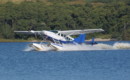
The 415 does not need a tanker base to reload. It flies low over a lake or the sea and drops a scoop into the water while still moving.
A published scooping run takes about 12 seconds over roughly 1,350 feet (410 m) at 70 knots, which fills about 6,137 liters (1,620 US gallons). The crew then climbs away and flies the short trip back to the fire.
That loop is the whole advantage. With a lake near the fire, a 415 can make drop after drop without landing.


From the CL-215 to the CL-415
The 415 descends from the piston-engine Canadair CL-215. In 1987, 17 CL-215s were refitted with turboprops and became the CL-215T.
The CL-415 was a new-build series, not a refit. It added a new cockpit, revised aerodynamics and a modified water-release system, and its engines sit closer to the fuselage.
Moving the engines reduced lateral stability. Designers answered with an inverted fixed leading-edge slat and extra surfaces for directional stability.
Powerplant and Performance
Two Pratt & Whitney Canada PW123AF turboprops drive the aircraft. The full specification table for the aircraft is on this page, so the figures here only add context.
The maximum takeoff weight is 43,800 lb (19,900 kg) with a land takeoff on a firefighting mission. After scooping, the aircraft is allowed to weigh more, about 47,000 lb, which is why older descriptions quote the higher number.
The speeds are modest because the airframe is a flying boat hull with a high wing. That slow, stable handling is what lets it scoop and drop low over rough terrain.

Where the Bombardier 415 Flies
Published fleet lists put Canada at 26 CL-415s, Italy at 18 and France at 12. Greece, Croatia, Morocco and Spain also fly the type, and Bridger Aerospace operates converted CL-415EAF aircraft in the United States.
Several of those countries now have the successor on order. The count of aircraft in service shifts as airframes are lost and replaced, so treat fleet numbers as a snapshot.
Bombardier 415 vs DHC-515
Viking Air bought the CL-415 type certificate in a deal completed on October 3, 2016. It then designed an updated aircraft, first called the CL-515 and renamed the DHC-515 by De Havilland Canada on March 31, 2022.
The DHC-515 carries up to 7,000 liters, against about 6,137 liters for the 415. Production is in Calgary, Alberta, where assembly of the first aircraft began in March 2026, with first delivery targeted for 2028.
Greece, France, Spain, Portugal, Croatia and Italy are among the customers, partly through an EU-financed order for the rescEU reserve. Alberta, Manitoba and Ontario have also ordered the type.
Frequently Asked Questions
How much does a Bombardier CL-415 cost?
Published unit costs run from roughly $31 million to $37 million, depending on the source and the year. The spec panel on this page shows $37 million for 2015, the final year of production. No new CL-415s are being built, so used and converted aircraft trade privately.
What is the water capacity of a Super Scooper plane?
The CL-415 holds up to about 6,137 liters (1,620 US gallons) of water. Its successor, the DHC-515, holds up to 7,000 liters.
What is the difference between CL-415 and 515?
The 515 is an updated version of the 415, renamed from CL-515 to DHC-515 in 2022. It carries more water and is built in Calgary, while the CL-415 line closed in 2015 after roughly 90 to 95 aircraft, depending on the count.
How much does a firefighting airplane cost?
It varies with the type and the support package. For scale, Greece’s 2024 order for seven DHC-515s was announced at about $530 million.
How many Bombardier 415s were built?
Sources give 90 to 95 aircraft over a production run from 1993 to 2015.
Sources and references used for research and fact-checking.