



Table of Contents
| Question | T-38A Talon | F-5E Tiger II |
|---|---|---|
| Role | Two-seat supersonic advanced trainer | Single-seat light fighter (two-seat F-5F for training) |
| First flight | 10 April 1959 (T-38 prototype line) | 30 July 1959 (F-5A); 11 August 1972 (F-5E) |
| Entered service | 17 March 1961 | 1964 (F-5A); Tiger II in the 1970s |
| Number built | 1,187 | 1,204 F-5A/B/C/D and 1,399 F-5E/F |
| Combat record | None | Vietnam War trials in 1965 and combat use by several air forces |
| Best-known US job | Pilot training and Thunderbirds team (1974 to 1982) | Aggressor squadrons (1975 to 1990), Navy and Marine adversary work |
| Operators today | USAF, US Navy, NASA, Germany, Turkey and others | Switzerland, South Korea, Iran, US Navy and Marines and others |
Same family, different jobs
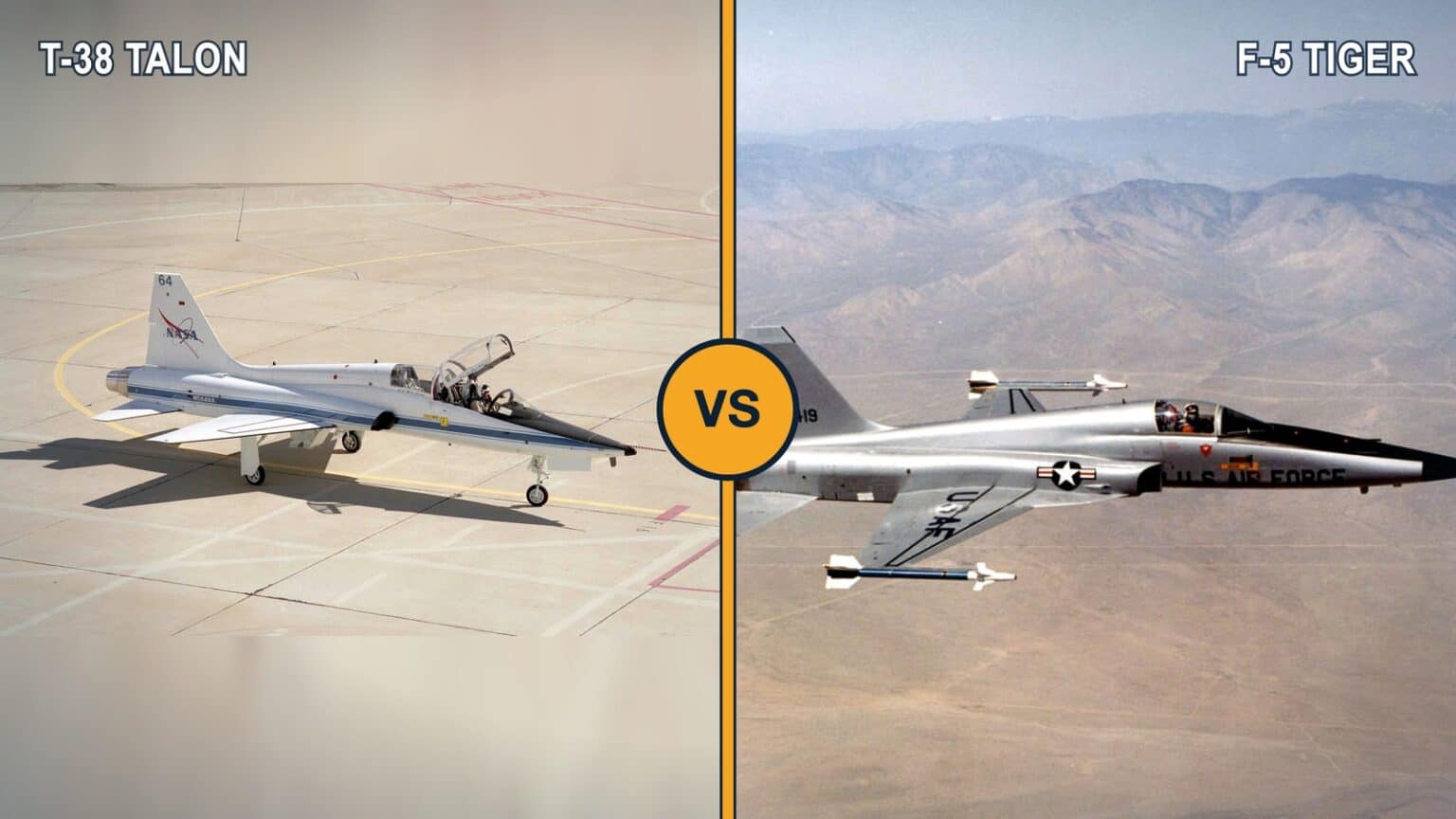
Both jets grew out of Northrop’s N-156 design of the late 1950s. The T-38 Talon first flew on 10 April 1959 and entered Air Force service on 17 March 1961.
The fighter version flew as the F-5A on 30 July 1959. It was chosen for the US Military Assistance Program as the F-5 Freedom Fighter.
So the T-38 is not a stripped F-5, and the F-5 is not an armed T-38. They are two answers to one airframe, built in parallel.
How they differ in the air
The Talon is a trainer with two seats in tandem and no combat radar. Students and instructors fly it to learn supersonic handling and formation work.
The F-5E Tiger II is a different animal. It carries a radar and weapons, and it was designed to be cheap to buy and easy to maintain for allied air forces.
Both use General Electric J85 engines, though in different versions. The widget above shows the exact figures side by side.


Which one saw combat
The F-5 did. In October 1965 the Air Force began a five-month combat evaluation called Skoshi Tiger. Twelve F-5As went to Vietnam and flew more than 2,600 sorties.
The T-38 never fought. In the US it stayed a trainer, though it did a famous display job for a while.


The Thunderbirds flew T-38s until four of them crashed on 18 January 1982 during an airshow practice. The team then moved to the F-16A.
From the N-156 to two aircraft
Northrop started with a lightweight supersonic design, the N-156. It was meant to be cheap, small and easy to keep flying.
The Air Force wanted a supersonic trainer first. That became the T-38, which was the world’s first supersonic trainer and the most produced one, at 1,187 airframes.
The fighter version took longer to find a customer in the US, and it was aimed at allied air forces from the start. That is why the F-5 sold far more abroad than at home.
Talon production ended in 1972. Tiger production ran until 1987, which is why the fighter family is the longer story.
What the F-5E did for the US
The Air Force flew the F-5E from 1975 to 1990 in aggressor squadrons at Nellis, in the UK and in the Philippines. Its small size let it stand in for Soviet fighters.
The Marines later bought used F-5s for VMFT-401, and the Navy flew the F-5E for adversary training too.


Abroad, the Tiger was a mainstay. Taiwan’s AIDC built 242 F-5Es and 66 F-5Fs, and the production line there closed in 1986.
Canada’s CF-5 is another licensed relative. Northrop’s later F-20 Tigershark was an advanced single-engine development of the same line.
The Navy swap
The Navy once used T-38s for dissimilar air combat training. It replaced them with the F-5 Tiger II, which looks and flies more like an enemy fighter.
That swap says a lot about the pair. The Talon is the aircraft you learn in. The Tiger is the one you fight against.
The shared lineage matters here. The two jets are close cousins, so the Tiger was a natural stand-in for training fights.
Who flies the Tiger abroad
Taiwan was once the largest operator, with 336 F-5E and F-5F aircraft in its inventory. Singapore ran about 49 upgraded F-5S and F-5T jets until the early 2010s.
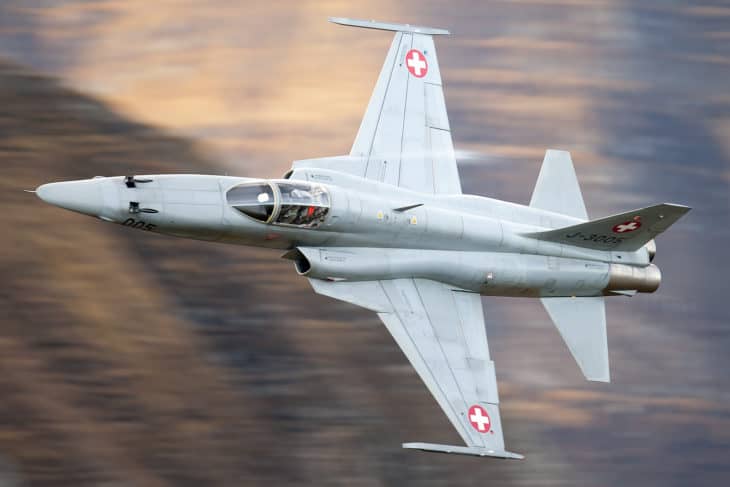
Switzerland, South Korea and Iran appear among the type’s main users in the F-5 data. Switzerland’s Tigers appear in several of the photos on this page.
Upgrades and offspring
The T-38 is still flying because it was rebuilt. The T-38C added a glass cockpit, a head-up display, GPS, inertial navigation and TCAS under the Avionics Upgrade Program.
Turkey flies an upgraded version as the T-38M, and Germany keeps its Talons in Texas for pilot training.
The F-5 family spawned more variants. Canada built the CF-5, and Northrop developed the F-5 line into the YF-17 and the F-20 Tigershark.
Iran later built its own Tiger-derived fighters, the Azarakhsh, Saeqeh and Kowsar. A NASA F-5E was also reshaped for DARPA sonic boom tests.
The F-5E got a newer APG-69 radar, but most operators skipped it to save money, so it saw little service.
Where each stands today
The T-38 has served the Air Force for more than 60 years as of 2026. The Air Force has named the Boeing-Saab T-7A Red Hawk as its possible replacement, with timing that depends on funding and testing.
Germany still trains at Sheppard AFB on T-38s, and Turkey flies the upgraded T-38M. The F-5 is retired from the US Air Force but still serves with several air forces and the US Navy.
So which is the better jet
It depends on the job. For teaching a pilot to fly supersonic, the T-38 is the one, and it has done that for decades.
For a small air force that wanted a cheap, supersonic fighter, the F-5 was the one. For a museum visitor, either makes a good photo.
The honest answer is that they are not rivals. They were built together to do two different tasks, which is why this pairing keeps coming up.
The verdict
The T-38 trains pilots and the F-5E plays the enemy. Same Northrop family, same engine line, different jobs. Only the F-5 was built to fight.
FAQ
Sources and references used for research and fact-checking.
About the Author

Tim is the owner and lead editor of AeroCorner since 2019, overseeing aviation content covering aircraft, airlines, airports, and the broader aviation industry. Through years of researching, writing, editing, and publishing aviation-focused content, he has developed extensive practical knowledge of commercial aviation and air travel. Based in Asia and a frequent traveler himself, Tim also brings firsthand passenger experience to AeroCorner’s coverage. Outside of publishing, he has also explored aviation firsthand through hands-on flight training in New Zealand.