

Table of Contents
| Measure | KC-46A Pegasus | KC-135R Stratotanker |
|---|---|---|
| Based on | Boeing 767 airliner | Boeing 367-80 prototype, developed alongside the 707 |
| First flight | 25 September 2015 | 31 August 1956 |
| First delivery | 10 January 2019 | June 1957 |
| Drogue refueling | Wing pods and a centerline drogue | Drogue adapter on the boom, or wing pods on some aircraft |
| Pallet positions | 18 | 6 |
| USAF fleet | More than 100 delivered; 263 planned | 375 (June 2026) |
| Cost per aircraft, as budgeted | $199.8 million (FY2027 request) | $39.6 million (1998) |
How to read this comparison
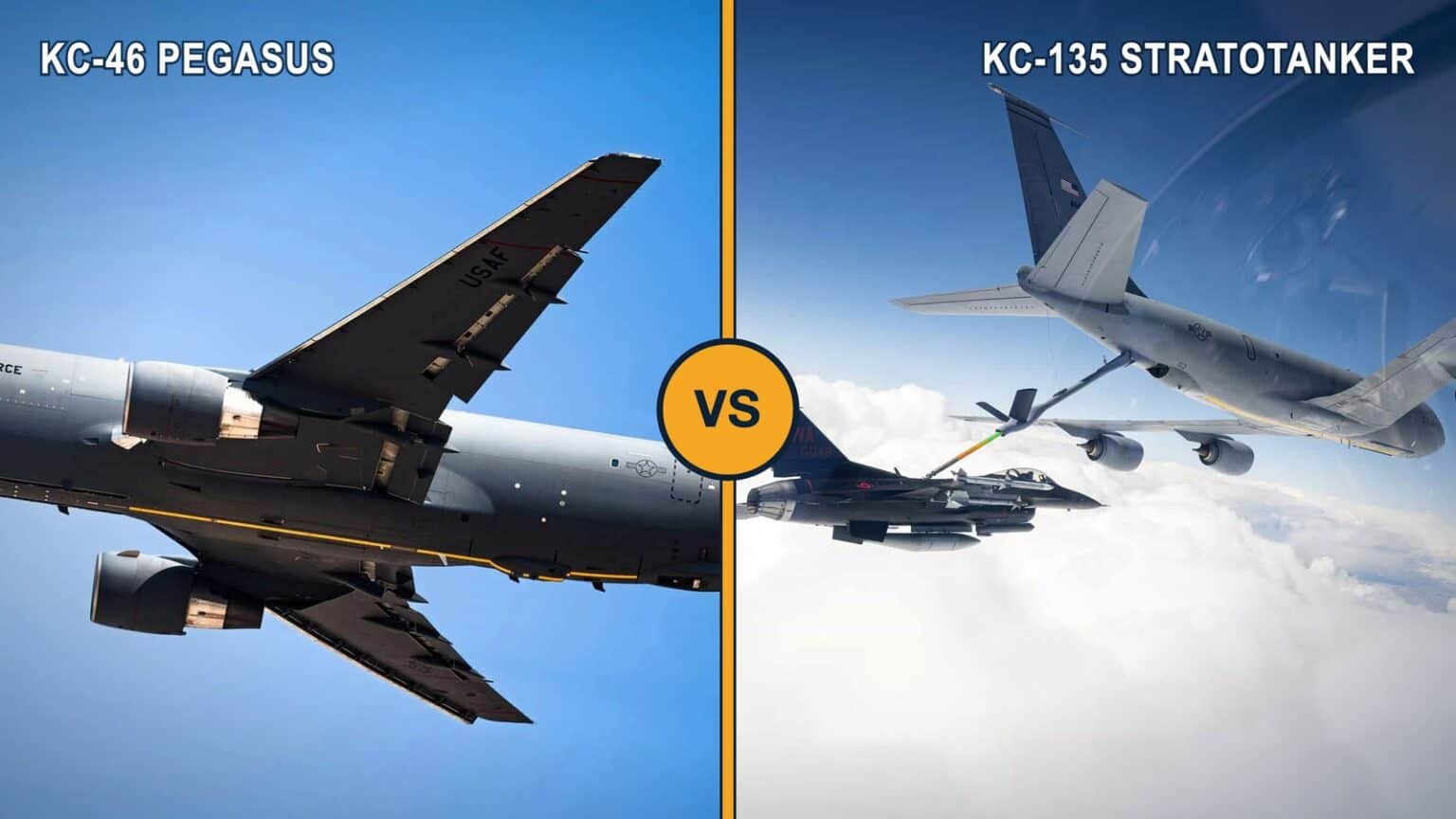
The spec panel above compares the KC-46A, the Air Force’s new tanker, with the KC-135R, the re-engined version that makes up most of the KC-135 fleet. Older KC-135E and KC-135A models differ in engines and performance. Fleet figures are for the U.S. Air Force only.
What each tanker is
The KC-135 Stratotanker is the Air Force’s workhorse tanker. It first flew on 31 August 1956 and entered service in June 1957, and it was developed from the Boeing 367-80 prototype alongside the 707 airliner.
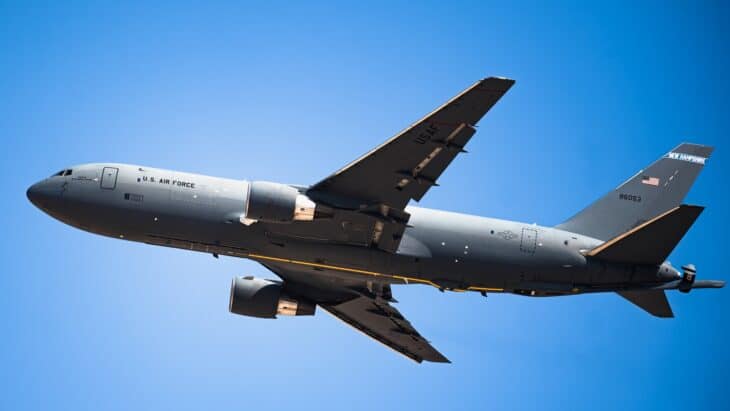
The KC-46 Pegasus is built from the Boeing 767. It combines the 767-200ER fuselage with the 767-300F wing, landing gear and cargo door, and the Air Force took its first one on 10 January 2019.
Both are flying gas stations with a cargo deck on top, and both appear in our ranking of every aerial refueling tanker in service. The question is how much the newer design adds.
Size and airframe
The KC-46 is the bigger aircraft in every dimension on the spec panel above, from length and wingspan to tail height. The KC-135 has a narrower fuselage than the 707 it grew up beside.
The KC-135R flies on four CFM56-derived turbofans, while the KC-46 has two Pratt & Whitney PW4062s. Both fly with a basic crew of three.
Edge: KC-46, for the larger, newer airframe.
How they refuel other aircraft
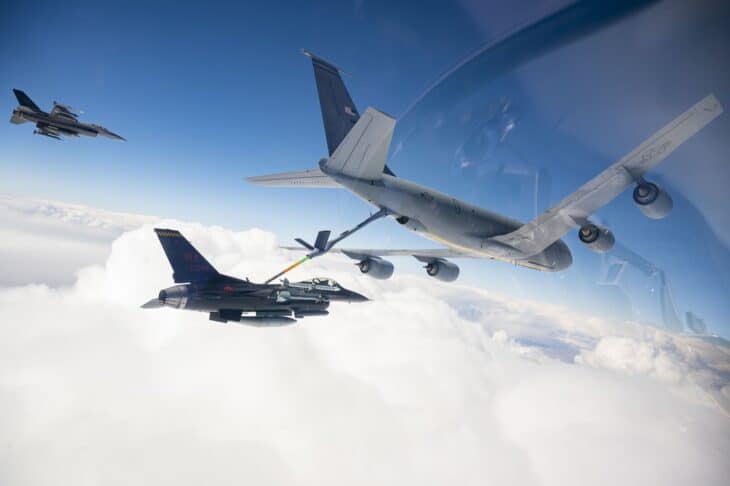
Both tankers pass fuel through a flying boom flown by a boom operator. On the KC-135, nearly all internal fuel can be pumped through the boom, and a shuttlecock-shaped drogue can be attached to refuel probe-equipped aircraft such as Navy and NATO fighters.
The KC-46 has wing-mounted drogue pods and a centerline drogue as well as its boom, so it can refuel boom and probe receivers on one mission. The wing pods were not fitted to the first 18 aircraft and were delivered later.
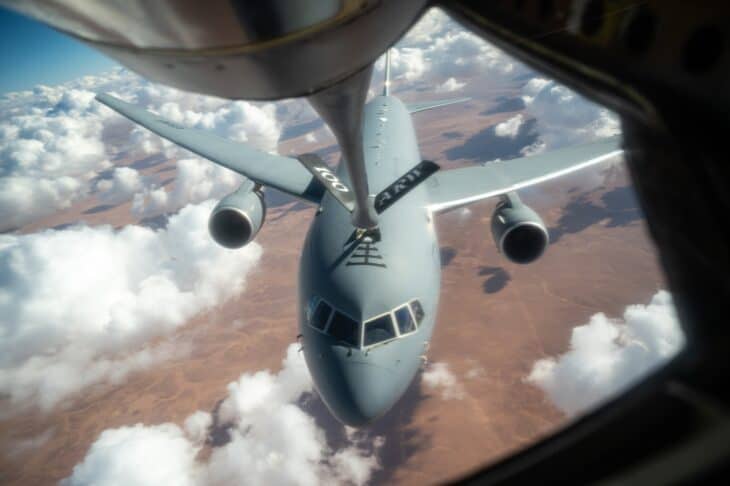

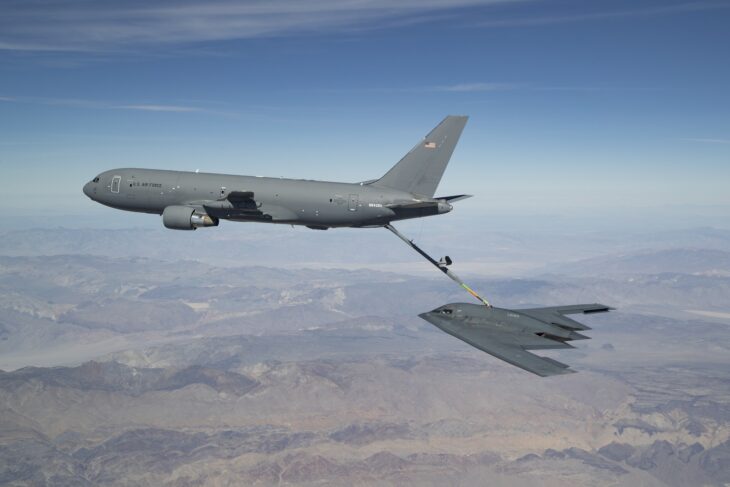
The photo above shows the old tanker topping up the new one.
Edge: KC-46, because one aircraft covers both receiver types without an adapter.
Cargo, passengers and patients
The KC-135 can carry up to 83,000 lb of cargo on six pallet positions, depending on how much fuel it carries. The KC-46 carries up to 65,000 lb on 18 pallet positions.
So the older tanker has the higher weight limit, and the newer one has the more flexible deck. The KC-46 is also set up for aeromedical evacuation, with room for 54 patients, 24 of them on litters, according to the design summary on Wikipedia.
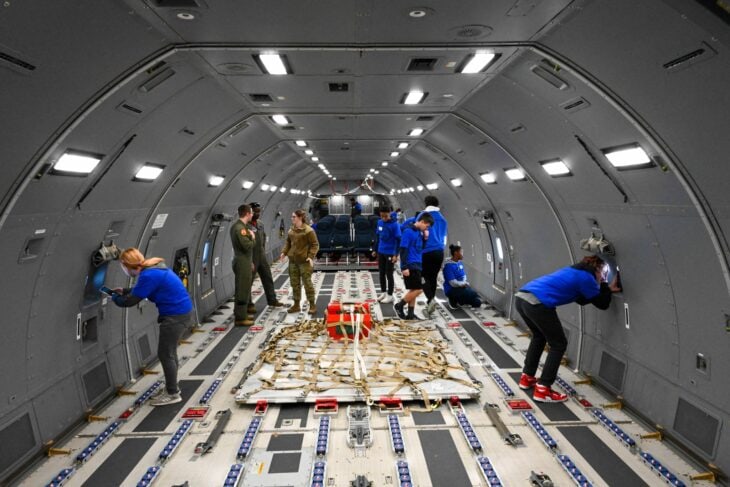

The KC-46’s cargo floor had a problem early on. In September 2019 the Air Force restricted cargo and passenger flights because floor locks could unlock in flight, and a fix was approved that November.
Edge: KC-135 on weight, KC-46 on pallets and patients.
Myth: the KC-46 replaces the KC-135 one for one
The Air Force says the KC-46 is planned to fully replace the KC-135 fleet. The numbers do not match one for one: the program of record is 263 KC-46As, against 375 KC-135s in service in June 2026. The KC-135 will keep flying for years while the KC-46 builds up.
Where the KC-46 has struggled
The KC-46’s boom operator flies the boom using cameras, not a window. The Remote Vision System shows multispectral imagery on three screens. Known issues include depth compression and curvature distortion.
In May 2025 the Air Force’s then chief of staff told a House subcommittee that the KC-46 had five Category 1 deficiencies, two of them from that system. A replacement, RVS 2.0, is now projected for summer 2027, three years behind schedule.
Boeing has absorbed more than $7 billion in losses under its fixed-price development contract. The Air Force expects all KC-46 shortfalls to be resolved by 2028.
The KC-135 has no such program history, because it has simply been doing the job since the 1950s. Its Block 45 upgrade had put 45 aircraft in service with a glass cockpit, a digital autopilot and a radio altimeter by January 2017.
Edge: KC-135, for proven reliability today.
Fleet size and age
The Air Force flew 375 KC-135s as of June 2026: 157 active duty, 62 Air Force Reserve and 156 Air National Guard. The oldest active U.S. military aircraft is a KC-135 built in 1957.
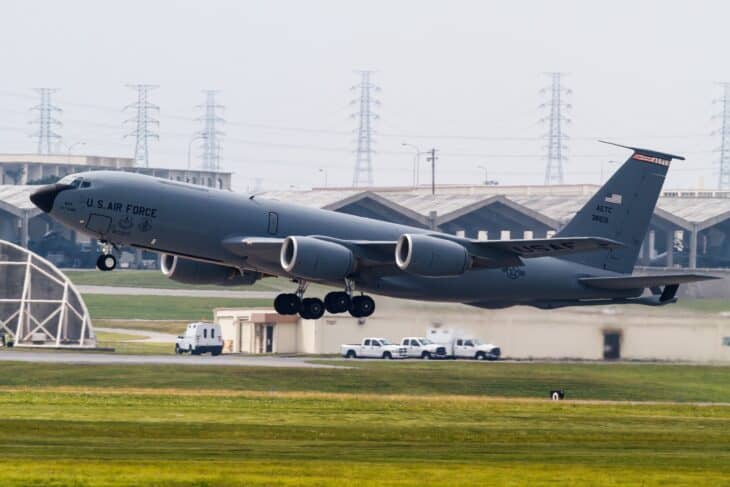

Outside the United States, Turkey flies seven KC-135Rs, Chile three KC-135Es, and the private tanker company Metrea fifteen KC-135Rs, while France has replaced its C-135FRs with A330 MRTTs.
The KC-46 has two foreign operators so far. Japan has taken six and Israel two, and Italy halted its KC-46 purchase in July 2024 and has since ordered A330 MRTTs.
More than 100 KC-46s had been delivered to the Air Force by mid-2026, with the planned buy now at 263. The FY2027 request asks for 15 more, and annual purchases are expected to rise to 18 a year from 2028 to 2031.
Edge: KC-135 on numbers, KC-46 on age.
Cost
The FY2027 budget lists the KC-46A at $199.8 million per aircraft, rising to $321.9 million in FY2028. That is a program unit cost, not a simple flyaway price, so it is not a like-for-like price tag.
The KC-135 spec panel shows $39.6 million, a 1998 figure from decades before the program existed. The two numbers are far apart in date, and in what they include.
Edge: KC-135 on price, though the comparison is not clean.
The verdict: why the Air Force needs both
The KC-46 is the better tanker on design: bigger, more flexible, able to refuel boom and probe receivers together and to carry patients. The KC-135 is the better tanker on delivered record, with a higher cargo limit, a cheaper price and 375 aircraft already in the fleet.

The Air Force needs both for years to come, because the KC-46 fleet is still building toward 263 while the KC-135 fleet stands at 375.
FAQ
Sources and references used for research and fact-checking.
About the Author

Tim is the owner and lead editor of AeroCorner since 2019, overseeing aviation content covering aircraft, airlines, airports, and the broader aviation industry. Through years of researching, writing, editing, and publishing aviation-focused content, he has developed extensive practical knowledge of commercial aviation and air travel. Based in Asia and a frequent traveler himself, Tim also brings firsthand passenger experience to AeroCorner’s coverage. Outside of publishing, he has also explored aviation firsthand through hands-on flight training in New Zealand.