

Table of Contents
There’s a reason the F6F Hellcat is considered one of the best fighters of World War II, and it wasn’t just its sheer power. The Hellcat was fast, agile, and had an impressive range – thanks in part to its Wright Cyclone engine. It could take on any enemy plane in the sky and come out on top.
But what about the P-51 Mustang? This aircraft was also highly sought after during WWII, and many experts consider it one of the best fighters ever built. So which plane was the better fighter? Let’s take a closer look.
The Grumman F6F Hellcat
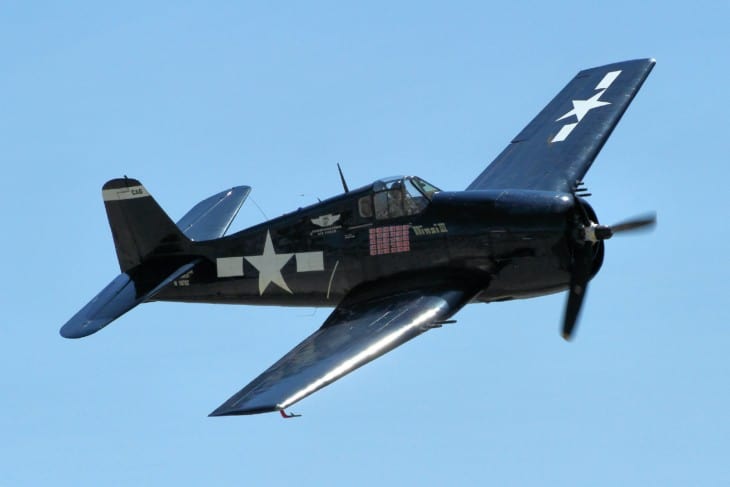
The Grumman F6F Hellcat was the United States Navy’s top dog during World War II, and for a good reason. Not only did it have a top speed of 611 km/h and a range of 1,520 km, but its Pratt & Whitney R-2800 Double Wasp engine also allowed it to cruise at a blazing 322 km/h. And with a wingspan of 13 m and a weight of 4,109 kg, this bad boy could certainly pack a punch.
The F6F was designed as the successor to the F4F Wildcat and as a counter to the Japanese Mitsubishi A6M Zero, and it proved to be more than up for the task.
The Hellcat dominated aerial combat and is credited with destroying over 5,000 enemy aircraft.
Why was the F6F Hellcat developed and built
The United States Navy’s search for a new fighter began with the decent but painfully slow F4F Wildcat. Enter the Grumman F6F Hellcat. Developed to combat the Japanese Mitsubishi A6M Zero, the Hellcat proved its worth in aerial combat during WWII.
Its impressive speed and armament quickly dominated the skies, and it became known as a “pilot maker” due to its forgiving flight characteristics.
Giving credit where credit is due, Hellcats were also responsible for shooting down 5,271 enemy aircraft – more than any other Allied naval aircraft.
What purpose did the F6F Hellcat serve?
The F6F Hellcat was a reliable and sturdy fighter aircraft primarily used by the United States Navy during World War II. It made its combat debut in September 1943 and proved a formidable enemy against Japan’s air force in the Pacific theatre.
The Hellcat could hold its own in dogfights, but it also had the range and power to escort bombers on raids. Its rugged design allowed it to endure battle damage and make emergency landings on aircraft carriers. Many credits its high survival rates to its ability to take punishment and keep flying.
Despite facing stiff competition from other fighter planes, the Hellcat achieved an impressive kill-to-loss ratio of 19:1 during the war. After the war, it continued to serve as a carrier-based fighter until the mid-1950s, when it was gradually phased out in favor of newer models.
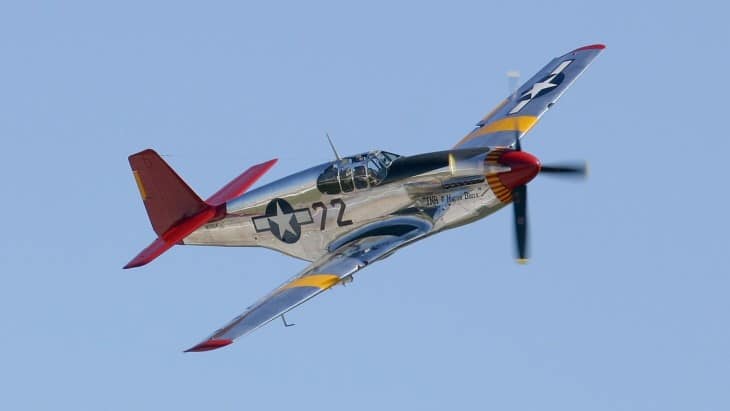
The North American P-51 Mustang
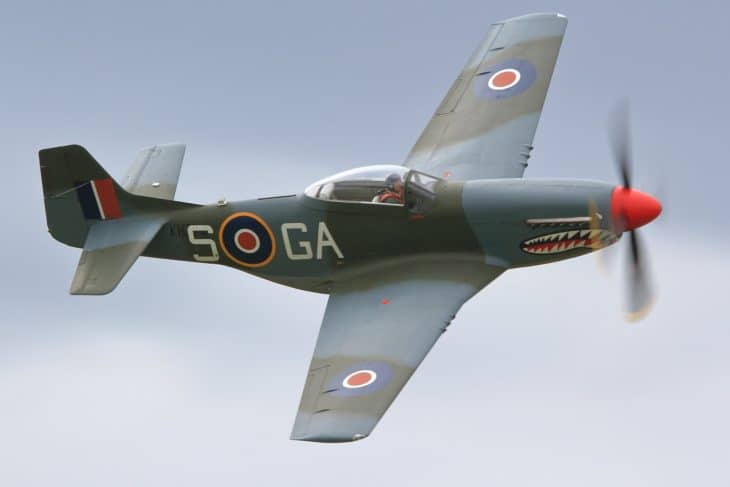
The P-51 Mustang was a sleek, versatile machine that dominated the skies during World War II and beyond. Its sleek design, with a wingspan of 11 meters and a top speed of 710 km per hour, made it a formidable opponent in dogfights.
And its capabilities extended beyond combat – the Mustang could also be used as a fighter bomber, able to carry out precision strikes on ground targets. The P-51’s impressive range meant it could escort bombers to their targets in Germany and back.
With its strong performance record and enduring legacy, it’s no wonder that the P-51 Mustang remains beloved by aviation enthusiasts today. The unit cost may have been 50,985 USD in 1945, but the Mustang is priceless to many.
Why was the P-51 Mustang developed and built?
The P-51 Mustang wasn’t necessarily flashy or glamorous, but it got the job done. Its development and construction were a response to the growing need for an effective bomber escort during World War II.
The Mustang relied on a common, reliable engine and had room for a larger fuel load, allowing it to accompany bombers on longer missions.
What purpose did the P-51 Mustang serve?
The P-51 Mustang may have been small in size, but it was a giant in the skies during World War II. Originally designed as a low-altitude interceptor, it proved versatile and was soon used for long-range escort missions, protecting bombers on their way to Berlin and beyond.
But its true prowess shone on its reconnaissance missions, flying solo and reporting vital intelligence on enemy movements.
The Mustangs even provided support for Allied troops on the ground during D-Day. And after the war ended, this legendary aircraft continued serving with air forces worldwide until the 1980s.
How are F6F Hellcat and P-51 Mustang different?
Though both the F6F Hellcat and P-51 Mustang played crucial roles in securing air superiority for the Allies during World War II, the two planes were quite different from one another.
The Hellcat was relied upon for its ruggedness and ability to withstand damage, while the Mustang was known for its impressive speed and agility.
In terms of performance, the Mustang could fly 50 mph faster and had a greater ceiling and range. And when it came to combat effectiveness, the Mustang outshone the Hellcat as well – shooting down nearly 5,000 enemy planes and destroying twice as many on the ground.
How are the F6F Hellcat and P-51 Mustang similar?
At a glance, the F6F Hellcat and the P-51 Mustang may seem very different. However, both planes share some crucial characteristics. Both were designed and built by powerhouse aerospace companies – the Hellcat by Grumman and the Mustang by North American Aviation. They also utilized advanced technologies developed during World War II, such as tail control surfaces that could be adjusted in flight for improved maneuverability.
Perhaps most importantly, both planes proved highly effective in combat, amassing impressive kill ratios against their Japanese and German adversaries.
What’s better about the F6F Hellcat?
This plane has several specifications that outperform its rivals, e.g.:
Design:
The F6F Hellcat was designed with air-cooled radial engines in mind from the start. This meant the engine could be placed forward in the fuselage, improving the plane’s center of gravity and balance.
Wings:
The Hellcat’s wing design was also superior to that of its contemporaries. The wing’s main spar ran through the length of the fuselage, providing extra support and preventing the wings from folding during high-speed dives.
Crew:
The crew compartment was also well-designed, with good visibility and easy access to all controls.
What’s better about the P-51 Mustang?
On the other hand, the P-51 Mustang had some impressive specifications of its own:
Engine:
The P-51 was powered by the legendary Rolls-Royce Merlin engine. This V-12 powerhouse propelled the plane to speeds over 400 mph.
Range:
The Mustang’s long range was thanks to its large fuel tank. This allowed the plane to stay in the air for hours, giving it the endurance needed for long-range escort missions.
Conclusion
So, which plane was better? It’s hard to say. The F6F Hellcat and the P-51 Mustang were exceptional aircraft that played vital roles in the Allies’ victory in World War II. In terms of specifications, the P-51 Mustang had a slight edge. But in terms of combat effectiveness, both planes were equally fearsome.
About the Author

With a passion for aviation, as well as surfing and scanning the web, Rocco is in his element analyzing aircraft data and the differences and similarities between aircraft.