



Table of Contents
| DC-10-30 | L-1011 TriStar 500 | |
|---|---|---|
| First flight of the family | August 29, 1970 | November 16, 1970 |
| Family service entry | August 5, 1971, American Airlines | April 26, 1972, Eastern Air Lines |
| This version’s debut | First delivered November 21, 1972 to KLM and Swissair | First flight October 16, 1978; British Airways service from May 7, 1979 |
| Built, whole family | 386 airliners plus 60 KC-10 tankers | 250 |
| Built, this version | 163 DC-10-30s for 38 customers | Not given in the sources used here |
| Third engine | In the tail fin, on a banjo-shaped structure | In the rear fuselage, fed through an S-duct |
| Military and special roles | KC-10 Extender tanker, 10 FedEx freighters | The Pegasus rocket launch aircraft Stargazer (an L-1011-100) |
Which variants this page compares
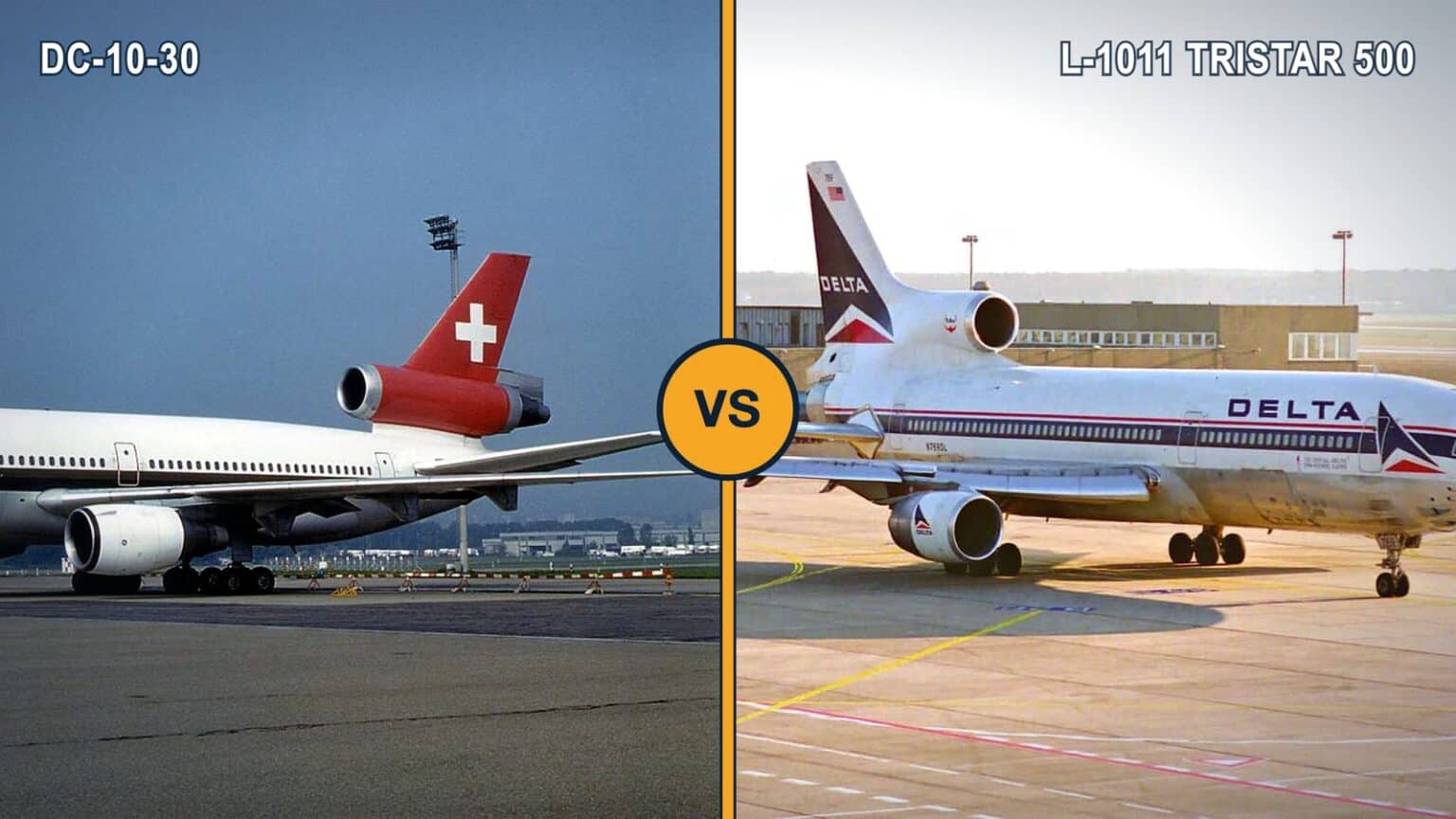
The panel above compares the DC-10-30 with the L-1011 TriStar 500. The DC-10-30 is the long-range, three-main-gear version with General Electric CF6-50 engines, and 163 were built. The TriStar 500 is the last and longest-ranged L-1011, with a shorter fuselage and Rolls-Royce RB.211-524B engines. Where a figure belongs to another variant, the text says so.
Design: the third engine is the giveaway
Both are three-engine widebodies from 1970, built for airlines that wanted a smaller alternative to the 747. The DC-10-30 puts its third engine in a banjo-shaped structure on top of the rear fuselage, and the vertical fin sits on that structure.
The L-1011 TriStar 500 buries the third engine inside the rear fuselage. Air reaches it through an S-duct on top of the body. Wikipedia says the S-duct cut drag and improved stability, and kept pressure loss close to a straight duct.


The myth: they are the same airplane
People often treat the two as interchangeable trijets from the same drawing board. They are not. They came from competing companies bidding for the same airline orders, and the engine layout differs. The tail is the quickest tell: a DC-10 has an engine in its fin, a TriStar has none there.
Size and range: the TriStar 500 flies slightly farther
The DC-10-30 is the larger aircraft. It is 181 ft 7 in (55.35 m) long against 164 ft 2 in (50.05 m) for the TriStar 500, and it has a maximum takeoff weight of 555,000 lb (251,500 kg) against 510,000 lb (231,500 kg).
The TriStar 500 is a shortened L-1011 built to fly farther. Its range is 5,345 nmi (6,150 miles, 9,900 km). The DC-10-30 manages 5,200 nmi (5,980 miles, 9,630 km).
So the smaller aircraft has the longer reach, by a modest margin. Published ranges depend on the passenger load and reserves assumed, so treat a gap this small as a tie on paper.
Cabins and passengers
The two cabins are close in width. The DC-10-30 cabin is 18 ft 8 in (5.70 m) wide and the TriStar 500 cabin is 18 ft 11 in (5.77 m) wide, so neither aircraft gives a seat-width advantage on paper.
Capacity is where the DC-10-30 pulls ahead. Wikipedia gives a typical two-class DC-10 layout of 270 seats, a main cabin range of 250 to 380 passengers, and an FAA exit limit of 380 for the -30.
The TriStar 500 is shorter, so it carries fewer people in a like-for-like layout. It was built for range rather than capacity.
Seat counts always depend on the airline, so any single number is only a typical case. Neither aircraft has a fixed passenger count.
Engines: General Electric against Rolls-Royce
The DC-10-30 uses three GE CF6-50C turbofans at 51,000 lbf (227 kN) each. The TriStar 500 uses three Rolls-Royce RB.211-524B engines at 50,000 lbf (222 kN) each.
The Rolls-Royce engine nearly sank the L-1011 program. In February 1971 Rolls-Royce went into receivership, which halted final assembly of the aircraft, and Lockheed has said it needed to sell 500 airliners to break even. It sold 250.

Technology: where the TriStar led
The L-1011 was the more advanced airliner. Wikipedia says it was the first widebody certified for FAA Category IIIc autolanding, which allows landing with no visibility.
Its autopilot flew a 1972 demonstration flight from the takeoff roll to landing. It also had direct lift control, which deploys wing spoilers on approach to hold the glideslope with steadier pitch. The TriStar 500 added active ailerons for gust alleviation.
Technology did not decide the sales race, though. The DC-10 outsold the TriStar by a wide margin.
Sales: why the DC-10 won
Douglas built 386 DC-10 airliners, plus 60 KC-10 tankers for the US Air Force, delivered from 1981 to 1988. Lockheed built 250 L-1011s between 1968 and 1984 and never reached its break-even target.
The DC-10-30 alone was delivered to 38 customers, and 163 were built. American Airlines ordered 25 DC-10s and United ordered 30 in 1968, so Douglas had large US launch orders as well.

Safety record and the 1979 grounding
The DC-10 carried a heavier reputation burden. On March 3, 1974, a cargo door failed on Turkish Airlines Flight 981 near Ermenonville, France, and the crash killed 346 people.
On May 25, 1979, the left engine and pylon separated from American Airlines Flight 191 after takeoff from Chicago O’Hare. All 271 people aboard and two on the ground died. The FAA withdrew the DC-10 type certificate on June 6, 1979 and reinstated it on July 13, 1979.
Neither accident involved the TriStar. We have not found a source that counts L-1011 accidents for the -500 alone, so this page makes no per-version safety comparison.
What happened to them
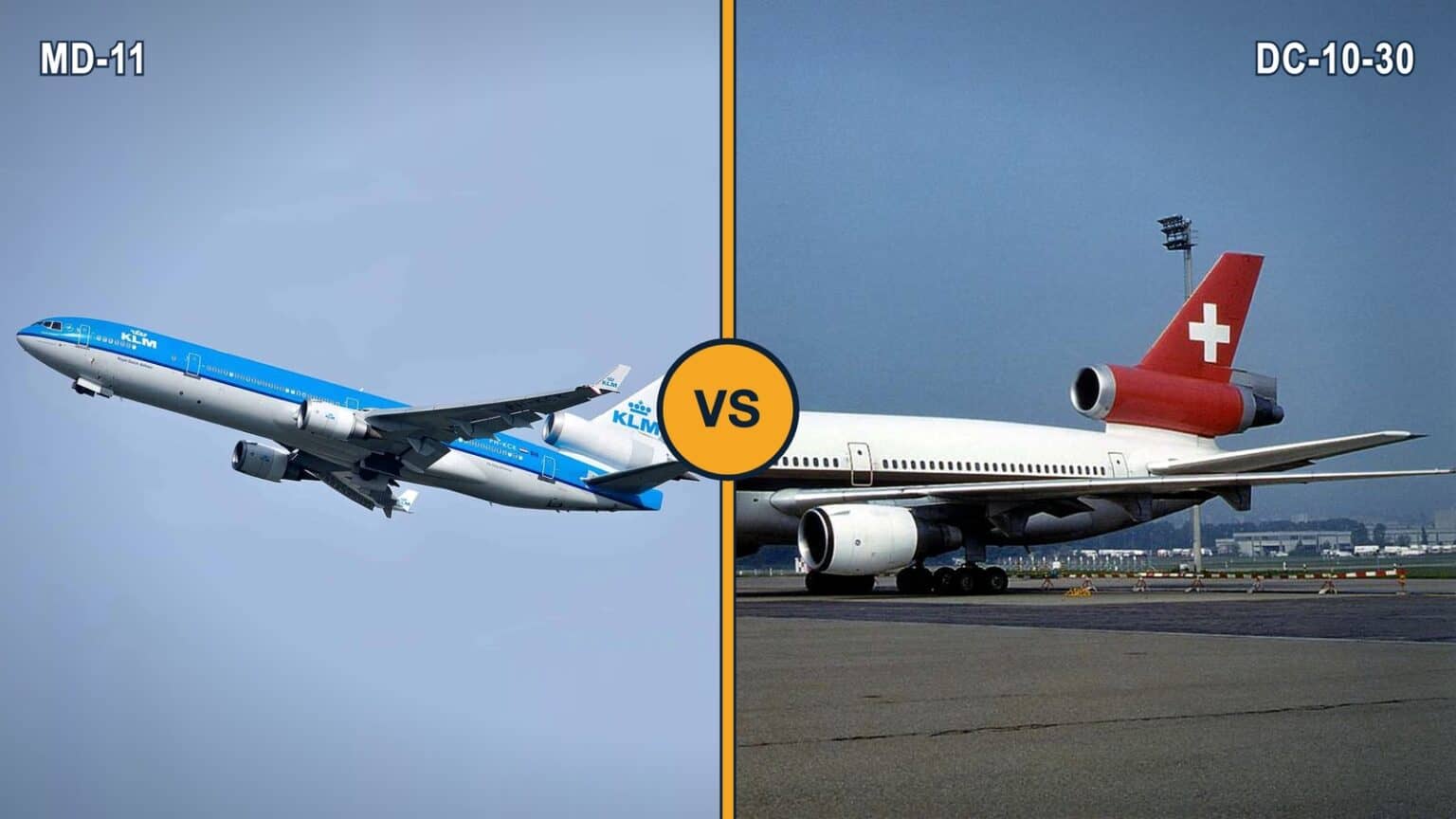
The DC-10 lived on as a freighter and a tanker. The KC-10 Extender is based on the DC-10-30CF, and FedEx operated a DC-10-30 all-freight version, of which 10 were built. The MD-11 was its stretched successor.
The L-1011 passenger service ended in the 2000s. Brussels Airlines flew its last scheduled L-1011 flight in August 2007, Thai Sky Airlines in February 2008 and Lloyd Aéreo Boliviano in May 2008. The one active L-1011 is Stargazer, a converted L-1011-100 that launches Pegasus rockets.
For other widebodies of the same era, see our ranking of the largest commercial airplanes.
Which was better?
For airlines, the DC-10-30 had the larger capacity: its FAA exit limit allows 380 seats. Neither is better in the abstract.
The DC-10-30 won the market with size, US launch orders and a freighter and tanker afterlife. The TriStar 500 kept its edge as the more advanced aircraft with slightly more range.
FAQ
Sources and references used for research and fact-checking.
About the Author

Tim is the owner and lead editor of AeroCorner since 2019, overseeing aviation content covering aircraft, airlines, airports, and the broader aviation industry. Through years of researching, writing, editing, and publishing aviation-focused content, he has developed extensive practical knowledge of commercial aviation and air travel. Based in Asia and a frequent traveler himself, Tim also brings firsthand passenger experience to AeroCorner’s coverage. Outside of publishing, he has also explored aviation firsthand through hands-on flight training in New Zealand.