



Table of Contents
| Measure | MD-11 | DC-10-30 |
|---|---|---|
| Role | Passenger and freighter trijet, 1990 onward | Passenger trijet, with freighter and tanker versions |
| First flight | January 10, 1990 | August 29, 1970 (the DC-10-10) |
| Service entry | December 20, 1990, Finnair | DC-10-30 first delivered November 21, 1972, to KLM and Swissair |
| Flight crew | Two pilots | Three: two pilots and a flight engineer |
| Cockpit | Six CRT displays, Honeywell VIA 2000 computers | Original three-crew flight deck |
| Wing tips | Winglets | Plain wing tips |
| Tail | Horizontal tail about 30% smaller than the DC-10-30’s, with a fuel ballast tank | Larger horizontal tail, no ballast tank |
| Built | 200 in all: 131 passenger, 53 freighter and 16 other | 446 DC-10s, 163 of them DC-10-30s, plus 60 KC-10 tankers |
| Passenger service ended | KLM, October 26, 2014 | Northwest, January 8, 2007 |
| Still flying | FedEx and others, as freighters | Mostly retired; a few tankers and one firefighting operator |
How we compare the MD-11 and the DC-10
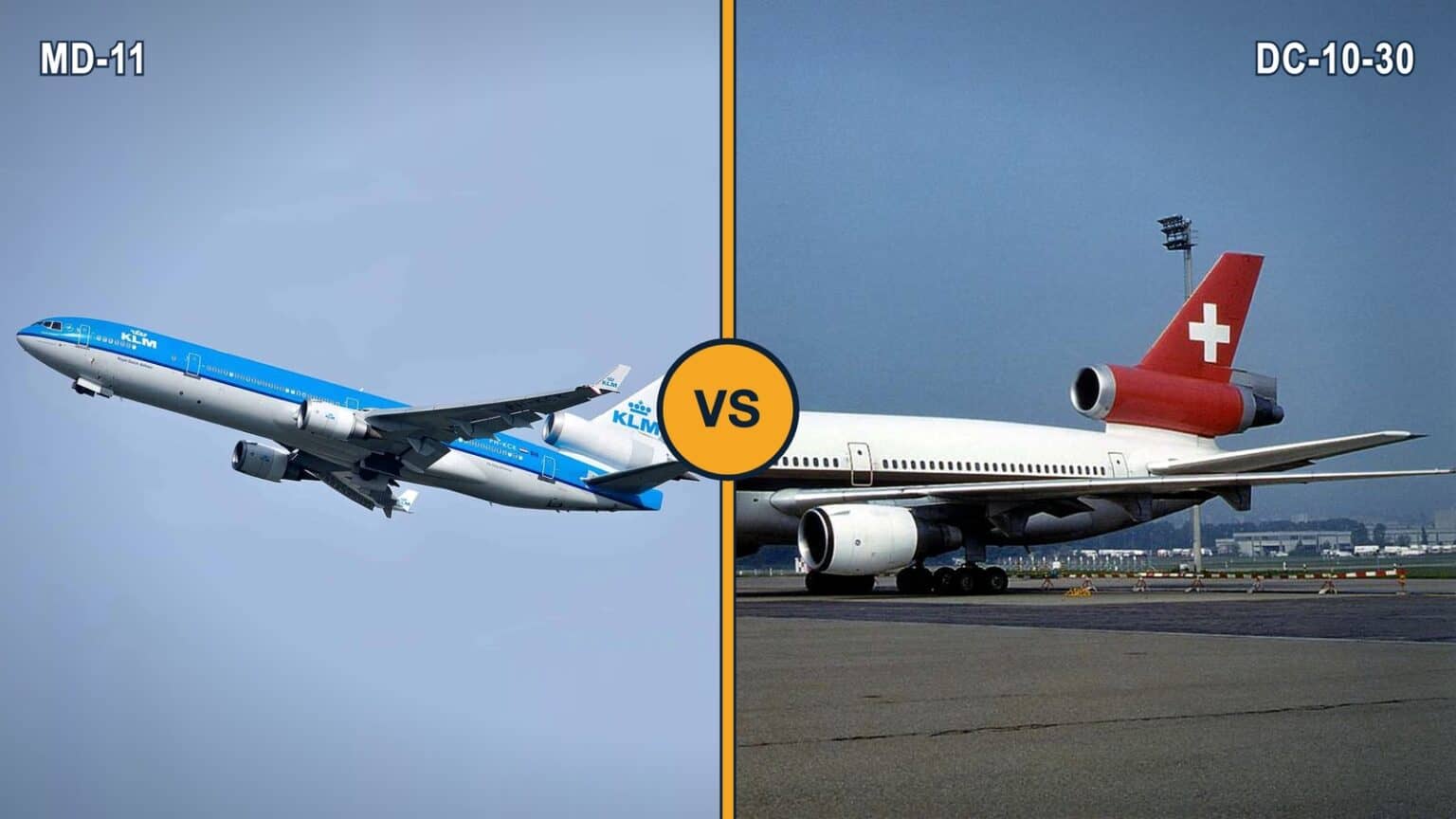
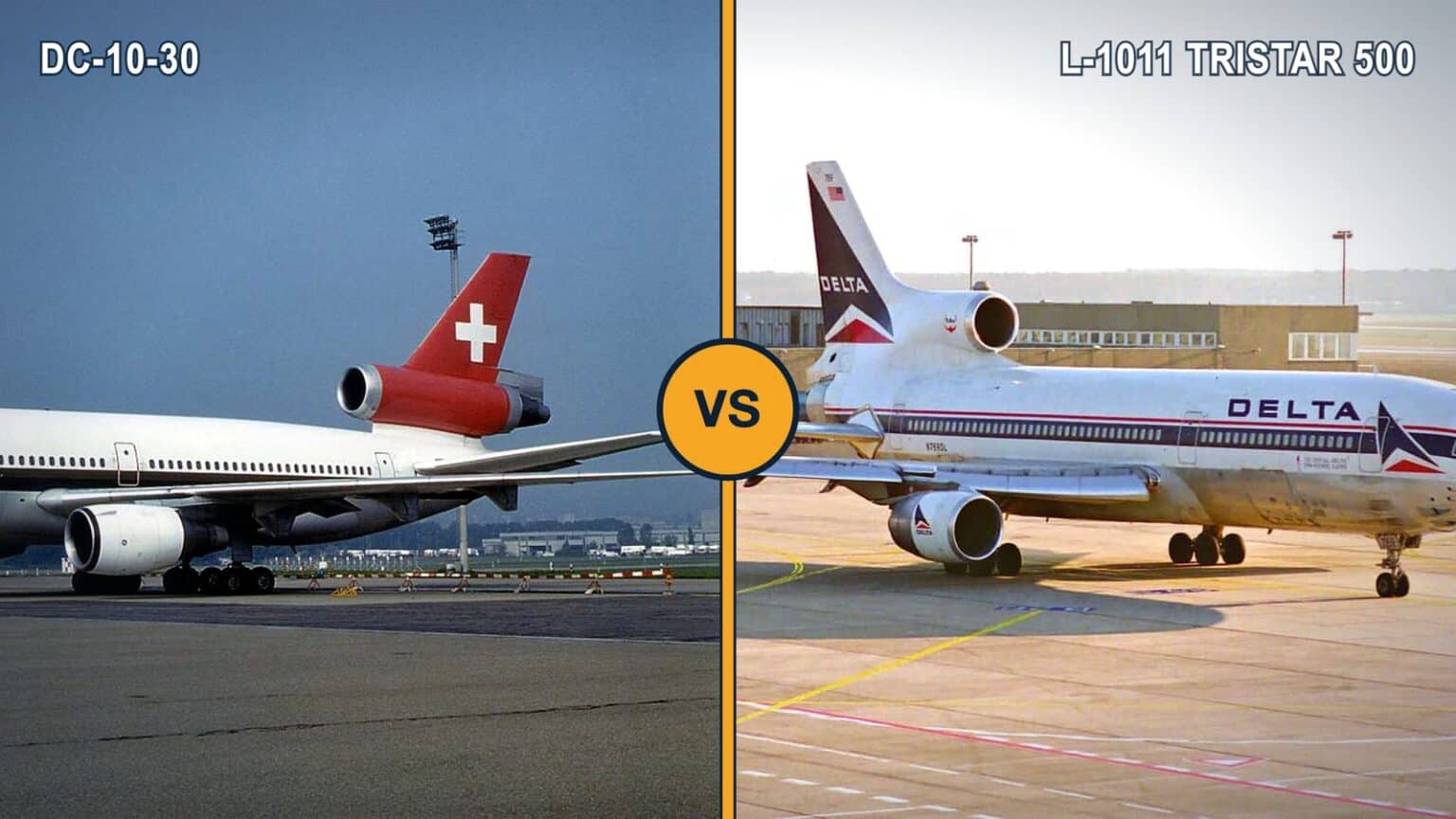
The MD-11 grew straight out of the DC-10, so the two look alike: three engines, one on each wing and one in the tail. Under the skin they are different aircraft.
The DC-10 came in several variants. We compare the MD-11 with the DC-10-30, the long-range version and the most common one, with 163 built.
Full specifications for the McDonnell Douglas MD-11, the DC-10-30 and the wider DC-10 family sit in our aircraft database.
The MD-11 was meant to be a cheap upgrade
McDonnell Douglas began studying DC-10 stretches in 1976 and launched the MD-11 on December 30, 1986. A shrinking cash flow limited how much it could redesign, so the MD-11 kept the DC-10’s basic trijet layout instead of starting fresh.
Which is better, the MD-11 or the DC-10?
The MD-11 is the more capable aircraft on paper. It is longer, carries more and flies farther, as the spec widget above shows.
The DC-10 is the easier aircraft to handle. The MD-11 traded some of that margin for efficiency.
So the answer depends on the job. For hauling freight over long distances, the MD-11. For forgiving handling, the DC-10.
Where the MD-11 wins
Cockpit and crew
The MD-11 flies with two pilots. Its Advanced Common Flightdeck has six CRT screens and a Honeywell VIA 2000 computer suite, and no flight engineer.
The DC-10 was designed with a crew of three. A flight engineer sat at a panel behind the pilots until later upgrades, such as Boeing’s MD-10 glass cockpit, removed the position.

Winglets, engines and efficiency
Winglets are the easiest way to tell the two apart from the side. The MD-11 has them, and they are credited with about 2.5% better fuel efficiency.
The MD-11 also moved to newer General Electric CF6-80C2 or Pratt & Whitney PW4000 engines, and used more composite panels.
Together with the stretch, that gave it a longer reach than the DC-10-30.
McDonnell Douglas pitched it as a longer-range alternative to twinjets like the Boeing 767 and the coming 777 and Airbus A330.
It missed its range and fuel burn targets at first. A Performance Improvement Program from 1990 to 1995 recovered some of that, and the MD-11ER of 1994 added an extra fuel tank.
Why the passenger MD-11 faded
Boeing merged with McDonnell Douglas in 1997 and chose to build only MD-11 freighters, to avoid competing with its own 767 and 777. The last passenger MD-11 went to Sabena in April 1998.
Three aircraft built for Yugoslav Airlines were never delivered because of the Yugoslav Wars. By the end of 2004, most passenger operators had replaced the type with the A330, A340 or 777.
Freighter life
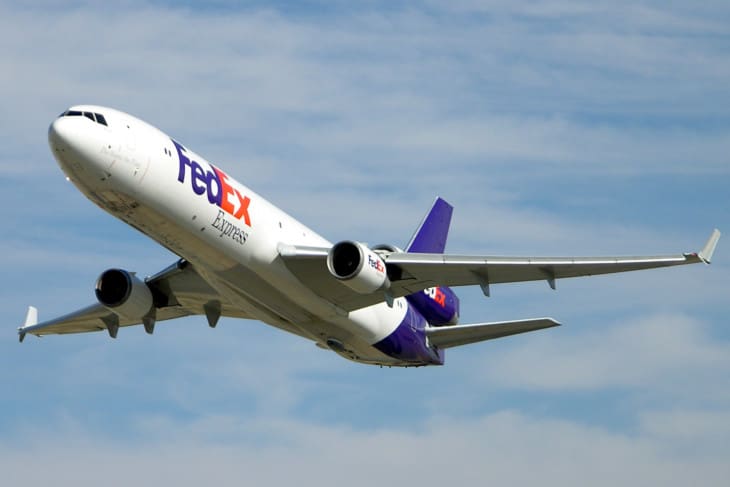
The MD-11 outlived its passenger career as a freighter. FedEx, UPS and Lufthansa Cargo all flew it, and 53 of the 200 built were MD-11Fs from the factory.
Several airlines converted passenger aircraft too. American sold its 19 MD-11s to FedEx, and Japan Airlines sent its 10 to be converted for UPS.

Where the DC-10 wins
A bigger tail and easier landings
The MD-11 has a horizontal tail 30% smaller than the DC-10-30’s. That cut drag, but it also reduced pitch damping and made crosswind landings harder.
To make up for it, the MD-11 uses a fuel ballast tank in the tailplane and a computer stability system. Typical landing speeds run 10 to 20 knots (12 to 23 mph, 20 to 35 km/h) above comparable aircraft.
The DC-10 has no such system and a lot more margin. Its long career also brought a steady stream of crews who knew it well.
Simplicity and a longer run
Production ended in 1989 after 446 aircraft, and the type kept flying with passenger airlines until Northwest retired its last on January 8, 2007.
The MD-11 was built for under 11 years and never reached the 300 sales McDonnell Douglas first projected.

Military and special duties
The DC-10 also became the KC-10 Extender. The US Air Force received 60 of them between 1981 and 1988, all based on the DC-10-30CF.
The MD-11 never saw production as a tanker. McDonnell Douglas proposed a KMD-11 and KC-10B, but they were not built.

Safety and the pylon problem
The DC-10 had a rough start. A flawed cargo door design caused several incidents, and the 1974 crash of Turkish Airlines Flight 981 near Paris killed 346 people, the deadliest crash in aviation history at that time.
The DC-10 also produced one of the great feats of airmanship. United Flight 232 lost all hydraulics at Sioux City, Iowa, on July 19, 1989, and the crew landed it under partial control.
Both aircraft carry a mixed safety record, and both share a weakness: an engine pylon that can separate. American Airlines Flight 191 was a DC-10 that lost its left engine at Chicago O’Hare on May 25, 1979.
A UPS MD-11F crashed after takeoff from Louisville on November 4, 2025, after a left engine and pylon separated, according to the preliminary report. Three crew and twelve people on the ground were killed.
On November 8, 2025, the FAA grounded all MD-11 aircraft. UPS retired its entire MD-11 fleet in January 2026.
Myth check: the MD-11 was a failed airliner
The MD-11 missed its range and fuel burn targets at first, which hurt sales. But the type stayed in daily service for 35 years, as a freighter. The DC-10, often remembered as the more successful airliner, is retired from airline passenger service.
MD-11 vs DC-10: the verdict
The MD-11 is the better freight aircraft. It is more efficient, needs fewer pilots and carried cargo for three decades.
The DC-10 is the better-handling aircraft, and it set the template. The MD-11 only exists because McDonnell Douglas stretched it.
For the wider picture, see our look at which airlines still fly the MD-11.
FAQ
Sources and references used for research and fact-checking.
About the Author

Tim is the owner and lead editor of AeroCorner since 2019, overseeing aviation content covering aircraft, airlines, airports, and the broader aviation industry. Through years of researching, writing, editing, and publishing aviation-focused content, he has developed extensive practical knowledge of commercial aviation and air travel. Based in Asia and a frequent traveler himself, Tim also brings firsthand passenger experience to AeroCorner’s coverage. Outside of publishing, he has also explored aviation firsthand through hands-on flight training in New Zealand.