

Table of Contents
The plan always seems airtight. Slip into the lavatory, take one quick pull on a vape, and exhale toward the ceiling. No ash, no lingering smell, nobody watching.
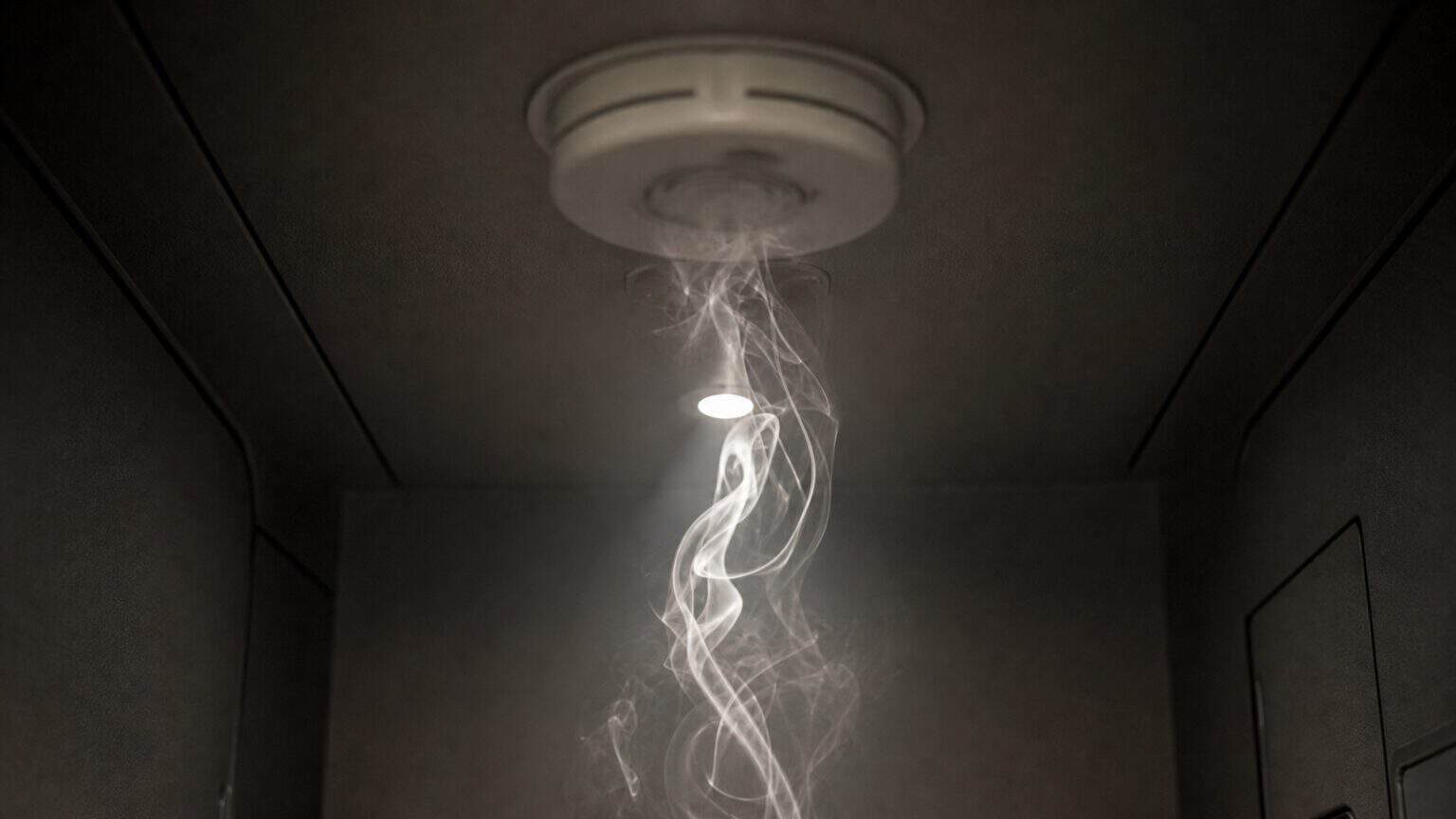
Then an alert goes off, either a warning light the pilots can see or an alarm a flight attendant cannot miss, and someone is knocking on the door. The small disc on the ceiling saw everything.
That detector was never designed with vapes in mind. It is there because of a fire on an Air Canada DC-9 in 1983, a fire whose cause was never found. Here is how three separate problems, a health law, a lavatory fire, and a lithium battery, add up to the no-vaping rule.
Why Can’t You Vape on a Plane?
Because US federal law treats vaping as smoking, and smoking has been banned on scheduled passenger flights in, to, and from the United States since 2000. The Department of Transportation wrote e-cigarettes into its smoking rule in 2016, and Congress wrote them into the statute itself in 2018.
The ban exists mainly to keep the cabin air clean. What makes it so hard to get away with is a lavatory smoke detector the FAA made mandatory after that 1983 fire. And the reason your vape has to travel in your pocket rather than your suitcase is a third rule entirely, about the lithium battery inside it.
The answer in one line
Federal law counts vaping as smoking, a lavatory smoke detector installed because of a 1983 fire is what catches it, and battery rules keep the device in the cabin where the crew can reach it.
The law treats vapor as smoke
The legal text is short. The federal smoking statute, 49 U.S.C. 41706, says: “The use of an electronic cigarette shall be treated as smoking for purposes of this section.” That line arrived with the FAA Reauthorization Act of 2018.
The Department of Transportation got there first. Its final rule, published in March 2016 and in force from April 4 that year, redefined smoking to include “electronic cigarettes whether or not they are a tobacco product, or similar products that produce a smoke, mist, vapor, or aerosol.”
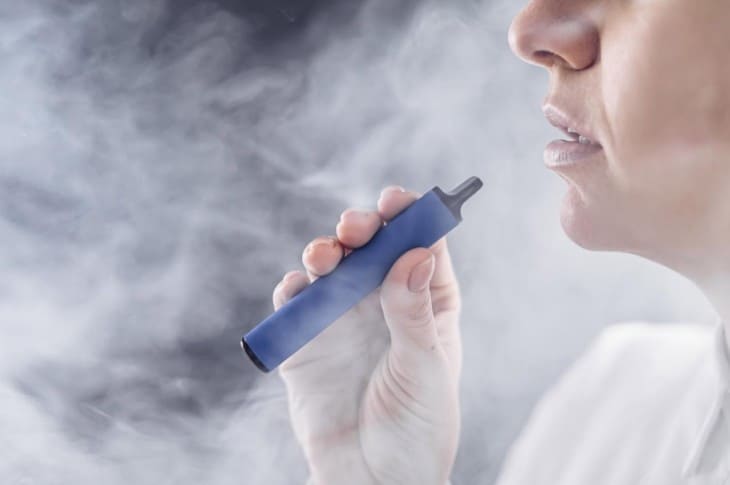
That wording matters. A nicotine-free vape is still covered, because the rule cares about what comes out of the device, not what goes into it. It applies to US and foreign airlines on scheduled flights in, to, and from the United States, and to charters that carry a flight attendant.
The FAA does not soften it. Vaping on board, its passenger guidance says, is “not only dangerous, it’s a federal offense.” In practice, that means a civil fine from the FAA.
The reason DOT gave was health, not fire. It pointed to the “potential adverse health effects of secondhand exposure to aerosols” in a closed cabin, including formaldehyde and acetaldehyde measured in the aerosol of some devices. It also said it had long treated e-cigarettes as covered and was simply making that official.
That fits the history of the smoking ban, which was a health campaign from the start. A 2004 history in the journal Tobacco Control credits health advocates who worked with “crucial assistance from flight attendants,” the people who spent whole careers breathing other people’s smoke.
The first ban’s two-hour limit has an origin story worth repeating. Senator Dick Durbin, who sponsored it as a congressman, says he asked a chain-smoking colleague, the late Minnesota congressman Marty Sabo, how long he could go without a cigarette. Sabo said two hours, so two hours it was.
July 1973
Varig Flight 820. A fire in the rear lavatory of a Boeing 707 approaching Paris kills 123 of the 134 people on board. A lit cigarette thrown into the waste bin is a possible cause.
1974
No smoking in the lavatory. FAA directive AD 74-08-09 requires no-smoking placards in airliner lavatories and ashtrays at set locations.
June 1983
Air Canada Flight 797. A lavatory fire on a DC-9 kills 23 passengers after an emergency landing near Cincinnati. Its origin is never determined.
March 1985
Detectors become mandatory. The FAA orders smoke detectors in airliner lavatories by October 1986 and automatic extinguishers in lavatory trash bins by April 1987.
April 1988
The first smoking ban. Smoking is banned on US domestic flights of two hours or less.
February 1990
Six hours. The ban extends to domestic flights of under six hours, which covers nearly all of them.
June 2000
Every scheduled flight. Following the AIR-21 aviation law that April, a DOT rule bans smoking on all scheduled passenger flights in, to, and from the US.
2016
Vapes count as smoking. DOT’s rule explicitly covers e-cigarettes from April. In May, a separate safety rule bans them from checked bags.
October 2018
Written into law. Congress adds e-cigarettes to the federal smoking statute itself.
The alarm: a fire nobody could explain
On June 2, 1983, Air Canada Flight 797 was cruising at 33,000 feet from Dallas toward Toronto and Montreal with 41 passengers and five crew. Shortly after 7 p.m., the cabin crew found the rear lavatory filling with smoke.
By then, according to the FAA’s own account, the fire had been burning undetected inside the lavatory for almost 15 minutes. The lavatory had no smoke detector, and neither US nor Canadian rules required one.
The crew made an emergency descent and landed at Greater Cincinnati International at 7:20 p.m. Within 60 to 90 seconds of the exits opening, a flash fire swept through the cabin.
Eighteen passengers and all five crew got out. Twenty-three passengers did not.
The FAA acted in March 1985. Its rule required a smoke detector in each lavatory by October 1986, with a warning light in the cockpit or an alert in the cabin that a flight attendant would notice, plus automatic extinguishers in lavatory trash bins by April 1987.
UPI’s report on the rule opened with the reason: “Because of a fire that killed 23 passengers aboard an Air Canada jet in 1983.” The frustrating part is that the fix had been on the table for a decade.
After Varig 820 in 1973, the NTSB recommended early detection of lavatory fires, such as smoke detectors. The FAA opted for no-smoking placards and more frequent lavatory checks instead, and it took Flight 797 to make detectors mandatory.
What the first detectors actually caught
Pan Am fitted residential-type ionization detectors to the lavatories of its whole fleet before the rule. From January 1984 they went off 35 to 40 times. Two alarms were real trash-bin fires started by cigarettes. Most of the rest were passengers smoking in the lavatory.
The device built to catch fires was catching rule-breakers from its first year, and commenters on the FAA’s rule saw it coming, noting that detectors would tend to deter unauthorized tobacco smoking. Vapes simply inherited the problem.
Federal rules now make it a violation in its own right to smoke in any airplane lavatory, or to tamper with, disable, or destroy its detector. The placard in every lavatory still quotes a penalty of up to $2,000 for tampering, a figure since adjusted for inflation to more than $5,400.
Why vapor sets off a smoke detector
Airliner lavatory detectors have used the same two technologies as the alarms in homes. The NTSB’s report on Flight 797 discusses both ionization and photoelectric types, and Pan Am’s early units were ionization detectors.
The photoelectric kind makes the vape problem easy to picture. It shines a light beam through a small chamber, with a sensor set off to one side where the beam cannot reach. Particles drifting into the chamber bounce light onto the sensor, and past a threshold the alarm trips.
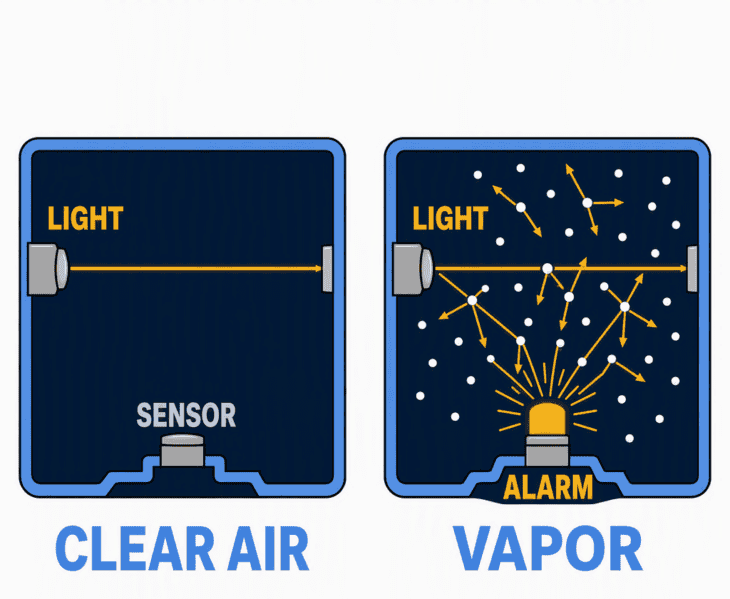
The detector has no idea what those particles are. NIST notes that home alarms can be set off by the particles coming off food as it cooks.
An exhaled vape cloud is a dense fog of liquid droplets. A 2020 laboratory study measured their mass median diameter at roughly 1 to 2.5 micrometers, with higher-powered devices producing the larger droplets.
Blow that cloud toward the ceiling of a room the size of a closet, and the sensor gets exactly what it was built to look for: a lot of particles, very fast.
In June 2021, the FAA proposed a $10,300 fine against a passenger on an Alaska Airlines flight to Los Angeles whose e-cigarette set off the lavatory smoke detector. That case also involved refusing to wear a mask.
The myth: a smoker started the fire that changed the rules
It is tempting to tell this story as a morality tale, in which a passenger sneaks a cigarette and 23 people die. The investigation does not support it.
The myth
Flight 797 was started by a cigarette in the lavatory. In fact the NTSB’s probable cause is a fire of undetermined origin. A burning cigarette was one of six possible ignition sources it weighed, alongside the toilet flush motor, the motor’s wiring, and the generator cables.
One passenger who used the lavatory about 25 minutes before the commotion told investigators she does not smoke. The man waiting to go in after her was never identified.
The flush motor drew a good share of the attention. Among the NTSB’s 18 recommendations were periodic inspections of the flush motor, its timer, and its wiring, and a review of how its electrical circuit was protected.
A 1986 National Research Council review of cabin safety was blunt about the wider pattern. Fires from lavatory smoking had been “of considerable concern,” it said, but wiring, speaker transformers, light ballasts, water heaters, and the flushing motor “are more likely sources of serious lavatory fires.”
So the detector that now catches vapers did not come from a smoker’s mistake. It came from a fire nobody could pin down, and from the lesson that a lavatory is a closed box where a fire can burn for a quarter of an hour before anyone notices.
Cigarettes were still a real lavatory hazard, which is why the rules hedge against rule-breakers. Under 14 CFR 25.853, every airliner lavatory must have an ashtray on or near its door “regardless of whether smoking is allowed in any other part of the airplane,” one of the reasons airliners still carry ashtrays decades after the ban.
The logic is plain. If someone is going to light up anyway, the cigarette should end up in a metal tray, not in a bin full of paper towels like the one suspected on Varig 820.
Why the vape has to fly in your pocket
There is one more twist. The same passenger who may not use a vape on board is required to bring it into the cabin.
Since May 2016, a Pipeline and Hazardous Materials Safety Administration rule has banned e-cigarettes and vaping devices from checked bags, and barred charging them or their batteries on board. It followed an FAA safety alert in January 2015, an interim rule that October, and a matching change to the international dangerous-goods rules.
The reason is the battery. “A number of recent incidents have shown that e-cigarettes in checked bags can catch fire during transport,” then-Transportation Secretary Anthony Foxx said when the rule was issued.
The problem has not gone away. The FAA says vapes were the leading cause of lithium battery incidents on aircraft in 2022, and its packing guidance asks passengers to take steps so the heating element cannot switch on by accident.
In the cabin, a device that overheats is a few feet from a flight attendant who can deal with it. In a cargo hold, nobody sees it, which is the whole case for why lithium batteries are treated as the most dangerous cargo on your flight.
So the next time you see the no-smoking symbol lit above your seat, it is carrying three separate stories. A health law whose first version was sized to a congressman’s two-hour craving. A battery rule that keeps your vape where someone can reach it.
And on the lavatory ceiling, a small detector that exists because 23 people died aboard Air Canada Flight 797, in a fire whose cause is still unknown. It was built to catch fires. From its very first year, it mostly caught people.
Sources and references used for research and fact-checking.
- National Transportation Safety Board, Aircraft Accident Report: Air Canada Flight 797, McDonnell Douglas DC-9-32, C-FTLU, Greater Cincinnati International Airport, June 2, 1983 (NTSB/AAR-86/02)
- Federal Aviation Administration, Lessons Learned, McDonnell Douglas DC-9-32, Air Canada Flight 797, C-FTLU
- Federal Aviation Administration, Amendment 121-185: Airplane Cabin Fire Protection (Federal Register, March 29, 1985)
- UPI Archives, Smoke detectors ordered for airliners
- Legal Information Institute, Cornell Law School, 49 U.S. Code 41706: Prohibitions against smoking on passenger flights
- Legal Information Institute, Cornell Law School, 14 CFR Part 252: Smoking Aboard Aircraft
- US Department of Transportation, Federal Register, Use of Electronic Cigarettes on Aircraft (final rule, March 4, 2016)
- Legal Information Institute, Cornell Law School, 14 CFR 121.317: Passenger information requirements and smoking prohibitions
- Legal Information Institute, Cornell Law School, 49 U.S. Code 46301: Civil penalties
- Legal Information Institute, Cornell Law School, 14 CFR 13.301: Inflation adjustments of civil monetary penalties
- Legal Information Institute, Cornell Law School, 14 CFR 25.853: Compartment interiors
- Wikipedia, Varig Flight 820
- Office of Senator Dick Durbin, Durbin Marks 36th Anniversary of Banning Smoking on Airplanes With Speech on Senate Floor
- PubMed Central, Clearing the airways: advocacy and regulation for smoke-free airlines (Holm and Davis, Tobacco Control, 2004)
- National Research Council, NCBI Bookshelf, Introduction, The Airliner Cabin Environment and the Health of Passengers and Crew (2002)
- National Research Council, NCBI Bookshelf, Air Quality in Emergency Situations, The Airliner Cabin Environment: Air Quality and Safety (1986)
- National Institute of Standards and Technology, How Do Smoke Detectors Work?
- Scientific Reports, via PubMed Central, Aerosol droplet-size distribution and airborne nicotine portioning in particle and gas phases emitted by electronic cigarettes (Lalo et al., 2020)
- NBC Los Angeles, $10,300 Fine Proposed for Passenger Accused of Smoking E-Cigarette in Lavatory on Alaska Airlines Flight to LA
- Pipeline and Hazardous Materials Safety Administration, DOT Bans E-Cigarettes From Checked Baggage
- Federal Aviation Administration, PackSafe: Electronic Cigarettes, Vaping Devices
- Federal Aviation Administration, Vapes On A Plane Marketing Kit
Get the Newsletter
The latest aviation news and stories sent to your inbox.
About the Author

Tim is the owner and lead editor of AeroCorner since 2019, overseeing aviation content covering aircraft, airlines, airports, and the broader aviation industry. Through years of researching, writing, editing, and publishing aviation-focused content, he has developed extensive practical knowledge of commercial aviation and air travel. Based in Asia and a frequent traveler himself, Tim also brings firsthand passenger experience to AeroCorner’s coverage. Outside of publishing, he has also explored aviation firsthand through hands-on flight training in New Zealand.