


Table of Contents
Police helicopters are an eye in the sky for officers on the ground. Their main jobs are backing up 911 calls, tracking suspects who run, taking over car chases and searching for missing people, with rescues and firefighting on top.
The typical US police helicopter is a light single-engine type such as the Airbus AS350 (now sold as the H125), crewed by a pilot and a tactical flight officer who runs the thermal camera, radios and searchlight. It is not cheap: the Los Angeles Police Department’s helicopters cost $2,916 per flight hour over 2018 to 2022, according to the city’s own audit.
| Mission | What the crew does | Real example |
|---|---|---|
| 911 and patrol support | Gets overhead first and tells ground units what it sees | Phoenix says its air unit can put police over a scene “in two minutes or less” |
| Suspect searches | Finds hiding people by body heat with a thermal camera | A Massachusetts State Police helicopter located the Boston Marathon bombing suspect in a covered boat in 2013 |
| Vehicle pursuits | Takes over tracking so patrol cars can back off | Phoenix air crews take over pursuits so ground officers can keep a safe distance |
| Missing people | Sweeps large areas from above | The UK’s national police air service says it searches up to 20 times faster than ground teams |
| Rescue | Hoists or lands crews where vehicles cannot reach | Phoenix flies an Agusta A109 with a hoist for mountain rescues |
| Firefighting | Drops water from a bucket slung under the aircraft | Phoenix and Austin police helicopters both fly firefighting missions |
| Major events | Streams live video to a control room | Every UK national police air service aircraft streams video to police control rooms |
| Speed enforcement | Times cars between painted highway markings | Usually done by state patrol airplanes, not helicopters |
What do police helicopters actually do?
A police helicopter rarely makes the arrest. Its job is to see what officers on the ground cannot, then talk them onto it. That one idea explains almost everything the aircraft is used for.
Backing up officers on 911 calls
Patrol support is the core mission. Phoenix lists “Patrol Support,” responding directly to 911 calls, as its air unit’s primary job, and its crews are available 24 hours a day. A helicopter flies a straight line over traffic, so it is often the first police unit on scene.
Once overhead, the crew can see escape routes, set up a perimeter and tell ground officers where to go. LAPD Chief Michel Moore made the same point in 2023, saying his department’s flights often reach calls before ground units and give officers critical information.
Finding suspects who run
A person hiding in a dark backyard is close to invisible from the street, but not to a thermal camera. The camera reads heat, so a warm body stands out against cooler grass, walls and roofs.
The best-known case came in April 2013. A Massachusetts State Police helicopter fixed its thermal camera on a boat where the Boston Marathon bombing suspect was hiding under a plastic cover.
Taking over car chases
A helicopter cannot stop a car, but it can follow one without being seen as a threat. Phoenix says its aircraft take over vehicle pursuits so ground officers can keep a safe distance, which cuts the risk of a high-speed crash.
That speed advantage is real. The UK’s National Police Air Service (NPAS) gives an average speed of 138 mph (222 km/h) for its fleet, well beyond what a patrol car can hold on city streets. For how that compares across types, see how fast helicopters fly.
Searching for missing people
Missing children, vulnerable adults and lost hikers are some of the most important calls an air unit takes. NPAS says its aircraft can search large areas “up to 20 times faster than ground-based teams.”
Rescues and firefighting
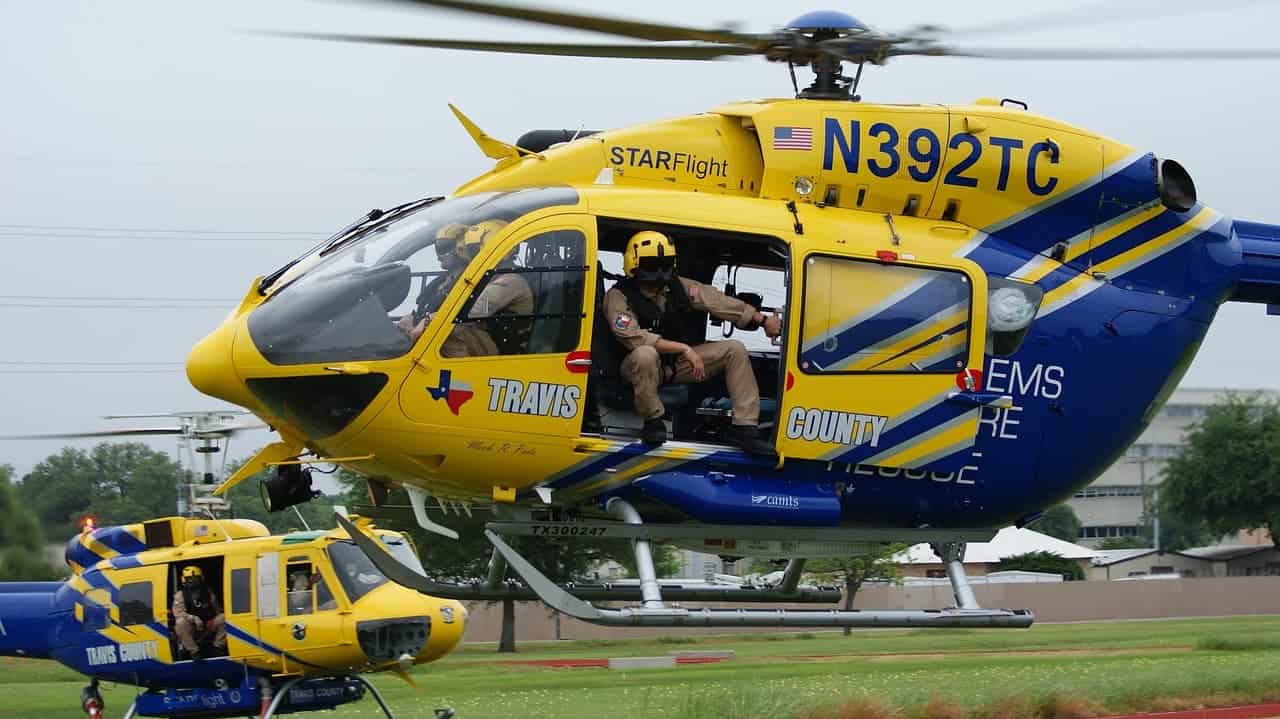
Many police air units double as rescue and fire units. Phoenix flies an Agusta A109 fitted with a hoist to pull injured people off the mountains around the valley, and its helicopters drop water from a “Bambi Bucket” on remote or large fires.
Austin’s two AS350 B3 helicopters are listed for patrol, search and rescue, and firefighting. It is one more reason helicopters can do jobs no other aircraft can: they hover, land in a clearing and carry a bucket or a hoist.

Speed enforcement (mostly airplanes)
The “speed enforced by aircraft” signs on highways usually mean an airplane, not a helicopter. Wisconsin State Patrol aircraft time cars between painted highway markings with a device called VASCAR, then radio ground units to make the stop.
Airplanes suit the job because they fly longer and cost less to run. Wikipedia’s survey of police aviation notes that fixed-wing aircraft allow higher, quieter surveillance with longer flying times and lower running costs.
What is on board a police helicopter?
Strip out the mission equipment and a police helicopter is an ordinary light helicopter. The kit bolted onto it is what makes it a police aircraft, and it can cost as much as the helicopter itself.
- Thermal and color camera. A ball turret under the nose combines a FLIR thermal sensor with a color video camera. Maryland State Police chose a Wescam MX-15i, which records to a digital video recorder.
- Searchlight. The Nightsun SX-16 that Maryland selected is rated at 40 million candlepower and can be slaved to the camera, so the light follows wherever the camera points.
- Moving map. A moving map display tells the crew exactly where they are over the city. Texas DPS called it “the most popular piece of police equipment we use.”
- Video downlink. An encrypted link sends live video to commanders on the ground or to a control room.
- Police radios. Texas DPS fitted six police radios and two aviation radios to one 2008 aircraft, so the crew can talk to the other agencies on scene.
- Night vision goggles and a loudspeaker. San Diego Sheriff’s crews typically wear night vision goggles after dark, and their helicopters broadcast public announcements to the neighborhood below.
The bill adds up. Texas DPS said its 2008 helicopter cost $1.5 million “and we spent another $1.5 million on equipment,” roughly $3 million in total.
Can a police helicopter see through walls?
No. A thermal camera reads the heat on a surface, not what is behind it. It cannot even see through a window, and anything that blocks heat blocks the image. The Boston suspect showed up in 2013 because the plastic boat cover was what FLIR called transmissive enough to let some body heat through.

Why is a police helicopter circling my neighborhood?
A helicopter that circles one spot is almost always working with officers on the ground. The San Diego County Sheriff’s Office says that when its helicopter orbits a location for more than a minute or two, day or night, it is assisting deputies or police below.

The reasons it lists are an operation, a rescue, a fire, a missing person or a suspect search. A circling helicopter with no searchlight is not idle: the thermal camera is doing the searching, so the light often stays off.
Height is set by safety and noise. San Diego’s sheriff helicopters generally fly no lower than 500 feet above the ground, the minimum for a safe autorotation landing after a mechanical failure, and crews are trained to fly at 1,000 feet at night.
To find out what is going on, try the department’s non-emergency line or its social media accounts. San Diego even runs a text line that sends you the helicopter’s announcements, because rotor noise often makes them hard to hear on the ground.
What do police helicopters look like?
Most US police helicopters are light, single-engine civilian types, not military machines. The Eurocopter AS350 B3 and its current version, the Airbus H125, are the workhorses, alongside the Bell 407 and the older Bell 206 JetRanger.
Bigger agencies add twins for rescue work, such as the Agusta A109 in Phoenix or the AgustaWestland AW139 that Maryland State Police ordered in 2010. In the UK, NPAS flies the EC135 and EC145.
There is no national paint scheme, so every agency picks its own colors. Three things give a police helicopter away: the agency name on the side, the camera ball under the nose and, on most, a big searchlight.

Some departments fly ex-military aircraft. Wikipedia notes that police forces sometimes use surplus types such as the Bell UH-1 Huey, and Fort Bend County, Texas, flies a 1971 OH-58A, the military version of the JetRanger, that came from the Arizona National Guard.
| Air unit | Helicopters | Worth knowing |
|---|---|---|
| LAPD Air Support Division | 17 helicopters: Airbus H125 B3 and H125 B2e, plus one Bell 412 | About 16,000 flight hours a year over 469 square miles (1,215 km²) |
| Phoenix Police Air Support Unit | 5 AS350 B3, 1 Agusta A109E | Also 4 airplanes; flies about 8,000 hours a year |
| Austin Police Air Support Unit | 2 AS350 B3, 1 Bell 206B3 (training only) | Patrol, search and rescue, and firefighting |
| Fort Bend County Sheriff, Texas | Bell OH-58A (1971, military surplus) | 3.3 hours endurance on 71 gallons of fuel |
| UK National Police Air Service | 19 EC135 and EC145 | Plus 4 fixed-wing aircraft; average speed 138 mph (222 km/h) |
Want to compare these with other civil types? Our guide to civilian helicopter types covers the light singles police units buy.
Who flies police helicopters?
A standard crew is two: a pilot and a tactical flight officer, or TFO. Austin flies every patrol mission with at least one of each on board.
The split matters. The pilot flies the aircraft, while the TFO runs the camera, the radios and the map and talks ground units onto the target. That leaves the pilot free to keep their eyes outside.

Most city and county units want police officers first and pilots second. Phoenix requires sworn members with at least three years as police officers, and LAPD air crews need at least three years of patrol car service. Some federal agencies hire civilian pilots directly.
The flying bar is high too. California Aeronautical University puts typical requirements at 1,500 to 3,000 or more flight hours, with helicopter, night and instrument time. It is one of several helicopter pilot jobs that demand a second career first.
Do police helicopters carry guns?
Police helicopters are observation aircraft, not gunships, but the officers inside are armed. LAPD air crews carry weapons so they can land and make arrests in places patrol cars cannot reach.
Some agencies go further. The Tallahassee Police Department requires its TFOs to pass airborne use-of-force training and a rifle qualification from a sheriff’s helicopter every two years.
The bigger worry for crews is being shot at. In one Texas case, a gunman fired at officers on the ground and at the police helicopter, and several rounds hit its rotor blades. STARFlight’s written policy tells pilots to “maintain sufficient altitude so the aircraft does not present itself as a target.”
How much does a police helicopter cost to run?
The aircraft is the smaller bill. Running it every day is where the money goes, and the clearest public numbers come from Los Angeles.
In December 2023, City Controller Kenneth Mejia published the first-ever audit of the LAPD Air Support Division. It found the city spent an average of $46.6 million a year on the unit, or $127,805 a day and $2,916 per flight hour.
Los Angeles flies more than most cities: typically two helicopters for 20 hours every day of the year, about 16,000 hours annually. At roughly 47.6 gallons (180 liters) of fuel an hour, that is about 761,600 gallons a year.
Smaller units fly far less. Fort Bend County’s OH-58A burns 22 gallons (83 liters) an hour and stays up for about 3.3 hours on a full tank, a useful benchmark for how far and how long helicopters can fly.
Do police helicopters actually reduce crime?
This is where the usual sales pitch runs ahead of the evidence. Helicopters clearly find people faster and make pursuits safer, but proof that patrol flights deter crime is thin.
What the Los Angeles audit found
About 61% of LAPD helicopter flight time went to work not tied to the highest-priority incidents, including transport flights, general patrols and 783 ceremonial fly-bys. The auditors found no persuasive empirical evidence of a clear link between helicopter patrols and crime reduction, and said the LAPD had not collected the data to test it. The department disagreed, saying its aircraft often beat patrol cars to calls.
Manufacturers make bigger claims. Bell says an air crew can see “30 times more than an officer on the ground” and cites a 9:1 to 27:1 effectiveness ratio from studies it does not name. Treat those as marketing until a department publishes its own numbers.
Among its recommendations: set performance metrics that are gathered and made public, and log the arrests and firearm recoveries air crews are directly responsible for.
A short history of police helicopters
Police flying started in New York City, which set up the first police aviation department. Helicopters began replacing police airplanes in the late 1940s, and the story of who invented the helicopter starts only a decade earlier.
1948
The first police helicopter. Bell says its Model 47D became the world’s first police helicopter when it joined the New York City Police Department.
1956
LAPD takes to the air. The LAPD Helicopter Unit starts with a single Hiller UH-12C.
1973
Phoenix air unit founded. It begins at Sky Harbor Airport with two piston Hughes 300C helicopters and one Cessna 172.
April 2013
Thermal finds a fugitive. A Massachusetts State Police helicopter locates the Boston Marathon bombing suspect hidden in a covered boat.
December 2023
Los Angeles audits its fleet. The City Controller’s first-ever audit puts the LAPD air unit at $46.6 million a year.
August 2025
Drone rule proposed. The FAA publishes its Part 108 proposal for drones flying beyond the operator’s line of sight.
Are drones replacing police helicopters?
Not yet, but they are taking over some of the short calls. Many departments now fly drones, and some send one to a 911 call as a first responder before officers arrive. Our guide to how police use drones covers what they do.
The rules are still catching up. The FAA proposed its Part 108 rule for beyond-line-of-sight drone flights on August 7, 2025, and as of October 2026 the final rule has still not been published, so police drone programs fly under FAA waivers.
A small drone cannot hoist a hiker off a cliff, drop water on a fire or carry two officers who can land and make an arrest. For now it is a cheaper first look, and the helicopter still handles the long searches and the rescues.
FAQ
Sources and references used for research and fact-checking.
- Los Angeles City Controller, LAPD Helicopter Audit
- ABC7 Los Angeles, LA controller's audit on LAPD helicopters questions benefit of program
- Wikipedia, LAPD Air Support Division
- Vertical, LAPD Air Support training for tactical and disaster preparedness
- City of Phoenix, Air Support Unit
- Austin Police Department, Air Support Unit
- Fort Bend County Sheriff's Office, Air Support
- San Diego County Sheriff's Office, ASTREA FAQs
- National Police Air Service, How we support police forces
- Wikipedia, Police aviation
- Aviation Today, Police Mission Equipment
- Popular Science, How It Works: The Thermal Camera That Found The Boston Bomber
- TMJ4 Milwaukee, Wisconsin State Patrol to conduct aerial traffic enforcement along I-94
- Tallahassee Police Department, General Order 65: Tactical Flight Officer Program
- KXAN, Safety in the sky: the rules for police helicopters
- California Aeronautical University, Police Pilot Career Guide
- Bell, Why Police Helicopters Are Worth the Investment
- DroneRanker, FAA Part 108 BVLOS Rule Status
Get the Newsletter
The latest aviation news and stories sent to your inbox.
About the Author
Tim is the owner and lead editor of AeroCorner since 2019, overseeing aviation content covering aircraft, airlines, airports, and the broader aviation industry. Through years of researching, writing, editing, and publishing aviation-focused content, he has developed extensive practical knowledge of commercial aviation and air travel. Based in Asia and a frequent traveler himself, Tim also brings firsthand passenger experience to AeroCorner’s coverage. Outside of publishing, he has also explored aviation firsthand through hands-on flight training in New Zealand.