

In March 2022, nobody knew whether Tiger Woods would play the Masters. Fourteen months earlier he had shattered his right leg in a car crash, and he had said nothing about competing.
Then his Gulfstream landed at Augusta Regional Airport, and golf Twitter did the rest. He played that Masters and made the cut.
That is the strange thing about the Tiger Woods private jet. It is not the most expensive celebrity aircraft, it is not the newest, and it is not even the flashiest jet on the PGA Tour ramp. It is simply the one aircraft in golf whose flight plan counts as breaking news.
This guide covers the airframe itself, what the FAA registry actually records, where the jet flew in its busiest recent season, what it genuinely cost, and why the tracking that fans love has become a problem worth thinking about.

Quick facts about Tiger Woods’ private jet
Tiger Woods’ Private Jet Fleet
Woods has exactly one aircraft, which makes him unusual in this series. Most athletes at his earnings level either run a small fleet or churn through airframes every few years.
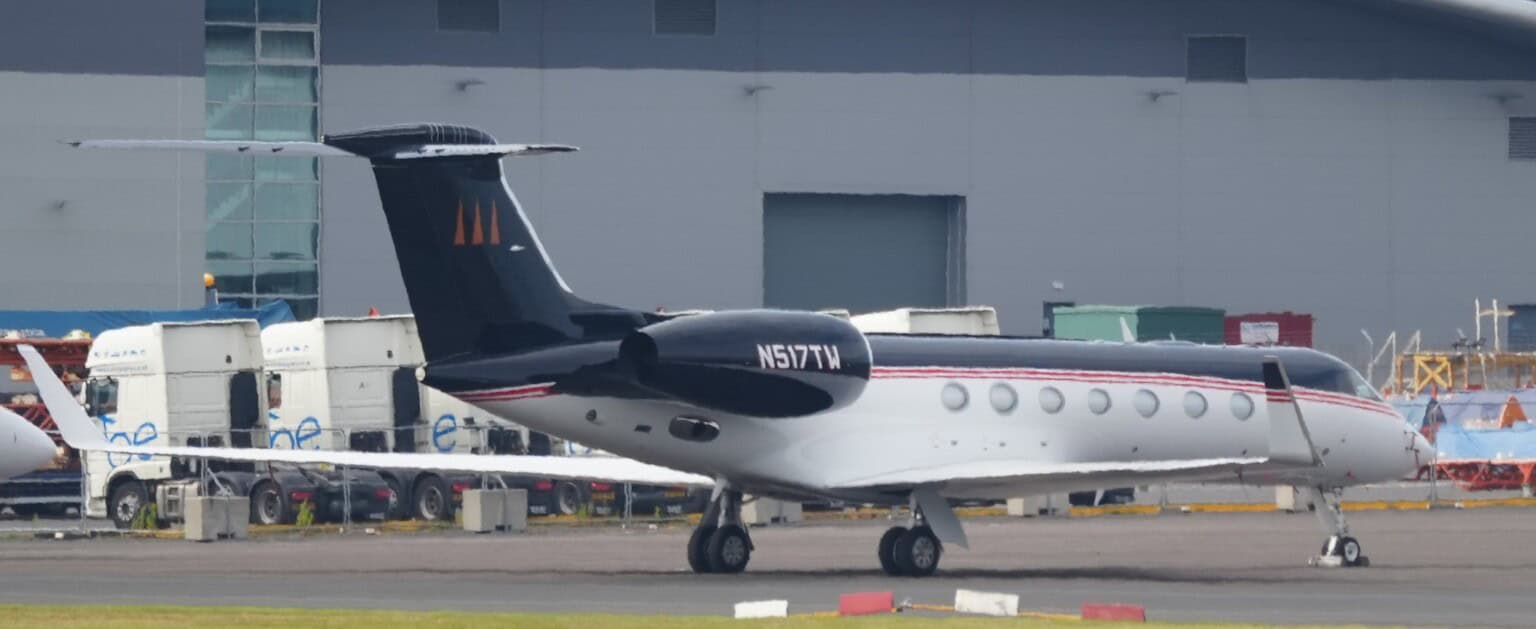
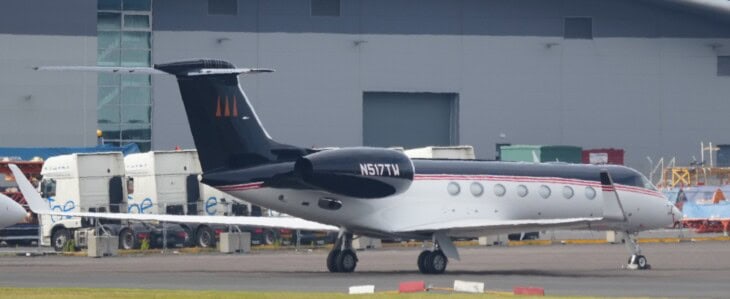
The jet is a 2008 Gulfstream G550, serial number 5209, registered N517TW to GTW Corporation of Jupiter, Florida. It is flown for him by Executive Jet Management of Cincinnati, which is why it shows up on trackers under the callsign EJM517.
What the old tail number gives away
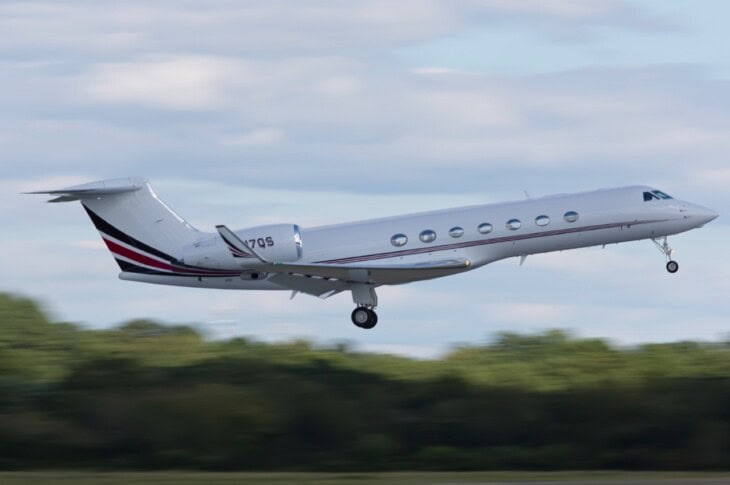
Before it became N517TW, this airframe wore the registration N517QS. The QS suffix is the NetJets convention, shared by dozens of Gulfstreams in the fractional fleet such as N510QS, N518QS and N534QS. In other words, Woods did not order a jet from the factory. He bought a used aircraft that had spent roughly a decade flying other people’s trips, then swapped the last two letters for his own initials and kept the 517.
The Origin Story: From Fractional Shares to a Tail Number of His Own
Woods was a NetJets customer and endorser long before he owned an aircraft outright. NetJets was also one of the few sponsors that stayed with him through the 2009 scandal, when AT&T, Accenture and Gatorade walked away.
A decade later he ended up flying a Gulfstream that had come out of that same fractional world.
2008
The airframe is built. Gulfstream completes serial number 5209, a GV-SP marketed as the G550, and the aircraft receives its airworthiness certificate in August 2008. It enters service on the US registry as N517QS.
2009 to 2018
A decade in fractional service. The QS registration block belongs to NetJets, so 5209 spends its first working life carrying fractional owners rather than one household. Over the same period Woods is publicly associated with NetJets as a client and endorser, one of the sponsorships that survives the collapse of his commercial portfolio in 2009 and 2010.
April 2019
A tail number of his own. Woods wins the Masters on April 14, 2019, his first major in eleven years. Registry trackers date the change from N517QS to N517TW, held by GTW Corporation of Jupiter, Florida, to that same spring. The FAA record today lists GTW Corp as registrant and Gulfstream GV-SP as the type.
March 2022
The flight that broke golf Twitter. With no announcement about the Masters and no competitive rounds since his 2021 car crash, N517TW flies to Augusta Regional Airport. Fans read it as a return, and Woods plays the tournament and makes the cut.
May 2022
Tulsa next. The jet is tracked into Tulsa ahead of the PGA Championship at Southern Hills, and the pattern is now established. Trackers treat the aircraft as a schedule announcement that Woods has not made.
2024
A full season on the tracker. The G550 logs 41 flights and about 71 flight hours. Its most-used airports are Witham Field in Stuart, Moore County Airport at Pinehurst, and Augusta Regional, which reads almost exactly like his tournament calendar.
February 2025
The jet stops flying. N517TW flies from Stuart to Brunswick Golden Isles Airport in Georgia on February 18, 2025, then sits. Long static periods at a single field usually mean heavy maintenance or an interior refurbishment rather than anything about the owner.
March 2025
A ruptured Achilles. Woods tears his left Achilles tendon while ramping up practice at home and has surgery a month before the Masters. The injury costs him the season, and a grounded owner means a grounded aircraft.
Spring 2026
An unusual stretch in Europe. The aircraft is based in Switzerland for several weeks and flies Zurich to Palm Beach International on May 13, 2026. The movements themselves become the story in the tabloid press, which is exactly the failure mode of jet tracking: the aircraft is visible, the passenger list never is.
Inside the Gulfstream G550
The G550 is the aircraft that defined ultra-long-range business aviation for a generation. Gulfstream built it from 2003 until production ended in 2021, delivering roughly 600 examples.
Two Rolls-Royce BR710 C4-11 turbofans produce 15,385 pounds of thrust each. The aircraft cruises at Mach 0.85, tops out at Mach 0.885, and certifies to 51,000 feet, which puts it above most weather and most airline traffic.
Range is 6,750 nautical miles, or about 7,770 miles (12,500 km). That is New York to Tokyo, or Florida to almost anywhere in Europe with fuel to spare, which matters for a golfer whose season includes an Open Championship on a different continent every July.
Airframe
Performance
Cabin and crew
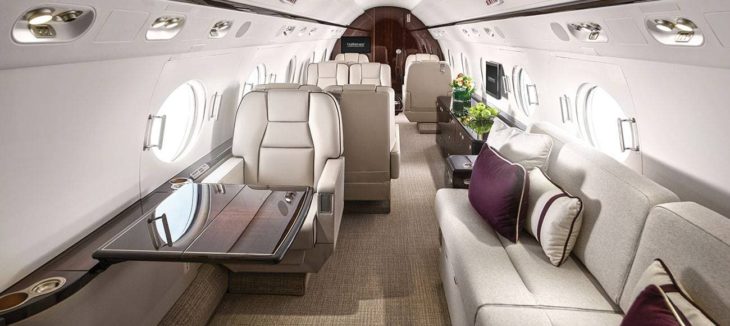
The cabin detail that matters most for Woods is not the seating. It is the 6,000-foot cabin altitude, which means the air pressure inside on a long flight is roughly what you would feel in Aspen rather than the 8,000 feet typical of an older airliner.
For a 50-year-old athlete with a fused lower back, multiple spinal surgeries, and a rebuilt right leg, a lower cabin altitude and a flat cabin floor are not luxuries. They are the difference between arriving able to walk 18 holes and arriving stiff.
Reading the Flight Log: The Jet Is the Schedule
Tracking data for 2024 records 41 flights and about 71 flight hours, an average leg of roughly an hour and three quarters. That is a light year by celebrity standards, and it is also a remarkably legible one.
| Airport | Code | What it lines up with |
|---|---|---|
| Witham Field, Stuart FL | SUA | Home base, about 20 miles (32 km) from his Jupiter Island house |
| Augusta Regional, GA | AGS | The Masters |
| Moore County, Pinehurst NC | SOP | The 2024 US Open |
| Glasgow, Scotland | GLA | The Open Championship at Royal Troon |
| Nassau and Great Harbour Cay | NAS / GHC | The Bahamas, home of his Hero World Challenge |
Almost every other celebrity jet in this series flies a lifestyle pattern: Las Vegas, Van Nuys, Miami, repeat. Woods flies a work pattern, and the work is on television, so anyone with a tracking app can check it against the tournament calendar.
That is why the jet became a news source. Woods is famously controlled about announcing his schedule, and as a past champion he stays in the Masters field until he formally withdraws, so the aircraft moves before the press release does.
The Tracking Problem Nobody in Golf Wants to Solve
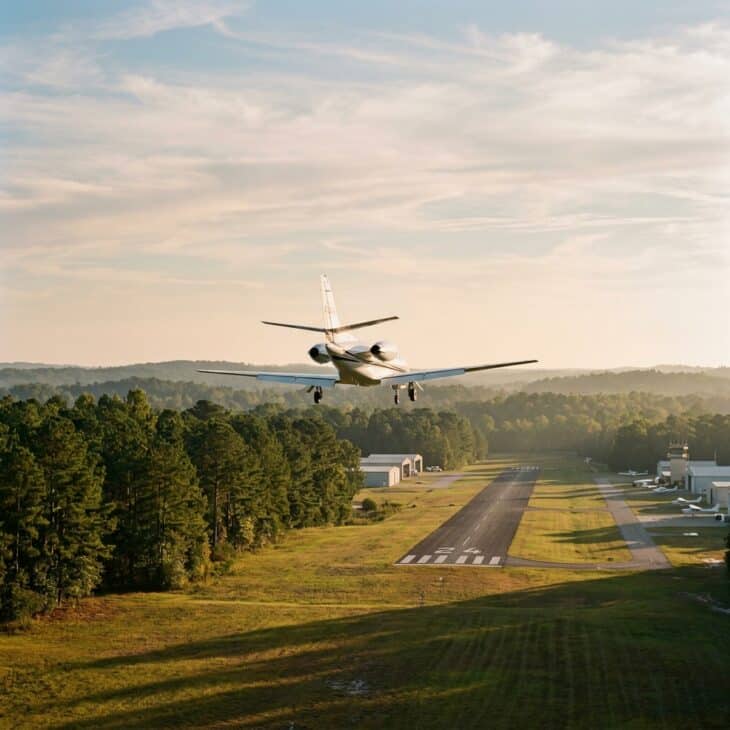
All of this works because of ADS-B. Since 2020 almost every aircraft in controlled US airspace has been required to broadcast its identity, position, and altitude, and volunteer receiver networks capture those broadcasts and publish them.
The system exists for safety. The side effect is that a $20 antenna can tell you where a specific Gulfstream is right now.
Owners can hide, and many do
The FAA runs programs that let private owners limit what is displayed: LADD, which blocks an aircraft from most public feeds, and PIA, which lets a US-registered jet fly on a temporary anonymous ICAO address. Congress went further in the 2024 FAA reauthorisation, directing the agency to let owners withhold registration data on request. That N517TW remains easy to follow is therefore a choice, or at least a choice nobody has bothered to reverse.
The limits of tracking matter as much as the capability. A tracker sees an airframe, not a passenger manifest, and a jet belonging to a public figure spends plenty of time carrying family, staff, or nobody at all on a repositioning leg.
Spring 2026 made that point uncomfortably well. When N517TW sat in Switzerland for weeks and then flew Zurich to Palm Beach on May 13, the movements themselves were treated as a story about Woods personally, with the tabloid press filling in the reasons that the data could never supply.
The same feed that lets fans celebrate a comeback lets anyone build a timeline of a private life. Taylor Swift’s team has spent years fighting exactly this, and her private jet tracking dispute is the closest thing the debate has to a test case.
What the Jet Actually Cost
Headlines routinely describe this aircraft as a $53 million or $54 million jet. That figure is the approximate list price of a brand-new G550 in the late 2010s, and it is not what a 2008 airframe changes hands for.
Pre-owned G550 values in 2026 run from roughly $11.5 million for the earliest 2003 examples to the mid-$30 millions for late-production aircraft. A 2008 model with a decade of fractional-fleet cycles behind it sits near the bottom of that band, plausibly $12 million to $18 million depending on engine programme, avionics, and interior condition.
Woods has never disclosed a price, and no public record fixes one. What the registry supports is the shape of the deal rather than the number: a used, high-time, ex-fractional aircraft rather than a factory order.
Why buying used is the smart move here
Woods flew about 71 hours in 2024. A new ultra-long-range jet only starts to make financial sense at several hundred hours a year, and depreciation on a new Gulfstream is brutal in the first five years. Buying a well-maintained older G550 lets the first owner absorb that curve while the second owner gets the same range, the same cabin, and the same 51,000-foot ceiling. It is the same logic that makes the used market the busiest part of business aviation.
Running costs are the part people underestimate. A G550 flown 200 hours a year typically costs somewhere between $2 million and $3 million annually once crew salaries, hangarage, insurance, maintenance reserves, and fuel are counted, and a good share of that bill arrives whether the aircraft flies or not.
The Emissions Question
A G550 burns roughly 400 gallons of jet fuel per hour, more on short legs and less in long-range cruise. Every gallon burned produces about 21 pounds (9.6 kg) of carbon dioxide.
Run that against 71 flight hours and 2024 comes out near 28,000 gallons and roughly 270 metric tons of CO2. That is an estimate built from a standard burn rate, not a measured figure, so treat it as an order of magnitude rather than an audit.
For scale, the average American accounts for about 14 metric tons of CO2 a year. One golfer’s travel year, on a fairly quiet schedule by celebrity standards, works out to something like 19 people’s annual footprint.
Woods is a modest case within his own peer group, which is the honest way to put it. He owns one aircraft, flies it well under 100 hours a year, and has never marketed himself as a climate advocate, which spares him the contradiction that follows several of the Hollywood celebrities with private jets around.
Tiger Woods’ Most Notable Private Jet Moments
The 2022 Augusta Arrival
The March 2022 flight into Augusta Regional is the moment jet tracking entered golf coverage properly. Woods had not committed to the tournament, and the aircraft answered the question before he did.
He teed it up thirteen months after a crash that came close to costing him the leg, and made the cut. Since then, every N517TW movement in April gets read the same way.
Glasgow, July 2024
The single longest trip in the jet’s 2024 log was the Atlantic crossing to Scotland for the Open Championship at Royal Troon. It is the one leg each year that genuinely requires an ultra-long-range aircraft rather than a mid-size jet.
Woods missed the cut. The aircraft still had to fly him home.
The Brunswick Winter
On February 18, 2025, the G550 flew a short hop from Stuart to Brunswick Golden Isles Airport in Georgia and then went quiet for months. Trackers speculated, but a long stay at a single field usually means one thing.
Heavy maintenance on a G550 is scheduled by hours and calendar time, and a mid-life inspection or an interior refit routinely parks an aircraft for weeks. Woods ruptured his Achilles a few weeks later, so the jet had little to do anyway.
The Jet That Waits in the Bahamas
Nassau and Great Harbour Cay both appear repeatedly in the flight log. Woods hosts the Hero World Challenge in the Bahamas each December and has long-standing ties to the Albany development on New Providence.
Those are the only regular legs in the log that are not obviously work, which tells you something about how the aircraft is used.
How Woods Compares to Other Golfers and Athletes
Golf has an unusually deep aviation culture. Arnold Palmer flew himself to tournaments for decades and logged thousands of hours in everything from a Cessna 172 to a Citation X, and he set the template for the touring pro who treats an aircraft as a tool.
| Golfer | Aircraft | Note |
|---|---|---|
| Tiger Woods | Gulfstream G550 (N517TW) | Owns one jet, flown by a professional crew |
| Rory McIlroy | Gulfstream G650ER | Took delivery of a newer, longer-range Gulfstream in late 2024 |
| Phil Mickelson | Gulfstream V (sold) | A certified pilot who sold his jet after about 20 years and now charters |
| Arnold Palmer | Cessna Citation X | Flew himself, the original golfer-aviator |
| Greg Norman | Lockheed JetStar | Early adopter of the touring pro’s private jet |
Woods sits outside the pilot tradition. There is no public record of him holding a pilot certificate, and unlike the celebrity pilots John Travolta and Harrison Ford, he is a passenger on his own aircraft.
Against the broader field of athletes with private jets, he is conservative. Michael Jordan flies a G550 in a custom Jumpman livery, LeBron James pairs a Gulfstream G280 with charters, and both put more visible personality onto the airframe than Woods ever has.
His aircraft carries no nickname, no logo, and no signature livery. For a man who spent 25 years as the most photographed athlete in the world, the jet is conspicuously anonymous, which may be the point.
The pattern behind one jet
Every choice here points the same direction: a used aircraft rather than a factory order, a plain white paint scheme rather than a personal livery, a management company rather than an in-house flight department, and a home base at a small county field rather than a headline airport. Woods spends heavily on privacy and lightly on display, and the only reason the aircraft is famous at all is that fans worked out it could tell them where he was going.
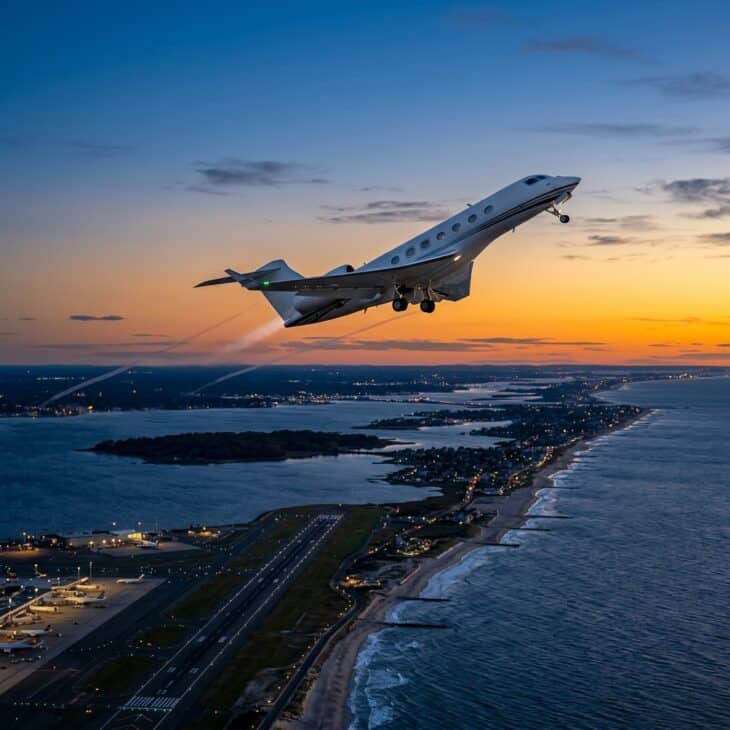
For readers comparing types rather than owners, the G550 also shows up repeatedly among the longest range private jets, which is the whole reason a golfer with one transatlantic trip a year still buys this much aircraft.
FAQ
Sources and references used for research and fact-checking.
- Simple Flying, The Upper Echelon Of Luxury: Tiger Woods' Gulfstream G550
- Simple Flying, Inside The Luxurious World Of Tiger Woods' Private Jet
- Golf.com, Is Tiger Woods prepping for the Masters? His jet might offer a clue
- Airport-Data (FAA registry data), N517TW aircraft data, Gulfstream Aerospace GV-SP (G550), C/N 5209
- AvBuyer, The Gulfstream G550 Price Guide
- Simple Flying, Fairway To Runway: The Pro Golfers Who Are Certified Pilots
- GolfMagic, Tiger Woods' private jet lands in Florida after Swiss rehab program
Get the Newsletter
The latest aviation news and stories sent to your inbox.
About the Author

Tim is the owner and lead editor of AeroCorner since 2019, overseeing aviation content covering aircraft, airlines, airports, and the broader aviation industry. Through years of researching, writing, editing, and publishing aviation-focused content, he has developed extensive practical knowledge of commercial aviation and air travel. Based in Asia and a frequent traveler himself, Tim also brings firsthand passenger experience to AeroCorner’s coverage. Outside of publishing, he has also explored aviation firsthand through hands-on flight training in New Zealand.