

Table of Contents
Pick NetJets if you want the biggest fleet, the shortest notice and the option to buy a share in 25-hour steps. Pick Flexjet if you want the same crew on the same airplane every time and a 25-hour card that costs almost exactly what NetJets charges.
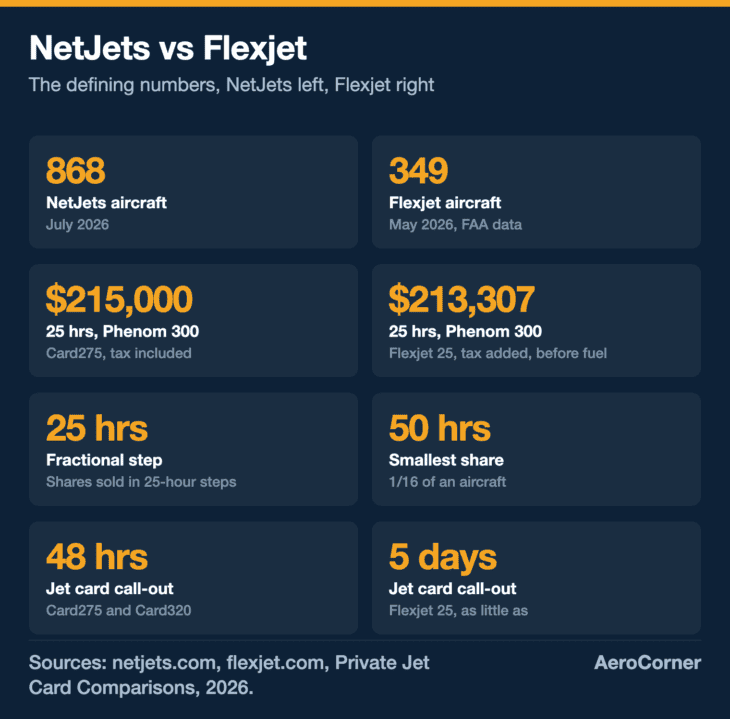
The deciding number is scale: NetJets flew 868 aircraft in July 2026, about 2.5 times Flexjet’s 349. For pilots choosing an employer, NetJets has a published, union-negotiated pay scale and Flexjet does not.
We compared fleet, jet cards, fractional terms, crews, safety and pilot pay as of October 2026, using each company’s own program pages, NTSB reports and fleet tallies from Private Jet Card Comparisons. If you are still deciding whether to fly private at all, start with private jet vs first class.
| Criterion | NetJets | Flexjet | Edge |
|---|---|---|---|
| Fleet size | 868 aircraft (July 2026) | 349 aircraft (May 2026, FAA data) | NetJets |
| Most common jet | Citation Latitude, 264 (Oct 2026) | Challenger 350, 90 (May 2026) | Even |
| 25-hour Phenom 300 card | $215,000, tax included (Card275, Jan 2025) | $198,425 plus 7.5% tax = $213,307, before fuel | Even |
| Card call-out notice | 48 hours | As little as 5 days | NetJets |
| Fractional entry | Shares and leases in 25-hour steps, 36-month minimum | 1/16 share (50 hours), terms up to 60 months | NetJets |
| Fractional notice | 4 to 10 hours | 10 hours | NetJets |
| Crew model | No dedicated-crew program advertised | Dedicated crew per aircraft (Red Label) | Flexjet |
| Ultra-long-range jets | Global 5000 to 8000, 96 aircraft | G650, G700, G500 and Global XRS, 39 aircraft | NetJets |
| Fatal accidents | 1 (June 16, 2026) | None reported | No clear edge |
| Pilot pay and union | About 3,100 union pilots, base $86,000 to over $400,000 (2024 contract) | Non-union since 2018, no published scale | NetJets |
How we compared
Program terms come from netjets.com and flexjet.com as of October 2026. Neither company publishes share prices or monthly fees, so we compared what both do publish: increments, notice and term. Fleet counts are Private Jet Card Comparisons tallies, NetJets for July 2026 and Flexjet from FAA data for May 2026. Card prices are the most recent published rates, NetJets from its January 2025 repricing. To compare like with like we added the 7.5% federal excise tax to Flexjet’s $7,937 hourly rate: 25 hours x $7,937 x 1.075 = $213,307, against NetJets’ $215,000 with tax included. Both sides can add fuel charges, which we left out.
Fleet size and aircraft
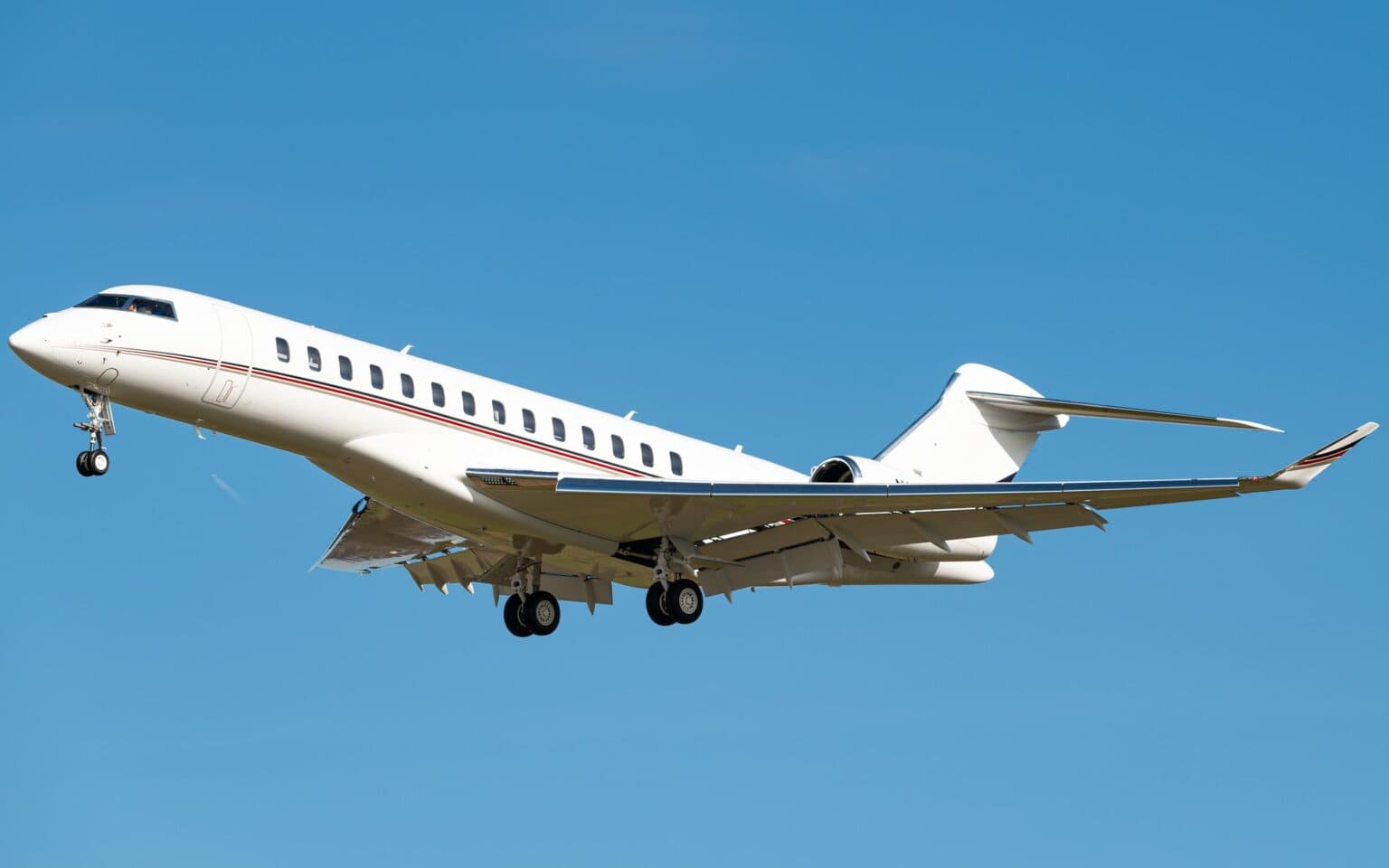
NetJets and NetJets Europe operated 868 aircraft in July 2026, up from 781 in February 2025. That is more airframes than Southwest Airlines flies, which we covered in how the NetJets fleet outgrew Southwest.
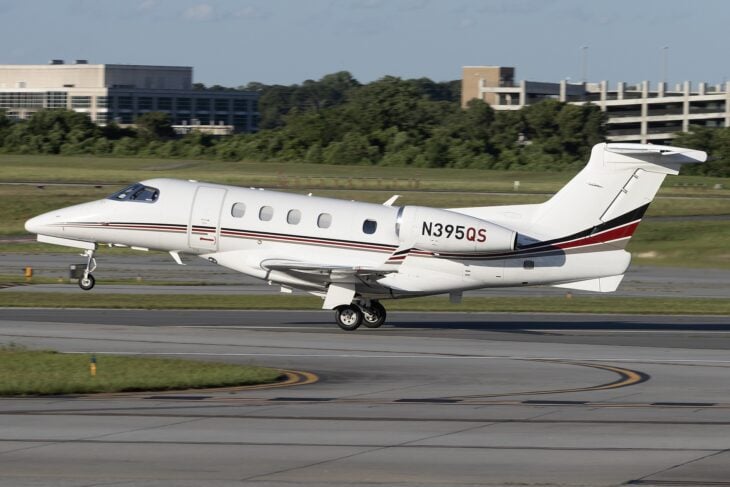
The fleet leans hard on one airplane. The Cessna Citation Latitude accounted for 264 of them in October 2026, ahead of 170 Phenom 300s and 97 Citation Longitudes.

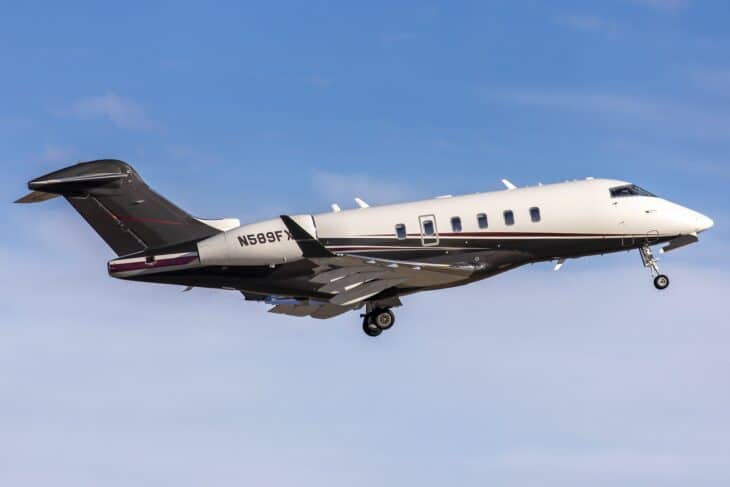
Flexjet flew 349 aircraft in May 2026, according to FAA data, and said it passed 340 at the end of 2025. Its most common type is the Bombardier Challenger 350 with 90, followed closely by 79 Embraer Praetor 500s and 66 Phenom 300s.

Flexjet is growing fast from a smaller base. In 2025 it placed a firm order for 182 Embraer jets with options on 30 more, a deal it valued at $7 billion and expects to nearly double the fleet over five years.
At the top end both carry ultra-long-range jets. NetJets lists 96 Bombardier Globals up to the Global 7500 and 8000, while Flexjet has 39, mostly its 30 Gulfstream G650s plus three G700s, two G500s and four Global Express XRS. Flexjet adds 32 large-cabin G450s below that tier.
Edge: NetJets. A fleet 2.5 times larger means more airplanes near you on a busy day and more large-cabin jets to choose from.
Jet card cost and availability
A jet card is prepaid flight time at a fixed hourly rate, with no share to buy. On the entry-level Phenom 300, NetJets’ Card275 costs $8,600 an hour with the federal excise tax included, or $215,000 for 25 hours, at its January 2025 repricing.
Flexjet’s 25-hour card on the same jet is $198,425, or $7,937 an hour, but that figure excludes the 7.5% tax and a monthly fuel adjustment. Add the tax and it comes to $213,307, just $1,693 less than NetJets, a gap of 0.8% before either side’s fuel charges.
The headline gap nearly disappears
Flexjet’s $198,425 card looks $16,575 cheaper than NetJets’ $215,000. Most of that difference is tax: NetJets quotes its Card275 price with the 7.5% federal excise tax included, and Flexjet quotes its price before it. Put both on the same basis and the gap shrinks to $1,693 over 25 hours.
Access rules differ more than price. Card275 gives 275 days of access with 90 blackout dates and a 48-hour call-out, while Flexjet says its card can be booked with as little as five days’ notice and is sold once per client.
Buying a NetJets card is also harder than it looks. On August 1, 2026, NetJets told staff it was cutting back jet card sales for the second time in five years, after suspending them entirely in August 2021, to focus on shared ownership.
Edge: Even. The tax-adjusted prices are within 1%, NetJets has the shorter call-out, and NetJets has been rationing new cards since August 2026.
Fractional ownership terms
Fractional ownership means buying a slice of a specific aircraft and paying a monthly management fee plus an hourly rate. Neither company publishes share prices or monthly fees, so the comparison comes down to the terms they do publish.
Flexjet shares start at 1/16 of an aircraft, which is 50 hours of the 800 flight hours each airplane is allotted per year, with more sold in 50-hour steps. Owners book with a 10-hour response time, on terms of up to 60 months.
NetJets sells shares in 25-hour increments with a 36-month minimum commitment, and guarantees an aircraft on as little as 4 to 10 hours’ notice. Its fractional owners get 10 peak days a year, and an owner whose booked type is unavailable is upgraded at no charge.
For a sense of the all-in cost, Private Jet Card Comparisons works out a 50-hour NetJets Phenom 300 share at $8,901 per flight hour, counting the purchase, fees, fuel and resale. That sits close to its $8,600 card rate.
Edge: NetJets. Smaller 25-hour steps, a shorter minimum commitment and slightly shorter guaranteed notice.
Crews and the onboard experience
This is where Flexjet sets itself apart. Under its Red Label program, launched in 2015, each aircraft has its own dedicated crew, so owners see the same pilots and cabin crew on the same airplane.
Flexjet also customizes cabins through its LXi interiors, lets owners swap hours into its European fleet, and offers helicopter access. NetJets advertises no equivalent dedicated-crew program, and sells fleet size and short notice instead.
Edge: Flexjet. A dedicated crew per aircraft is the one service feature NetJets does not match.
Safety record
On June 16, 2026, a NetJets Citation Latitude, N523QS, crashed on a highway short of the runway at Laredo, Texas, after diverting on a flight from Los Cabos to Austin. One passenger was killed.
AIN reported it as the first fatal accident of any fractional operator since NetJets created the segment in 1986, which also means Flexjet has had none. The NTSB’s July 2026 preliminary report describes low fuel pressure warnings in the right fuel system and generator failures, but gives no probable cause.
Flexjet’s most serious recent event was non-fatal. On February 25, 2025, one of its Challenger 350s crossed a runway at Chicago Midway as a Southwest 737-800 was landing, and the 737 went around, passing about 200 feet behind the jet’s tail.
One fatal accident in four decades across hundreds of aircraft is too small a sample to rank two operators. The NTSB has not yet determined a probable cause for the Laredo accident.
No clear edge. Both have long, nearly clean records, and a single accident does not show one operator is safer than the other.
For pilots: pay, union and seniority
Most of the NetJets vs Flexjet search results are pilots choosing an employer, so this section is for them. NetJets pilots are represented by the NetJets Association of Shared Aircraft Pilots (NJASAP), roughly 3,100 pilots judging by the 3,052 votes cast on 98% turnout in 2024.
In April 2024 they ratified a contract amendment by 78.31%, giving a 52% raise in compensation over five years and base pay from $86,000 to more than $400,000 depending on the wage table. That contract runs to 2029.
Flexjet pilots voted out the Teamsters Local 1108 in May 2018 and have been non-union since, so Flexjet sets pay itself and publishes no current scale. Its last official figures date from 2018 and are too old to compare.
The crew models shape the job, too. Red Label pilots fly one assigned aircraft, while NetJets pilots work across a fleet more than twice as large, which means more seats to bid and more bases to move through.
Edge: NetJets. A published, union-negotiated pay scale beats one you cannot see before you sign.
Who owns them
NetJets belongs to Warren Buffett’s Berkshire Hathaway, which bought it in 1998 for $725 million, half of it in stock. It expects to take about 100 new aircraft in 2026.
Flexjet began in 1995 as a Bombardier division and was sold to Kenn Ricci’s Directional Aviation, a deal announced in 2013 at $185 million. In July 2025 an investor group led by LVMH-backed L Catterton put in $800 million for a 20% stake, and Flexjet remains private.
Who should pick which
| If you… | Pick | Because |
|---|---|---|
| Fly 25 hours a year and want a card now | Flexjet | NetJets has cut back card sales since August 2026, and the price is within 1% once tax is added |
| Need a jet on short notice from many airports | NetJets | A fleet of 868 and a 4 to 10 hour guarantee for owners |
| Want to own a slice but fly under 50 hours | NetJets | Shares come in 25-hour steps |
| Want the same crew and cabin every trip | Flexjet | Red Label assigns a dedicated crew to each aircraft |
| Need helicopter access too | Flexjet | Owners can swap hours into helicopters |
| Are a pilot who wants a union contract | NetJets | NJASAP contract to 2029, base $86,000 to over $400,000 |
Myth: Flexjet is the budget option
Flexjet’s card looks $16,575 cheaper on paper, but only because its $198,425 price leaves out the 7.5% federal excise tax that NetJets includes. Tax-adjusted, the 25-hour Phenom 300 cards are $213,307 and $215,000. Flexjet competes on dedicated crews and cabins, not on price.
FAQ
Sources and references used for research and fact-checking.
- NetJets, NetJets Share
- Flexjet, Fractional Ownership
- Flexjet, Flexjet 25 Jet Card
- Flexjet, Flexjet 2025: A Historic Year in Review
- Private Jet Card Comparisons, NetJets: fleet, pricing and programs
- Private Jet Card Comparisons, Flexjet: fleet, pricing and programs
- Private Jet Card Comparisons, NetJets rebrands, expands jet card lineup, cuts prices
- Private Jet Card Comparisons, NetJets limits jet card sales, leases (again)
- AIN, NetJets Latitude Accident Marks First Frax Fatality
- Private Jet Card Comparisons, NetJets responds to NTSB preliminary report on Laredo accident
- AVweb, NTSB Issues Preliminary Report On Midway Near-Collision
- AVweb, NetJets Pilots Overwhelmingly Approve Revised Contract
- Flexjet, Flexjet Congratulates Pilots Who Successfully Decertified Teamsters Local 1108
- Wikipedia, Flexjet
- Wikipedia, NetJets
Get the Newsletter
The latest aviation news and stories sent to your inbox.
About the Author

Tim is the owner and lead editor of AeroCorner since 2019, overseeing aviation content covering aircraft, airlines, airports, and the broader aviation industry. Through years of researching, writing, editing, and publishing aviation-focused content, he has developed extensive practical knowledge of commercial aviation and air travel. Based in Asia and a frequent traveler himself, Tim also brings firsthand passenger experience to AeroCorner’s coverage. Outside of publishing, he has also explored aviation firsthand through hands-on flight training in New Zealand.