

Table of Contents
Kathmandu’s Tribhuvan International Airport is the most dangerous airport in the world. More than 400 people have died in accidents at or on approach to it since 1970, and the terrain, weather, and single runway that produced those crashes are all still there.
This list ranks on two things together: the documented accident record at each airport, and the objective hazard of getting into it. That second part means terrain and obstacle clearance, usable runway length against the length the aircraft flying there actually need, and the weather crews face on a normal day.
It is a deliberately unglamorous measure. Most lists of this kind rank on scenery and viral landing videos, which is how a Caribbean beach and a French ski slope end up above airports that have killed hundreds of people. Every figure below is current as of 2026.
| Rank | Airport | Core hazard | Deadliest accident on record |
|---|---|---|---|
| 1 | Tribhuvan International, Kathmandu (KTM) | Valley ringed by terrain, monsoon weather, one runway | PIA Flight 268, 1992: 167 dead |
| 2 | Tenzing-Hillary, Lukla (LUA) | 1,729 ft runway on an 11.7% slope, no go-around | Yeti Airlines Twin Otter, 2008: 18 dead |
| 3 | Remote Alaska airstrips (Cape Newenham and similar) | Fog, minimal approach aids, nowhere to divert | Cape Newenham charter, 2026: 8 dead |
| 4 | Toncontín, Tegucigalpa (TGU) | Hillside bowl, hard turn onto short final | TAN-SAHSA Flight 414, 1989: 131 dead |
| 5 | Congonhas, São Paulo (CGH) | 6,173 ft runway surrounded by a city | TAM Flight 3054, 2007: 199 dead |
| 6 | Madeira, Portugal (FNC) | Tabletop runway on columns, severe wind shear | TAP Flight 425, 1977: 131 dead |
| 7 | Courchevel Altiport, France (CVF) | 1,762 ft runway on an 18.6% slope, no instrument approach | Piper PA-46, 2021: 1 dead |
| 8 | Aspen-Pitkin County, USA (ASE) | 7,820 ft elevation, one-way runway between mountains | Gulfstream III, 2001: 18 dead |
| 9 | Paro, Bhutan (PBH) | 18,000 ft peaks, daylight visual approaches only | No fatal airliner accident |
| 10 | Juancho E. Yrausquin, Saba (SAB) | 1,312 ft runway with cliffs at both ends | No fatal scheduled-flight accident |
How this ranking works
Two inputs, weighted together. First, the documented accident and serious-incident record at the airport itself. Second, the objective approach hazard: terrain and obstacle clearance, usable runway length against what the aircraft operating there require, and prevailing weather. Airports were not ranked on how frightening the landing looks on video. Closed airports such as Hong Kong Kai Tak are excluded, and so are airports whose real risk is armed conflict on the ground, which is a security problem rather than an aviation one.
1. Tribhuvan International Airport, Kathmandu, Nepal (KTM)
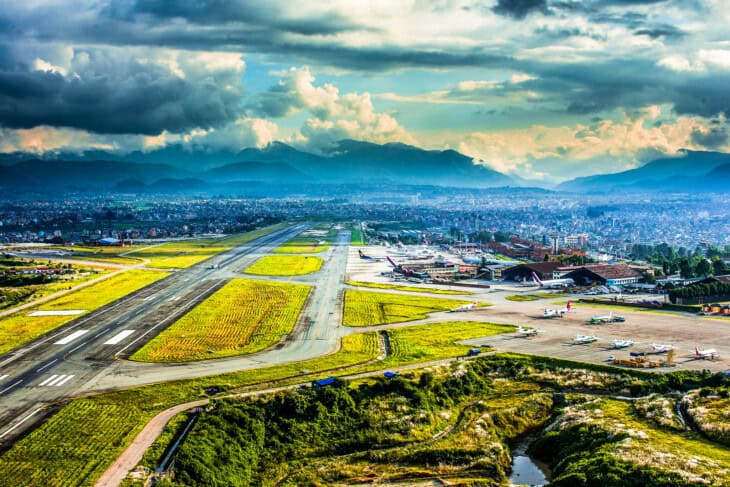
Kathmandu tops this list because it is the only airport in the world that combines a modern jet-airline fatal record with a hazard that has never been engineered away. The airport sits at 4,390 feet in a bowl of hills, with a single runway, 02/20, running 10,991 feet.
The record is brutal. Thai Airways Flight 311 hit a mountainside in July 1992, killing 113. Nine weeks later Pakistan International Airlines Flight 268 struck terrain on approach to the same runway, killing all 167 on board.
It did not stop there. Sita Air Flight 601 crashed shortly after takeoff in 2012, killing 19, and US-Bangla Flight 211 came down beside the runway in 2018, killing 51.
The most recent was a Saurya Airlines CRJ200 that crashed on takeoff in July 2024, killing 18.
280 dead in nine weeks
In the summer of 1992, two widebody airliners flew into terrain on approach to the same Kathmandu runway within two months of each other. Thai Airways Flight 311 in July killed 113 people, and Pakistan International Airlines Flight 268 in September killed 167. No other airport in the world has a comparable pair of accidents in a single season.
What has improved is the navigation. Kathmandu now uses RNP AR approaches with curved radius-to-fix turns that thread aircraft around the hills, originally designed for runway 02 in 2012 and rebuilt with new procedures that entered service in 2022.
That helps a modern, properly equipped airliner. It does not help the monsoon, the density altitude, or the fact that a crew who loses the picture here has terrain on nearly every heading. Kathmandu is the airport most likely to kill a large number of people next, which is what “most dangerous” ought to mean.
2. Tenzing-Hillary Airport, Lukla, Nepal (LUA)
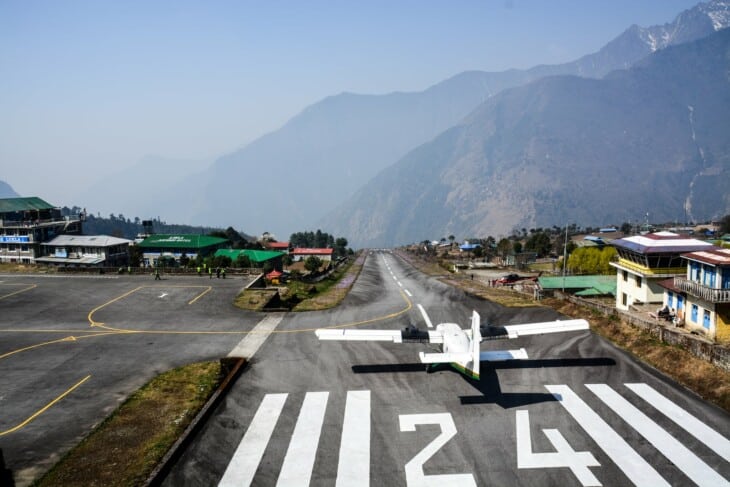
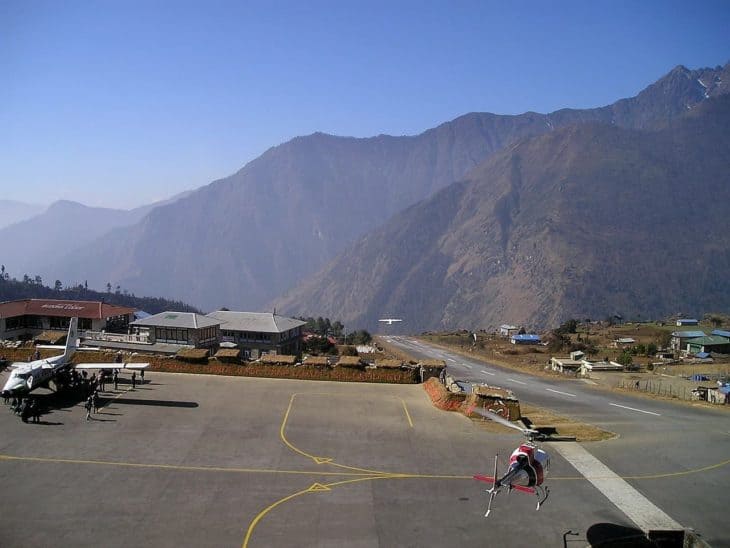
Lukla is the airport with the highest hazard per landing anywhere in commercial aviation. It sits at 9,337 feet, and runway 06/24 is 1,729 feet long on a gradient of 11.7 percent.
Aircraft land uphill and take off downhill because the slope is doing work the runway length cannot. There is a mountain wall past the top end and a sheer drop into the valley at the bottom, which means there is no go-around. Once committed, a crew is landing.
The record reflects it. Five fatal accidents have killed 26 people, the worst being a Yeti Airlines Twin Otter that crashed on approach in October 2008, killing 18.
Summit Air lost a Let 410 to trees short of the runway in May 2017, then a second Let 410 that struck a parked helicopter during a departure in April 2019. Our full profile of Lukla Airport covers the strip and its operations in more detail.
Lukla ranks second rather than first only because the aircraft are small. The chance of any given approach going wrong is higher here than at Kathmandu, but a Twin Otter carries 19 people and an Airbus A310 carries 113.
3. The Remote Alaska Airstrips, USA
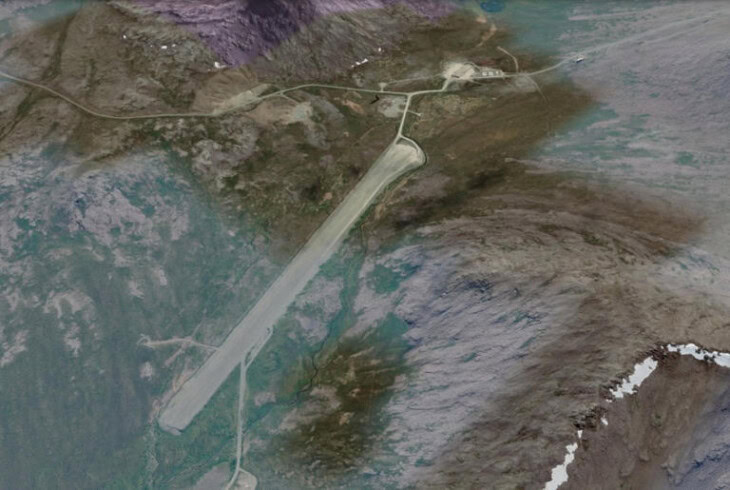
Almost no list includes this category, which is a serious omission. Alaska’s remote strips kill more people than any famous mountain airport, and they do it steadily rather than in headline-grabbing single events.
The NTSB found that between 2008 and 2017, Alaska’s overall aviation accident rate ran 2.35 times the rate for the rest of the United States, with a fatal accident rate 1.34 times higher. In 2016, a state with under one percent of the national population accounted for 5.4 percent of all fatal US crashes.
The hazard profile is specific: gravel or tundra strips, fog and low cloud arriving faster than forecast, sparse approach aids, and frequently no alternate within fuel range. Many communities have no road access at all, so the flight goes or nobody moves.
Cape Newenham Long Range Radar Site Airport, about 460 miles (740 km) southwest of Anchorage, is the current example. On 20 August 2026 a Cessna 441 operated by Security Aviation crashed there in fog with visibility under a quarter of a mile, after aborting a first approach.
All eight people on board died: two pilots, two US Army Corps of Engineers staff, and four contractors.
The danger is the routine, not the drama
A tourist can spend a lifetime avoiding Lukla and Courchevel. In rural Alaska the equivalent flight is the school run, the grocery delivery, and the medical transfer, flown in weather that would ground a scheduled airline. That exposure, repeated daily across hundreds of strips, is why the state’s numbers look the way they do.
4. Toncontín International Airport, Tegucigalpa, Honduras (TGU)
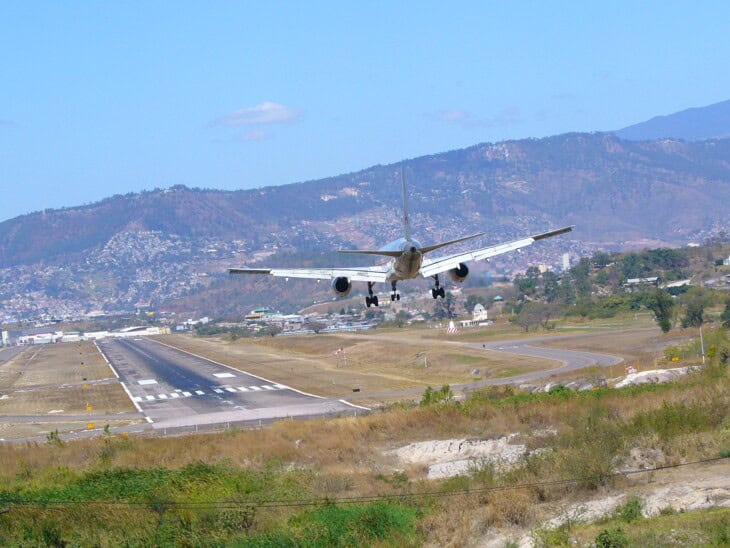
Toncontín earned its reputation honestly. The airport sits at 3,307 feet in a bowl of hills inside a capital city, and the approach to runway 02 requires a descending path that follows the terrain before a sharp left bank onto a very short final.
TAN-SAHSA Flight 414 flew into high ground on approach in October 1989, killing 131 of the 146 people on board. In May 2008 TACA Flight 390 landed long on the wet runway, overran onto a road, and killed five.
Here is the part most lists have not updated. The runway was extended by roughly 1,000 feet to 7,096 feet in 2009, and on 16 November 2021 international airline traffic moved out entirely to the new Comayagua International Airport at Palmerola. American, United, Copa, and Avianca all went with it.
Toncontín still handles domestic, cargo, and general aviation, and the hills have not moved. But the specific risk that made it famous, a full airliner threading that approach with 150 passengers aboard, has largely been designed out of the system.
5. Congonhas Airport, São Paulo, Brazil (CGH)
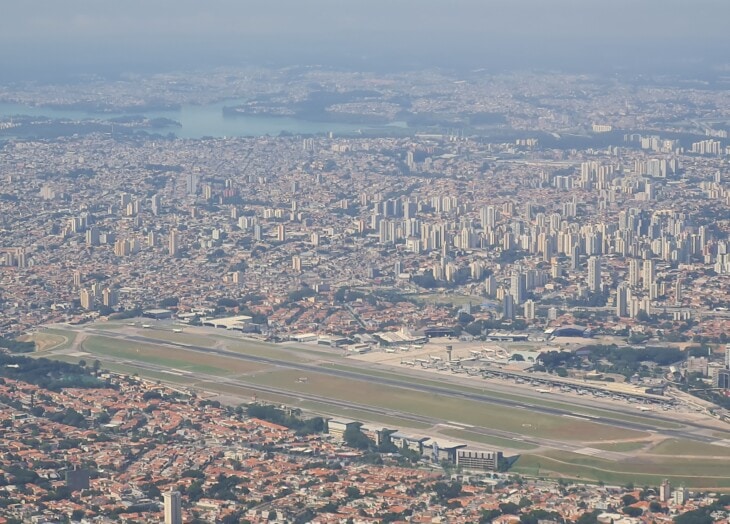
Congonhas holds the single deadliest accident on this list, and it is still only fifth. That gap between record and current risk is exactly what a ranking like this has to be honest about.
On 17 July 2007, TAM Flight 3054 overran runway 35L in the rain, crossed a major road, and hit a warehouse. All 187 people on board died along with 12 on the ground, making it Brazil’s worst aviation accident.
The underlying geometry is genuinely bad. The main runway is 6,173 feet, the airport sits at 2,635 feet elevation, and it is boxed in by dense city about five miles (8 km) from downtown São Paulo, so there is no room to lengthen anything.
What changed is everything that could be changed. The runway was resurfaced with drainage grooving within two months of the crash, an engineered materials arrestor bed was installed in 2022, and operations are now capped by hourly slot limits, aircraft weight restrictions, and a night curfew.
6. Madeira Airport, Portugal (FNC)
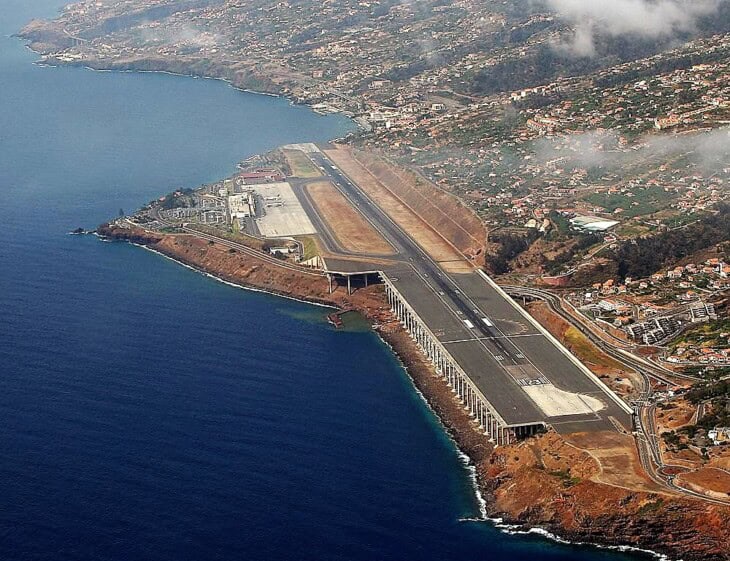
Madeira is the wind airport. Runway 05/23 runs 9,124 feet along a cliff edge, and roughly half of it sits on a platform over the Atlantic supported by 180 concrete columns, each about 230 feet tall.
The structure is an engineering award winner. The problem is the air moving over it: terrain-driven turbulence and wind shear that regularly exceed what an airliner can safely accept, which is why Madeira operates under mandatory wind limits and diversions here are routine rather than exceptional.
Pilots need airport-specific training before they can operate here, one of a small group of fields worldwide with that requirement. We cover that group in detail in our guide to the airports pilots need special certification just to land at.
The worst accident predates the extension. In November 1977 TAP Flight 425 landed long on what was then a much shorter runway, ran off the end, and went over a steep bank, killing 131 of the 164 people on board.
7. Courchevel Altiport, France (CVF)
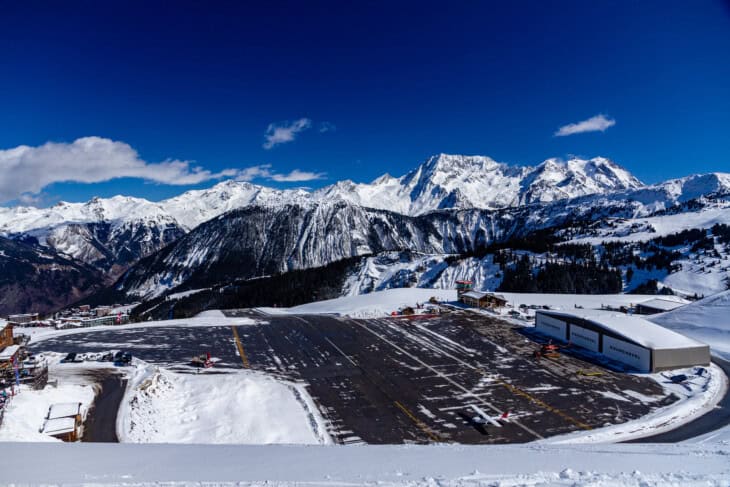
Courchevel has the most extreme runway geometry in regular use anywhere. The strip is 1,762 feet long at an elevation of 6,588 feet, sloping upward at 18.6 percent, which is steeper than most ski runs on the mountain it is carved into.
There is no instrument approach, no approach lighting, and no go-around procedure, because the terrain does not allow one. Fog or low cloud simply closes the airport.
The accident record is small in absolute terms, with nine accidents and incidents since 2003 and one death, a Piper PA-46 that struck an embankment above the runway threshold in August 2021. That is a function of low traffic and a highly selected pilot population, not of an easy airport.
8. Aspen-Pitkin County Airport, Colorado, USA (ASE)
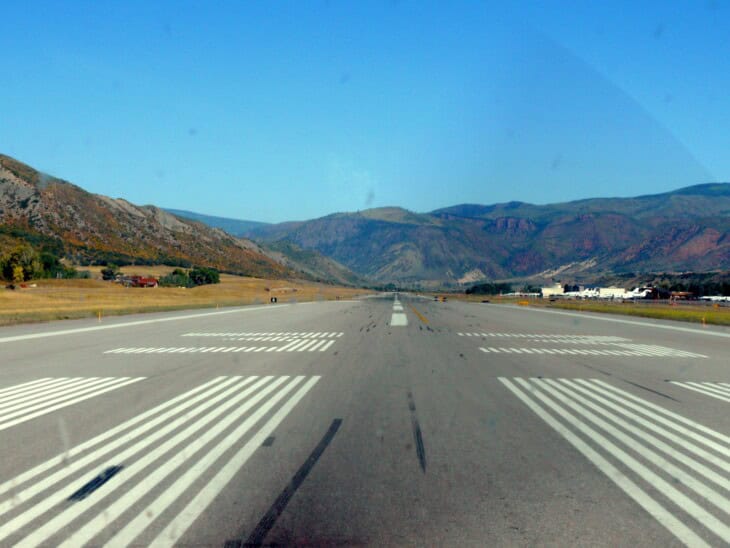
Aspen is the most dangerous airport in the United States served by scheduled airlines, and it is dangerous for reasons that never appear in the tourist brochure. It sits at 7,820 feet with a single 8,006 foot runway hemmed in by mountains.
High elevation means high density altitude, which means longer takeoff rolls and worse climb performance exactly where the terrain demands the opposite. Aircraft are capped at 95 feet of wingspan and 100,000 pounds, which rules out mainline jets entirely.
Because of the ridgeline to the south, most commercial traffic must land on runway 15 and depart on runway 33, so arrivals and departures run in opposite directions on the same strip. Aspen also appears in our roundup of the highest airports in the world by elevation.
In March 2001 a Gulfstream III on a charter approach descended below minimum descent altitude in poor visibility and hit terrain short of the runway, killing all 18 people on board. It remains the airport’s worst accident.
9. Paro International Airport, Bhutan (PBH)
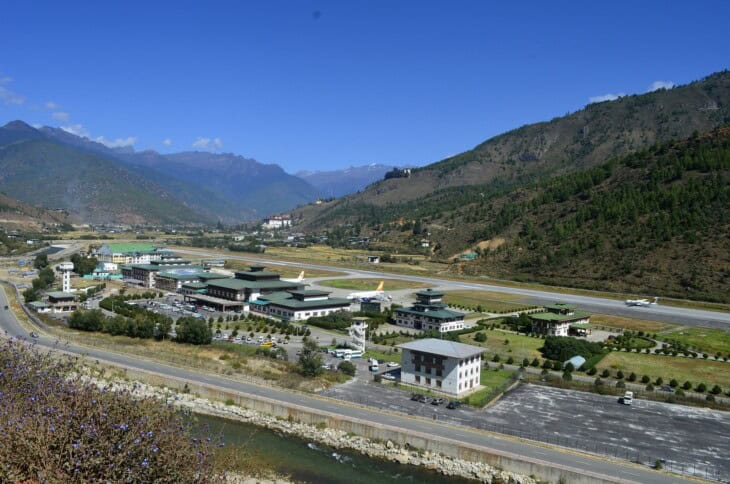
Paro is the airport most often called the world’s most dangerous, and by the measure used here it is not. It is the hardest, which is a different thing, and the distinction is the most useful idea in this article.
The setting is genuinely severe. The airport sits at 7,333 feet with a 7,431 foot runway, 15/33, inside a valley ringed by peaks reaching 18,000 feet, and the final approach involves a descending series of turns between mountainsides.
Bhutan’s response was to remove almost every variable. Operations are visual only, daylight only from sunrise to sunset, with additional afternoon restrictions in windy seasons, and only a very small number of pilots are certified to fly the approach.
The result is that Paro has never had a fatal airliner accident. It ranks ninth here because the underlying hazard is real and unforgiving, not because anyone has died proving it.
10. Juancho E. Yrausquin Airport, Saba (SAB)
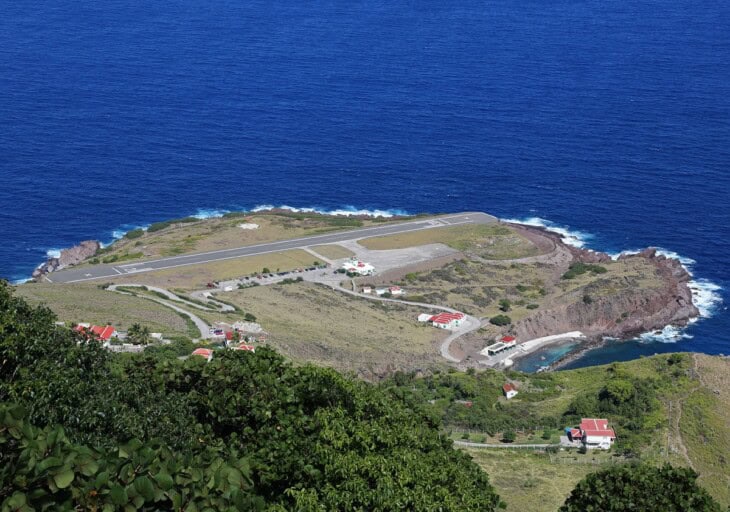

Saba has the shortest commercial runway in the world. Runway 12/30 is 1,312 feet long, sits 60 feet above sea level, is flanked by high hills on one side, and ends in cliffs dropping into the sea at both ends.
No jet can use it. Traffic is limited to short takeoff and landing types, mainly the de Havilland Twin Otter and the Britten-Norman Islander, plus helicopters, and pilots need specific authorisation.
The safety record is remarkable given the geometry. Across five recorded accidents since 1971, including a Cessna that ditched offshore in 2015 and an Islander hard landing in 2023, there has been no fatal accident to a scheduled commercial flight.
Saba closes the list as the strongest evidence for the argument running through it: a terrifying runway with strict rules is safer than a normal-looking runway with weak ones.
The famous ones that did not make the list
Two airports appear near the top of almost every competing ranking and belong nowhere near this one, because in both cases the hazard is not to the aircraft.
What about St Maarten and Gibraltar?
Princess Juliana in St Maarten has a flat, ordinary 7,546 ft runway, no terrain constraint, and no history of terrain-driven airliner accidents. The danger there is to spectators on Maho Beach, where a New Zealand tourist was killed by jet blast in July 2017 after ignoring the warning signs. Gibraltar is on those lists because Winston Churchill Avenue crossed the runway, closing to traffic more than fifteen times a day. That stopped on 31 March 2023, when the Kingsway tunnel opened and all vehicles were routed underneath. Both airports are famous photographs, not dangerous approaches.

Conflict-zone airports are excluded for a different reason. The threat at an airport under active fire is ground-based and political, it changes month to month, and it says nothing about terrain, runway, or weather.
The same logic excludes airports that are merely unpleasant. Long queues, bad terminals, and chronic delays are a different complaint entirely, which we cover separately in our ranking of the worst airports in the United States. A dangerous airport and an annoying airport are rarely the same place.
What actually makes an airport dangerous
Across all ten entries, the same four factors keep appearing, and none of them is the one passengers worry about.
Terrain removes options. An airport in a bowl or a valley takes away the go-around, the diversion, and the margin for a mishandled approach, which is why controlled flight into terrain dominates the fatal accidents on this list.
Runway length removes margin. A runway that is adequate when dry and adequate when the aircraft is light stops being adequate the moment it rains or the load goes up, and overruns are the second most common way these airports kill people.
Weather removes the picture, and it is the factor most often present at the moment things go wrong. Fog at Cape Newenham, monsoon cloud at Kathmandu, and wind shear at Madeira are all the same problem in different clothing.
Elevation removes performance. Thin air lengthens the takeoff roll and flattens the climb gradient at Kathmandu, Lukla, Paro, Aspen, and Courchevel, which is precisely the combination terrain is least forgiving of. Route-level risk works differently again, as our look at the most dangerous flight routes shows.
The encouraging pattern is that every one of these factors responds to rules. Paro and Saba are proof that a brutal airport with disciplined restrictions can go decades without killing anyone, and Congonhas is proof that a deadly one can be substantially fixed.
FAQ
Sources and references used for research and fact-checking.
- National Transportation Safety Board, Comprehensive Alaska Aviation Safety Approach Needed
- CBS News, Alaska plane crash near remote radar site kills all 8 people on board
- Airbus, Kathmandu airport adopts NAVBLUE RNP AR procedures
- Wikipedia, Tenzing-Hillary Airport
- Wikipedia, Congonhas Airport
- Government of Gibraltar, Airport Tunnel to open on 31st March 2023
Get the Newsletter
The latest aviation news and stories sent to your inbox.
About the Author

Tim is the owner and lead editor of AeroCorner since 2019, overseeing aviation content covering aircraft, airlines, airports, and the broader aviation industry. Through years of researching, writing, editing, and publishing aviation-focused content, he has developed extensive practical knowledge of commercial aviation and air travel. Based in Asia and a frequent traveler himself, Tim also brings firsthand passenger experience to AeroCorner’s coverage. Outside of publishing, he has also explored aviation firsthand through hands-on flight training in New Zealand.