

Table of Contents
Hawaii has 39 open airports and landing facilities, according to the FAA’s airport master records effective November 26, 2026. Only Rhode Island (22) and Delaware (38) have fewer of the 50 states.
Yet the state’s airline traffic is enormous. Its 9 commercial service airports boarded 18.57 million passengers in 2025, and Honolulu alone carried 10.43 million of them.
How Many Airports Are in Hawaii?
The FAA answer is 39 for late 2026. In the FAA’s records, “airport” means any registered landing facility, so the count covers runway airports and heliports alike. Hawaii has no registered seaplane base.
25 of the 39 are runway airports and 14 are heliports. Only 14 are open to the public, every one of them a runway airport. The other 25 are private: military fields, small private strips and helipads.
Hawaii airports at a glance
39 open landing facilities in FAA data effective November 26, 2026. 25 runway airports and 14 heliports. 14 open to the public. 15 run by the state Department of Transportation. 9 commercial service airports in 2025, 7 of them primary. 18.57 million airline boardings in 2025, 56% of them at Honolulu.
Hawaii’s Airports by Island
Split by island, the count follows the population. Oahu, home to Honolulu, has the most landing facilities. The Big Island has the most public airports, because it is big enough to need four.
| Island | Runway airports | Heliports | Total | Open to the public | Airline airports (2025) |
|---|---|---|---|---|---|
| Oahu | 5 | 7 | 12 | 3 | 1 |
| Hawaii (Big Island) | 6 | 5 | 11 | 4 | 3 |
| Kauai | 5 | 0 | 5 | 2 | 1 |
| Maui | 3 | 1 | 4 | 2 | 1 |
| Molokai | 4 | 0 | 4 | 2 | 2 |
| Lanai | 1 | 1 | 2 | 1 | 1 |
| Tern Island (French Frigate Shoals) | 1 | 0 | 1 | 0 | 0 |
| Total | 25 | 14 | 39 | 14 | 9 |
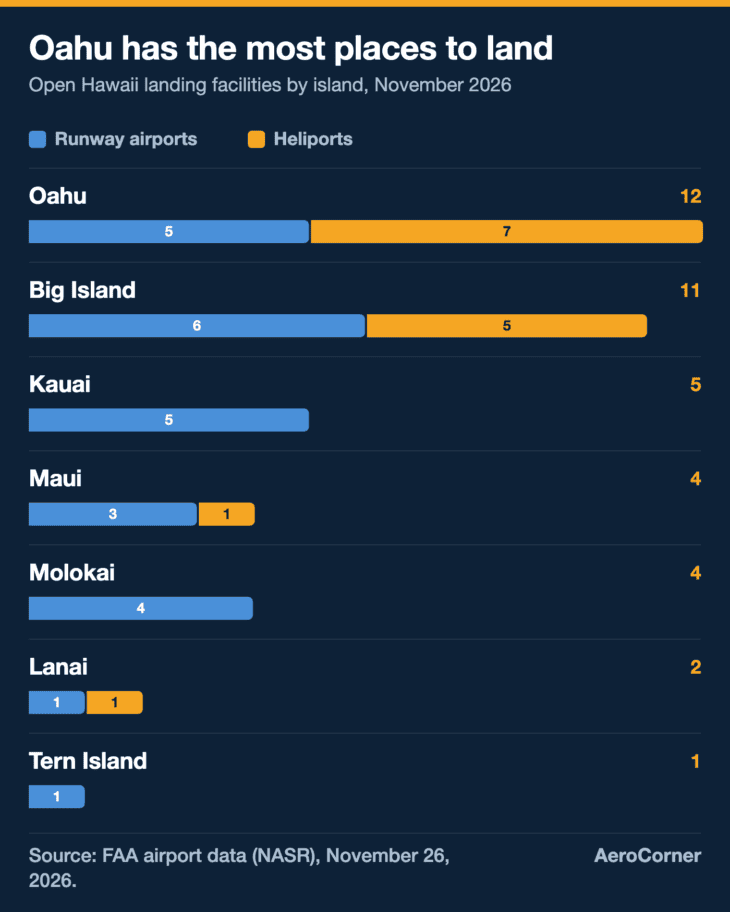
Oahu’s seven heliports include three hospital pads in Honolulu, a power plant pad, a fire and police station in Kahuku, a Navy helipad at Pearl Harbor and one at the Ritz-Carlton at Turtle Bay. Its five runway airports include two military fields: Wheeler Army Airfield and Marine Corps Air Station Kaneohe Bay.
Hickam is not on the list. The Air Force side of Joint Base Pearl Harbor-Hickam has no separate FAA record; it shares Honolulu’s runways. The longest of them, 8L/26R, runs 12,360 feet (3,767 m).
The Big Island holds the highest field in the state. Bradshaw Army Airfield, at the Pohakuloa training area, sits at 6,190 feet (1,887 m).
The most remote is Tern Island, at French Frigate Shoals in the Northwestern Hawaiian Islands. Its 3,000-foot (914 m) coral runway is listed as closed except in an emergency or with prior permission from the US Fish and Wildlife Service.

No seaplane bases, but Honolulu has water runways
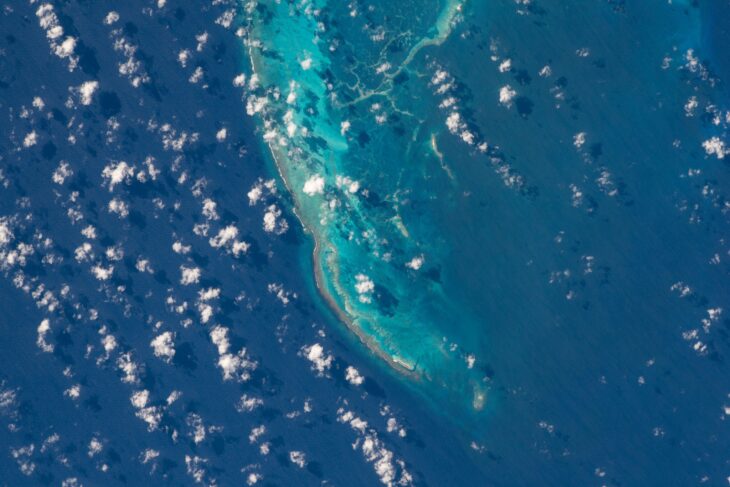
Hawaii is the only state made entirely of islands, yet the FAA lists no seaplane base there. Honolulu’s own record carries two water runways instead, 04W/22W at 3,000 feet (914 m) and 08W/26W at 5,090 feet (1,551 m).
How Many Hawaii Airports Have Airline Flights?
9 Hawaii airports were commercial service airports in 2025. To qualify, an airport needs scheduled passenger service and at least 2,500 boardings a year. 7 of the 9 are primary airports, with more than 10,000 boardings each.
| Airport | Island | FAA hub size | 2025 boardings |
|---|---|---|---|
| Honolulu, Daniel K. Inouye (HNL) | Oahu | Large | 10,430,353 |
| Kahului (OGG) | Maui | Medium | 3,450,472 |
| Kona (KOA) | Big Island | Small | 2,034,749 |
| Lihue (LIH) | Kauai | Small | 1,822,008 |
| Hilo (ITO) | Big Island | Small | 703,669 |
| Molokai (MKK) | Molokai | Nonhub | 74,970 |
| Lanai (LNY) | Lanai | Nonhub | 49,572 |
| Waimea-Kohala (MUE) | Big Island | Non-primary | 4,129 |
| Kalaupapa (LUP) | Molokai | Non-primary | 3,654 |
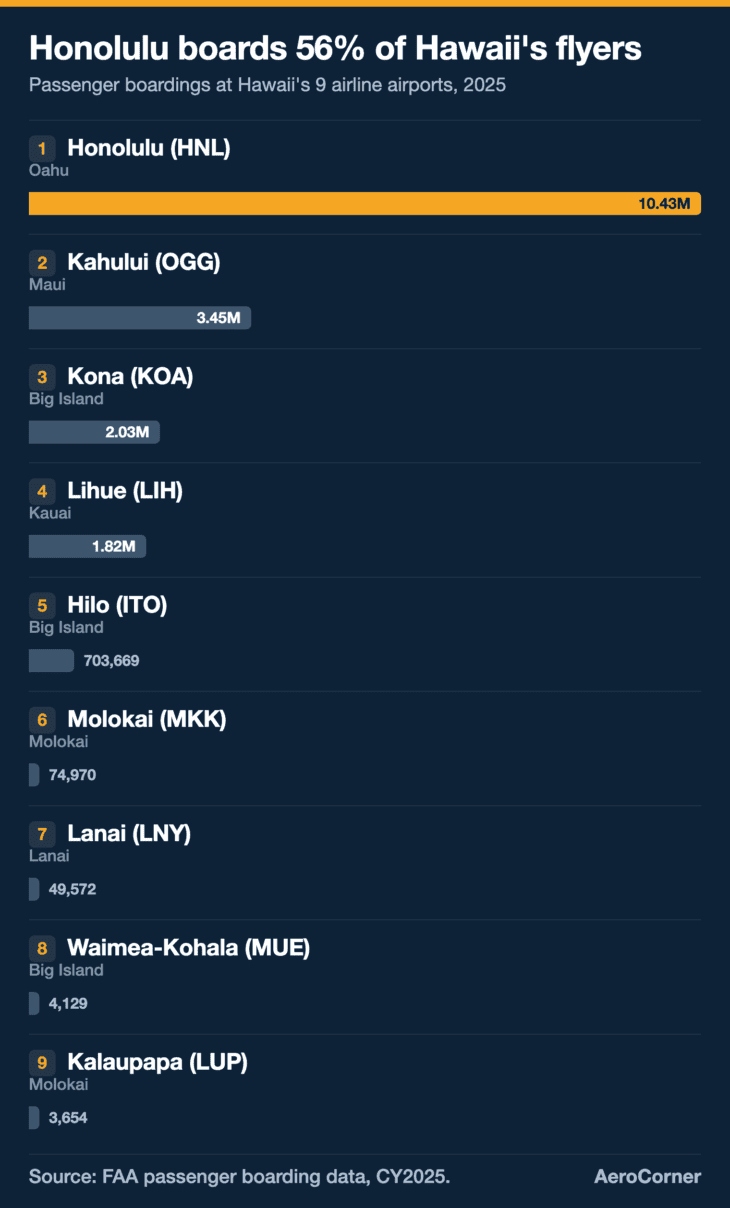
Those 9 airports boarded 18.57 million passengers in 2025, up from 18.46 million in 2024. Honolulu took 56% and ranked 30th in the US, a large hub. Kahului on Maui added 19%, and Kona and Lihue about 11% and 10%.
The smallest airline airport has the strangest gate. Kalaupapa, on Molokai’s north shore, serves the Kalaupapa settlement, and the FAA record warns that entering the settlement needs prior permission from the state Department of Health.
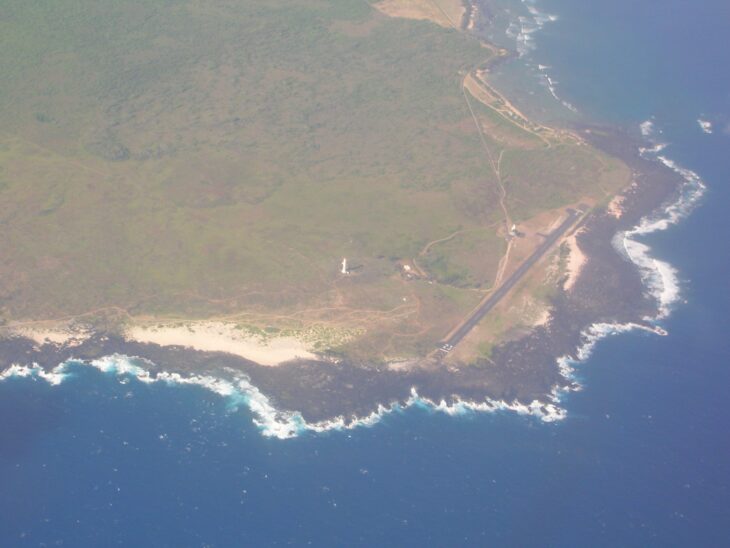

Lanai was the year’s outlier. Its boardings nearly doubled, from 25,186 in 2024 to 49,572 in 2025, a 97% rise. Molokai went the other way, down 11% to 74,970.
Go below the commercial service line and 3 more airports logged airline boardings: Hana with 2,240, Kapalua with 1,188 and Kalaeloa with 6. That makes 12 Hawaii airports with any airline passengers in 2025. Hawaiian Airlines and Alaska Airlines now share an owner; our guide to Hawaiian vs Alaska Airlines explains how the two fit together.
Why Other Sites Give a Different Number
Search the question and you will see 129, 39, 15, 12, 9, 8 and 7. Most of them are real counts. They just count different things.
129 is not the FAA's number
One airport directory in the search results says Hawaii has 129 airports, 12 with scheduled flights. The FAA file lists 39 open landing facilities. The 12 is closer to the mark: it matches the number of Hawaii airports with any airline boardings in 2025.
15 is the state system. The Hawaii Department of Transportation Airports Division lists 15 airports on six islands: Honolulu, Kalaeloa and Dillingham on Oahu, Kahului, Hana and Kapalua on Maui, Molokai and Kalaupapa, Lanai, Hilo, Kona, Waimea-Kohala and Upolu on the Big Island, and Lihue and Port Allen on Kauai.
That 15 is not the same as the FAA’s 14 public airports. Kapalua, on West Maui, is state-owned but filed as private use: it takes only airline and charter operators with prior permission, and no jets. Dillingham Airfield is public use but sits on Army-owned land.
The airline counts split three ways. 9 airports are commercial service, 7 are primary, and 8 hold an FAA operating certificate under 14 CFR Part 139, the rule for airports that serve larger airline aircraft.
Those groups do not line up either. Kapalua holds a Part 139 certificate but is not a commercial service airport, while Waimea-Kohala and Kalaupapa are commercial service airports without one. The FAA file marks 5 airports (Honolulu, Kahului, Kona, Lihue and Hilo) as landing-rights airports, where US Customs clears arriving international flights by prior arrangement.
Towers are a fourth count. The FAA file lists an air traffic control tower at 11 of the 39 facilities, military fields included, which leaves 28 without one.
How Hawaii Compares With Other States
Hawaii ranks 48th of the 50 states for landing facilities, ahead of only Delaware and Rhode Island. Nationally, the same FAA file lists 19,163 open facilities; our count of how many airports are in the US explains where they are.
The contrast with the other state outside the lower 48 is stark. Alaska has 774 airports, 131 of them seaplane bases, and 80 commercial service airports. Hawaii has a twentieth as many facilities and a ninth as many airline airports.
Passengers tell a different story. Honolulu’s 10.43 million boardings in 2025 were nearly four times Anchorage’s 2.73 million, from one airport in a state with fewer airports than Vermont.
FAQ
Sources and references used for research and fact-checking.
- Federal Aviation Administration, NASR 28-day subscription: airport data (APT CSV), effective November 26, 2026
- Federal Aviation Administration, CY 2025 Commercial Service Airports: passenger boardings, rank order and percent change from 2024
- Federal Aviation Administration, CY 2025 Enplanements at All Airports
- State of Hawaii Department of Transportation, Airports Division, Hawaii Airports
- Wikipedia, List of airports in Hawaii
Get the Newsletter
The latest aviation news and stories sent to your inbox.
About the Author

Tim is the owner and lead editor of AeroCorner since 2019, overseeing aviation content covering aircraft, airlines, airports, and the broader aviation industry. Through years of researching, writing, editing, and publishing aviation-focused content, he has developed extensive practical knowledge of commercial aviation and air travel. Based in Asia and a frequent traveler himself, Tim also brings firsthand passenger experience to AeroCorner’s coverage. Outside of publishing, he has also explored aviation firsthand through hands-on flight training in New Zealand.